
What Your Toyota’s Dashboard Light Is Telling You—and What to Do Next
Color is only one clue. A flashing car-with-squiggly-lines symbol commonly means TRAC or VSC is actively responding to wheel slip.
A Toyota dashboard light is a starting point, not a complete diagnosis. To interpret it correctly, identify the icon and color, note whether it is steady or flashing, read the full Multi-Information Display message, listen for a buzzer, and pay attention to how the vehicle is operating.
The same general-looking symbol can represent a normal status, maintenance reminder, disabled feature, or fault requiring an immediate stop. Before resetting a light, continuing to drive, or replacing a part, use the exact model-year Owner’s Manual to resolve any uncertainty.
How to Read a Toyota Dashboard Light Before Taking Action
When an unfamiliar light appears, use this rapid triage sequence:
- Identify the shape and color. An oil can, battery, steering wheel, tire outline, or triangle provides more useful information than color alone.
- Check whether it is steady or flashing. Flashing may indicate normal system intervention or increased urgency, depending on the symbol.
- Read the entire display message. Do not dismiss accompanying text after recognizing the main icon.
- Listen for a buzzer or chime. Note whether it sounds once, repeats, or continues.
- Look for related warnings. One warning may accompany or result from another condition.
- Assess the vehicle. Watch for rising temperature, changed braking or steering, rough running, power loss, severe vibration, smoke, unusual smells, or abnormal noises.
- Consult the exact Owner’s Manual. Model-specific instructions take precedence over a generic Toyota dashboard-symbol guide.
As a first-pass convention, red often indicates a condition requiring immediate attention, yellow or amber generally calls for investigation, and green or blue usually confirms that a feature is active. These are not universal rules. The icon, operating conditions, display message, and model-specific instructions matter more than color alone. General automotive guidance similarly separates normal system indicators, situational alerts, and malfunction warnings while treating red or blinking warnings as the highest priority (Kelley Blue Book’s dashboard-light overview).
Many dashboard lamps illuminate briefly when the vehicle starts. This is commonly a system check, not evidence that every monitored system has failed. A light that remains on, begins flashing unexpectedly, or fails to illuminate when the applicable manual says it should may require attention (Toyota of Irving’s dashboard-symbol guide).
Dashboard lights generally fit into four groups:
- Warning lights report a potentially unsafe condition or system malfunction.
- Maintenance reminders indicate that scheduled service may be due but do not diagnose a failed part.
- Disabled-system indicators report that a feature such as traction control has been switched off or is unavailable.
- Normal operating indicators confirm that a feature such as high beams, cruise control, or a turn signal is active.
Scope note: This guide covers common Toyota dashboard symbols and meanings, not every icon used on every Toyota. Appearance, color, wording, behavior, and required action can vary by model, model year, trim, powertrain, installed equipment, software configuration, and market. The linked examples primarily reflect U.S.-market references; owners elsewhere should use their regional Toyota documentation.
Toyota’s warning-light reference expressly covers common lights rather than an exhaustive catalog and directs owners to vehicle-specific documentation when a symbol is not listed. Its page also provides access to Toyota Owner’s Manuals (Toyota’s official dashboard warning-light reference). If your symbol is absent here—or behaves differently from this guide—follow the exact Owner’s Manual rather than extrapolating from a similar icon.
Stop-Safely Warnings: Oil Pressure, Overheating, Charging, and Serious Brake Symptoms
Some warnings can indicate a risk of rapid mechanical damage or loss of an important vehicle function. “Stop safely” means moving out of traffic without making an abrupt or hazardous maneuver, selecting a secure location, and activating the hazard lights where appropriate.
| Visual description | Typical meaning | Urgency | Immediate response |
|---|---|---|---|
| Oil can, often red | Engine oil pressure is too low | Stop safely | Move to a safe location, shut off the engine, and follow the manual; do not assume adding oil resolves the warning |
| Thermometer over waves | Engine coolant temperature is too high | Stop safely | Stop in a safe place, switch off the vehicle, and allow it to cool |
Battery shape with + and – |
Charging-system malfunction | High | Move to safety and arrange diagnosis |
BRAKE, an exclamation point in a brake-shaped circle, or another model-specific brake warning |
Parking brake engaged or a brake-system condition | Context-dependent; potentially immediate | Confirm the parking brake is released; stop if braking has changed or the warning persists |
| Any warning accompanied by smoke, burning odor, severe shaking, sudden power loss, hard steering, or altered braking | Potentially serious vehicle or safety condition | Immediate escalation | Stop as soon as it is safe and seek assistance |
Low engine oil pressure
An oil-can indicator can alert you to low engine oil levels or issues with the oil pressure From Blinking Symbols to Warnings: How to Interpret Toyota Dashboard Lights | West Kendall Toyota. It is not interchangeable with a low-oil-level message. Oil level describes how much oil is present; oil pressure concerns the engine’s pressurized lubrication while it operates.
If the oil-pressure warning appears while driving, move to a safe location and shut off the engine. Do not continue merely because the engine sounds normal, and do not treat adding oil as a guaranteed repair. Toyota identifies the symbol as a low-engine-oil-pressure warning, while dealership guidance recommends stopping immediately in a safe place when it appears (Falmouth Toyota’s dashboard-light guide).
Once stopped, follow the Owner’s Manual. If it permits an oil-level check, use the specified procedure on level ground. If the warning remains, do not operate the engine until the condition has been assessed.
High coolant temperature
A thermometer over waves commonly represents excessive engine-coolant temperature. Toyota instructs the driver to stop immediately in a safe place when this warning appears.
After reaching safety, switch off the vehicle and allow it to cool. There is no universal restart or recovery procedure because the correct steps depend on the model and the cause of the overheat (Toyota of Downtown Chicago’s warning-light guide).
Consult the Owner’s Manual and obtain assistance if the cause cannot be safely established. Do not keep driving solely because the warning disappears after the engine cools.
Charging-system warning
The battery-shaped light is a charging-system warning, not proof that the battery itself has failed. Possible causes may involve the battery, charging circuit, wiring, connections, or drive components, but the icon alone does not identify the failed part.
A loss of charging can lead to electrical failures or vehicle shutdown. Dealership guidance recommends stopping for a charging-system warning rather than relying on the vehicle to continue operating (Falmouth Toyota’s charging-system guidance). Move to an appropriate stopping place and arrange testing. Do not buy a battery or alternator solely because the battery symbol illuminated.
Brake-system warning
A general brake-system warning must be distinguished from the ABS warning. The general warning may appear because the parking brake is engaged, but it can also indicate another braking-system condition.
First, verify that the parking brake is fully released. If the warning remains—or the brake pedal feels soft, unusually hard, lower than normal, or otherwise different—stop safely and seek assistance. The same applies if stopping performance declines or the vehicle pulls during braking. General automotive guidance distinguishes a brake-system warning from an ABS fault and treats changed braking as an urgent condition (Car and Driver’s dashboard-warning guide).
Do not assume every brake-related light is “only ABS.” An ABS warning concerns anti-lock braking or Brake Assist operation; a general brake warning accompanied by changed pedal feel or reduced stopping performance presents a different and potentially more urgent situation.
Symptoms can override the apparent color
A yellow warning accompanied by severe shaking may be more urgent than a red reminder that simply reports an open door. Regardless of color, escalate your response if you notice:
- Smoke or steam
- A burning smell or strong fuel odor
- Severe vibration or shaking
- Sudden or substantial power loss
- A rapidly rising temperature indication
- Steering that suddenly becomes difficult
- A changed brake pedal or reduced braking
- Loud knocking, grinding, or scraping
- Several warnings appearing together
These symptoms do not identify a failed component.
Engine, Check-Engine, and Maintenance Lights Are Not the Same
The check-engine light, oil-pressure warning, and MAINT REQD reminder communicate different conditions and require different responses.
Check-engine or Malfunction Indicator Lamp
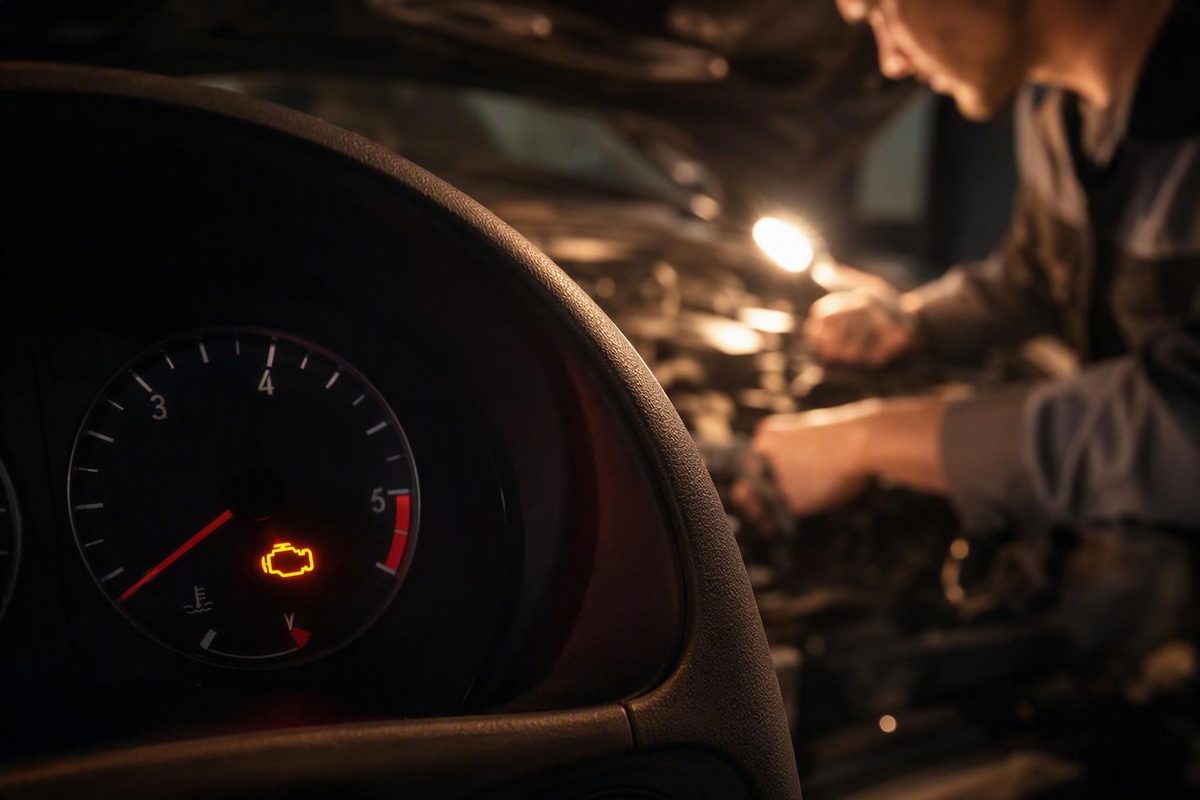
The check-engine light, usually shaped like an engine, is also called the Malfunction Indicator Lamp. It reports that the vehicle has detected an engine-management or emissions-system condition. Possible causes range from relatively simple conditions to faults that affect drivability or other systems.
A steady check-engine light still requires diagnosis. It is not proof that the vehicle can be driven indefinitely. Consider how the vehicle runs, whether other warnings are present, and what the Owner’s Manual says.
Treat a flashing check-engine light as more urgent, especially if it is accompanied by severe shaking, poor acceleration, smoke, unusual odors, or abnormal noises. Pull over safely and seek assistance instead of trying to drive through the condition. Automotive guidance recommends diagnostic testing for a steady warning and stopping for assistance when the light blinks or the vehicle runs erratically (Car and Driver’s check-engine guidance).
A warning light or diagnostic trouble code generally identifies a detected condition or affected system. It does not ordinarily prove which part failed. A sensor-related code, for example, does not by itself establish that the sensor must be replaced.
Do not disconnect the battery or erase codes merely to turn off the light.
MAINT REQD or wrench symbol
MAINT REQD or a wrench symbol is generally a mileage- or distance-based service reminder. It is not, by itself, a diagnosis of mechanical failure.
Review the maintenance schedule for the exact model, year, powertrain, operating conditions, and market. Do not apply one universal maintenance interval to every Toyota. After the required service has been completed, reset the reminder only through the procedure specified for that vehicle.
Low oil level versus low oil pressure
These alerts are not equivalent:
- Low oil level: The engine may not contain the expected quantity of oil. Check it safely on level ground using the vehicle’s prescribed procedure.
- Low oil pressure: The engine may not be receiving adequate pressurized lubrication. Stop safely and shut down.
A low level can contribute to a low-pressure condition, but topping up the oil does not prove that pressure has returned to normal. Conversely, a low-oil-level message does not necessarily mean oil pressure has already been lost.
A diagnosis-before-parts workflow
Use this sequence before authorizing or attempting a repair:
- Document the warning. Photograph the icon and complete display message.
- Record the conditions. Note temperature, speed, weather, fuel level, recent work, and whether the warning appeared during startup, acceleration, braking, or steady driving.
- Describe symptoms. Record rough running, power loss, odors, noises, smoke, steering changes, or altered braking.
- Check the Owner’s Manual. Confirm the symbol and required immediate response.
- Perform only safe preliminary checks. Depending on the warning and manual, these may include checking oil level on level ground, verifying tire pressure, or confirming that a fuel cap is secured.
- Retrieve applicable diagnostic information. Record it before clearing anything.
- Test the affected system. Do not infer a failed component from the icon or code alone.
- Replace parts only when the evidence supports the repair.
- Confirm the result. Verify that the warning remains off and the system operates as intended.
Toyota dealership guidance likewise identifies the Owner’s Manual as the primary model-specific resource and presents listed component causes as possibilities rather than conclusive diagnoses (Kendall Toyota’s dashboard-light guide).
Braking, Steering, and Occupant-Safety Symbols
Warnings involving braking assistance, steering assistance, airbags, and restraints deserve prompt attention even when the vehicle still appears to operate normally.
ABS warning
Appearance: Usually the letters ABS inside a circle or bracketed circle.
Meaning: Toyota identifies this as a malfunction in the Anti-lock Braking System or Brake Assist. It is distinct from the general brake-system warning.
Dealership guidance says conventional braking may remain available during an ABS fault, but anti-lock assistance may be unavailable. This does not guarantee that continued driving is appropriate. Road conditions, other warnings, pedal feel, and the vehicle-specific manual must guide the decision.
If the ABS warning appears by itself and braking feels normal, avoid unnecessary travel and arrange prompt inspection. If the general brake warning also appears—or pedal feel or stopping performance changes—stop safely and seek assistance (Falmouth Toyota’s ABS guidance).
The ABS light does not prove that a wheel-speed sensor, module, or another particular component has failed.
Electric Power Steering warning
Appearance: A steering wheel, commonly with an exclamation point.
Meaning: The EPS warning indicates a malfunction involving the electric power-steering system.
If assistance is impaired, steering may require more effort. Any sudden steering change increases urgency because vehicle control may become more difficult. Reduce speed smoothly, avoid abrupt steering inputs, and move to a safe location if steering effort changes (Dalton Toyota’s warning-light guide).
The symbol does not identify a failed motor, sensor, control unit, wiring circuit, or mechanical steering component.
SRS airbag warning
Appearance: A seated person facing a circle that represents an airbag.
Meaning: The SRS warning indicates a malfunction involving the supplemental restraint system. Depending on the vehicle, the monitored functions may include airbags, passenger-occupant classification, or seat-belt pretensioners.
Arrange prompt inspection. The warning alone does not establish that an airbag, module, sensor, pretensioner, or another specific part has failed.
Seatbelt reminder
Appearance: A seated person shown with or next to a belt.
Meaning: The driver or front passenger should fasten the seatbelt. The reminder may be accompanied by a chime.
Check the occupied seating positions covered by the vehicle’s reminder system. If the reminder behaves unexpectedly after occupants are properly restrained, consult the manual rather than assuming that a buckle or sensor has failed.
Passenger AIR BAG ON/OFF
Appearance: PASSENGER AIR BAG ON, OFF, or similar wording.
Meaning: This display communicates front-passenger airbag or occupant-classification status. It is not the same as the seated-person-and-circle SRS malfunction warning.
The expected status depends on the conditions described in the Owner’s Manual. If the display does not match the expected condition, follow the model-specific instructions and arrange inspection when directed.
Toyota’s supplied guidance specifically states that, during hybrid-system startup, expected ABS or SRS warning lights that fail to illuminate can mean those systems are unavailable and recommends immediate inspection. Do not automatically generalize that statement to every startup sequence on every Toyota; use the applicable model manual.
Tire Pressure, Slip, TRAC OFF, and VSC OFF
These symbols can represent a straightforward tire-pressure correction, normal stability-control intervention, or a disabled or malfunctioning feature. Steady versus flashing behavior is particularly important.
Tire-pressure warning
Appearance: A tire cross-section—sometimes described as a horseshoe—with an exclamation point.
Toyota says the tire-pressure warning can mean low tire inflation pressure or a tire-pressure warning-system malfunction. Do not rely on appearance alone; measure pressure with a suitable gauge.
When it is safe:
- Inspect the tires for obvious damage.
- Measure each applicable tire.
- Compare the readings with the vehicle’s specified cold-tire pressure, commonly shown on the tire-information label.
- Adjust the tires as directed by the vehicle instructions.
- Recheck for damage or continuing pressure loss.
Temperature changes can affect pressure, but a warning that remains after correction may require inspection for a leak, tire problem, sensor issue, or monitoring-system fault (West Kendall Toyota’s warning-light guide).
There is no single Toyota-wide TPMS threshold, flashing duration, reset sequence, or relearn procedure suitable for every model. Follow the exact Owner’s Manual instead of using instructions written for a different Toyota.
Slip indicator
Appearance: A car with squiggly or wavy lines beneath it.
A flashing slip indicator can be normal while Traction Control or Vehicle Stability Control is responding to wheel slip. Reduce accelerator input, steer smoothly, and allow additional room for stopping or changing direction.
A slip light that remains continuously illuminated during ordinary conditions may have a different meaning. Depending on the vehicle, the system may have been disabled or a malfunction may be present. Check whether TRAC OFF, VSC OFF, or an accompanying display message is also shown (Signature Toyota’s dashboard-light guide).
TRAC OFF
TRAC OFF means traction control has been switched off. In some circumstances, a driver may deliberately disable traction intervention, but the controls, limitations, and automatic reactivation behavior differ among vehicles.
If the indicator appears unexpectedly, check the Owner’s Manual and determine whether the applicable switch was pressed. Reactivate the system only through the documented procedure. The indicator alone does not prove that traction control is broken.
VSC OFF
VSC OFF indicates that stability-control and associated traction functions have been disabled under the applicable procedure. This can reduce the electronic assistance available when the vehicle loses traction or stability.
Do not use a universal “press and hold” procedure found for another Toyota. Button location, hold duration, supported modes, speed restrictions, and reactivation behavior can differ by model and year. If the indicator remains after the prescribed procedure—or appears with other fault warnings—arrange diagnosis.
Master Warning, Display Messages, and Buzzer-Accompanied Alerts
The triangle with an exclamation point is commonly the Master Warning indicator. It is a catch-all alert: the triangle directs you to more information but does not identify the underlying condition by itself.
Toyota describes a flashing Master Warning accompanied by a buzzer as the master warning system detecting a malfunction. Read the full Multi-Information Display message and follow its instructions before making assumptions from the triangle alone.
Toyota’s inappropriate-pedal-operation warning illustrates why the message and buzzer matter: when the buzzer sounds, Toyota instructs the driver to follow the response displayed on the Multi-Information Display (Toyota’s official warning-light descriptions).
The significance can change according to whether the symbol is:
- Steady or flashing
- Accompanied by a single or repeating buzzer
- Paired with another red or amber warning
- Displayed only during startup
- Triggered during braking, acceleration, or shifting
- Accompanied by a system name or detailed instruction
Photograph or write down the exact wording, provided it is safe to do so. “Triangle came on” is much less useful than a report containing the icon color, flashing pattern, buzzer behavior, operating conditions, and complete message.
Some equipped vehicles have warnings that depend heavily on the accompanying text. Toyota lists air-suspension malfunction and unengaged-Park or transmission-Park malfunction warnings as conditions requiring immediate dealer inspection. These systems are not installed on every Toyota.
A Master Warning does not prove that a particular switch, sensor, control unit, wiring circuit, or mechanical component has failed. If the display tells you to stop, stop safely. If it requests a basic action, perform it only when conditions permit. If the message remains, returns, or accompanies abnormal vehicle behavior, arrange inspection.
Normal Status and Reminder Indicators
Not every illuminated symbol means something is broken. Many lights simply confirm that a feature is active or request a routine action.
| Indicator | Typical meaning | Normal response |
|---|---|---|
Cruise-control symbol or CRUISE |
Cruise control is activated | No corrective action if intentionally selected |
| Left or right arrow | Corresponding turn signal is active | Confirm that it cancels after the maneuver |
| Blue headlamp/high-beam icon | High beams are on | Dim them when required |
| Gas pump | Fuel level is low | Refuel; do not assume a fixed remaining range |
| Arrow beside fuel-pump icon | Fuel door is on the indicated side | Use as a refueling-position reminder |
| Car with lock/security symbol | Immobilizer or anti-theft status | Flashing can be normal when the system is armed |
| Washer-fluid symbol | Washer-fluid level is low, where equipped | Refill when safe |
| Open-door icon | A door or closure is open or ajar | Close it and verify that it latches |
| Headlight or fog-light symbol | Corresponding exterior lighting is active | No action if intentionally selected |
ECO |
Economy-driving status or mode, depending on model | Informational; behavior varies |
HOLD or Brake Hold |
Brake Hold is active, where equipped | Follow its documented operating conditions |
Cruise control
A cruise-control indicator generally confirms that the system has been activated. Additional icons or color changes may distinguish system availability, a set speed, radar cruise, or a malfunction.
Do not assume that a yellow or amber cruise-related symbol is normal merely because a green version of the same general icon is a status indicator. Check the full display and manual.
Turn signals and high beams
The left and right arrows confirm that the corresponding exterior turn signal is active. A blue headlamp symbol confirms that high beams are on. Under normal conditions, these are operating indicators rather than fault warnings.
Unexpected behavior can still require attention. A signal that does not cancel or exterior lamps that do not operate as expected should be checked even if the dashboard indicator illuminates.
Low fuel and the fuel-door arrow
A gas-pump icon means the fuel level is low. Refuel promptly, but do not rely on a fixed number of remaining miles. Available range varies with the vehicle and operating conditions.
Where fitted, a small arrow beside the fuel-pump icon points toward the side containing the fuel door. It is a location aid, not a separate warning.
Security or car-with-lock indicator
The security indicator relates to the immobilizer and anti-theft system. Flashing can be normal when the system is armed.
On conventional-key vehicles, it may flash after key removal and stop when a registered key is inserted. On Smart Key vehicles, it may flash after the engine switch is turned off and stop when the appropriate ignition mode is selected. Behavior that differs from the applicable manual may require assessment.
Equipment-dependent reminders and status lights
Depending on the model and installed equipment, you may also see:
- Low washer fluid: Add an appropriate washer product when safe.
- Open door or liftgate: Check the applicable closures.
- Headlights or parking lights: Exterior lighting is active.
- Fog lights: Front or rear fog lamps are active, where fitted.
- ECO: The vehicle is reporting economy-oriented operation or a selected mode.
- Brake Hold: The hold function is active under its specified conditions.
An ordinary feature icon may become a possible fault warning if it appears in an unexpected color, flashes contrary to normal behavior, or remains on after the feature has been switched off. Interpret the state as well as the shape.
Finding the Correct Meaning for Your Exact Toyota
A generic guide cannot cover every Toyota dashboard symbol. Instrument clusters differ by model, year, trim, powertrain, installed equipment, software configuration, and market. Even familiar symbols may use different colors or display logic.
Use the vehicle-specific Owner’s Manual as the controlling source. A practical lookup process is:
- Record the Toyota model and model year.
- Note the powertrain where relevant.
- Photograph the complete instrument cluster and display message.
- Record the icon’s color and surrounding shape.
- Note whether it was steady, flashing, or intermittent.
- Record every buzzer or chime.
- Note the driving conditions and vehicle symptoms.
- Search the manual’s warning-light, indicator, instrument-cluster, or emergency-procedure section.
- Follow the response for that exact symbol and behavior.
Pay close attention to the surrounding shape. An exclamation point inside a tire outline differs from one inside a triangle, brake-shaped circle, or steering-wheel symbol. Reporting only “an exclamation mark came on” is not enough to distinguish tire pressure, Master Warning, braking, steering, or another alert.
Hybrid owners should also recognize the green READY indicator where fitted. It means the hybrid system is initialized and the vehicle can move, even when the gasoline engine is silent. Do not assume silence means the vehicle is switched off (Toyota of Downtown Chicago’s hybrid indicator overview).
Other equipment-dependent symbols may include AWD Lock, lane-departure warnings, blind-spot monitoring, dynamic radar cruise control, 4LO, RCTA OFF, differential lock, terrain modes, and other driver-assistance or four-wheel-drive states. Some indicate normal operation; others may flash or change color when a feature is unavailable or malfunctioning. Their presence alone does not support one universal definition or control procedure.
Use this decision framework:
- Stop safely for an urgent oil-pressure or temperature warning, a serious brake symptom, smoke, burning odors, severe shaking, sudden power loss, hard steering, or a display instruction to stop.
- Arrange prompt inspection for persistent engine, ABS, EPS, SRS, charging, stability-control, or other system warnings.
- Perform only safe basic checks for low fuel, tire pressure, washer fluid, open doors, or oil level when the warning and manual support that action.
- Take no corrective action for a confirmed normal status indicator such as a turn signal, high beams, intentionally selected cruise control, or an armed security system.
In every category, diagnose before replacing parts. Clearing a light does not repair its cause.
Frequently Asked Questions
Is it normal for all the Toyota dashboard lights to come on when the vehicle starts?
Many warning and indicator lights normally illuminate briefly during startup as a system check, then go out. This does not mean all of those systems have failed.
Investigate a light that remains on, begins flashing unexpectedly, or behaves differently from the Owner’s Manual description. A warning that never illuminates when expected can also matter because the vehicle may be unable to present that alert later.
Toyota’s supplied material specifically addresses expected ABS and SRS lights during hybrid-system startup: if they do not illuminate, Toyota says those systems may be unavailable and recommends immediate inspection. For other startup sequences, follow the exact model manual rather than assuming the same rule applies universally.
Can I keep driving when the ABS warning light is on?
An ABS warning means a fault has been detected in ABS or Brake Assist. Dealership guidance says conventional braking may remain available, but anti-lock assistance may be unavailable. This does not automatically make continued driving safe.
If the ABS warning appears alone, pedal feel remains normal, and the Owner’s Manual does not direct an immediate stop, limit unnecessary travel and arrange prompt inspection. Stop safely and seek assistance if the general brake warning is also illuminated, pedal feel changes, stopping performance declines, or another serious symptom appears.
An ABS light alone does not prove that a sensor or module needs replacement.
Why is the Toyota slip indicator flashing instead of staying on?
A flashing car-with-squiggly-lines symbol commonly means TRAC or VSC is actively responding to wheel slip. This can be normal in low-traction conditions.
Reduce accelerator input, steer smoothly, and increase following distance. Do not switch the system off merely to stop the light from flashing.
A slip indicator that remains continuously illuminated during ordinary driving may mean the system has been disabled or a malfunction is present, depending on the vehicle. Check for TRAC OFF, VSC OFF, or an accompanying display message, then consult the model-specific manual.
Does the MAINT REQD light mean something has failed?
Usually not. MAINT REQD or a wrench symbol is generally a distance-based reminder that scheduled maintenance may be due, rather than proof of a mechanical failure.
Review the maintenance schedule for the exact model, year, powertrain, market, and operating conditions. Do not apply one service interval to every Toyota. Complete the required maintenance before resetting the reminder; turning the light off does not constitute service or repair.
If MAINT REQD appears with another warning, interpret the other warning separately. A maintenance reminder does not explain a check-engine, oil-pressure, brake, or charging-system fault.
Why is the tire-pressure light still on after I inflated the tires?
First confirm that every applicable tire was measured with a suitable gauge and adjusted to the vehicle’s specified pressure. Do not rely on visual appearance or use the tire sidewall’s maximum pressure as the vehicle setting.
The light may remain on because:
- A tire is still below the specified pressure.
- Pressure was measured under different temperature conditions.
-
A tire has a slow leak or other damage.
-
A sensor or another part of the monitoring system has a fault.
Do not assume one universal Toyota reset or relearn procedure. Consult the exact Owner’s Manual. If pressure is correct but the light remains on or flashes unexpectedly, inspect the tires for damage and arrange diagnosis instead of repeatedly clearing the warning.
The most reliable response to any Toyota dashboard light has four parts: identify the exact icon, account for its color and behavior, read every accompanying display message, and assess how the vehicle is operating. Urgent warnings or serious symptoms call for a safe stop. Persistent system warnings require diagnosis rather than guesswork. Routine indicators may require only a simple action—or no action at all. When uncertainty remains, the exact model-year Owner’s Manual should settle it before you reset the light, continue driving, or replace a part.