
A Blinking Check-Engine Light Calls for Immediate, Careful Action
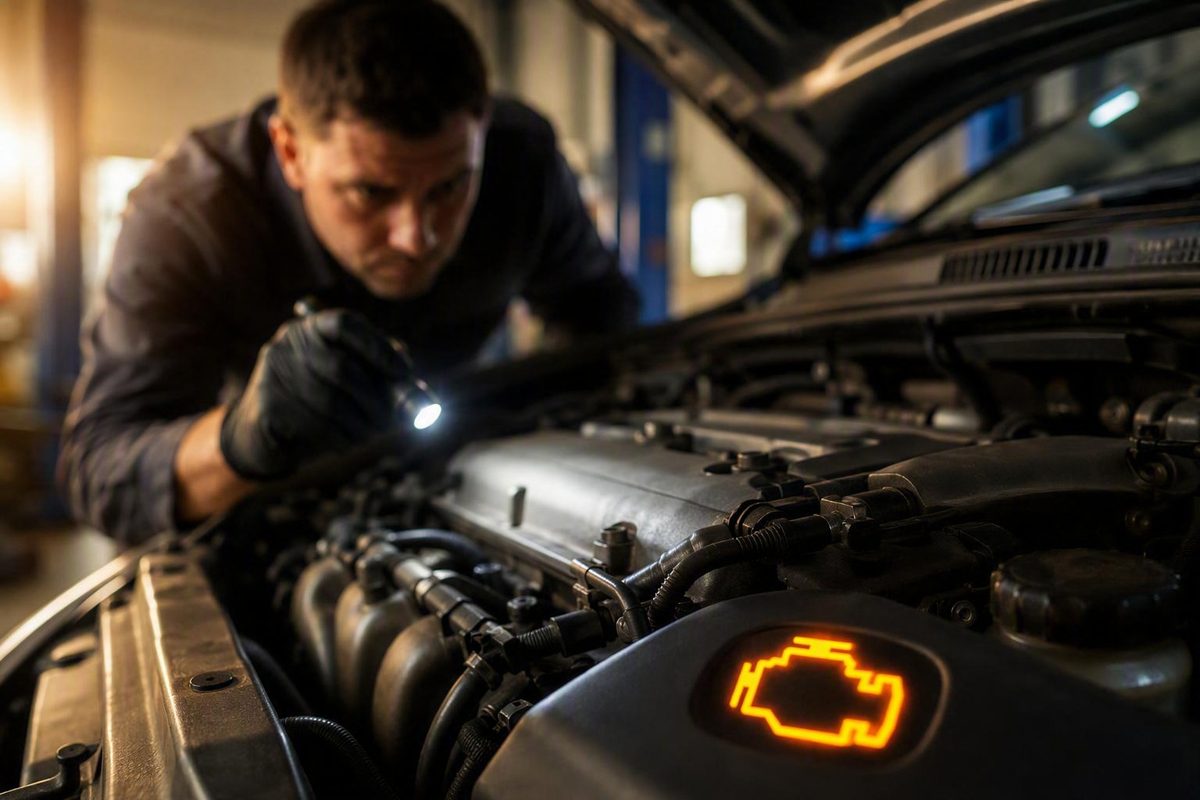
Most often, it signals an active misfire. Even if flashing stops when you ease off the throttle, the fault may remain, so reach a safe stopping place.
The short answer: treat a flashing light as an urgent warning
A flashing or blinking check-engine light usually indicates a serious active problem—most commonly an engine misfire. A misfire means one or more cylinders are not burning the air-fuel mixture properly. Because the fault may be occurring while the engine is running, a flashing warning calls for a faster response than a steadily illuminated light.
If you are driving now, ease off the accelerator and focus on reaching the nearest safe stopping place. Do not continue reading until you are safely out of active traffic.
The light signals urgency, but it does not identify the failed part. It cannot prove that a spark plug, ignition coil, injector, sensor, catalytic converter, wiring harness, or engine computer has failed. AutoZone similarly describes a flashing malfunction indicator lamp as a serious emissions or powertrain warning, often associated with a misfire, and recommends reducing engine load and stopping safely rather than continuing normally (AutoZone’s flashing check-engine-light guidance).
The main concern on a gasoline-powered vehicle is that incomplete combustion may allow unburned fuel to enter the exhaust. That fuel can generate damaging heat in the catalytic converter. A severe fault may also cause rough running, reduced power, vibration, stalling, or difficulty maintaining a safe speed.
This article primarily addresses conventional gasoline engines. Consult the owner’s manual for the vehicle-specific response.
There is no universal safe distance, speed, or driving time when the light is flashing. Use this practical rule:
- Move only as far as necessary to leave immediate traffic danger.
- Ease off the accelerator and avoid heavy engine load.
- Do not treat reaching safety as permission to finish the trip.
- Once securely stopped, follow the owner’s manual.
- If flashing persists or the engine is running abnormally, arrange roadside assistance or towing.
A vehicle that seems to run normally may still have an intermittent or load-dependent fault. Shaking, substantial power loss, stalling, smoke, overheating, severe mechanical noise, a strong fuel or burning odor, a visible leak, or another critical dashboard warning makes continued operation especially unwise.
What to do immediately while you are driving
Traffic safety comes first. Do not slam on the brakes or stop abruptly in a live travel lane solely because the light begins flashing. Instead, make a controlled move toward the nearest genuinely safe stopping place. Guidance for flashing-light events consistently recommends reducing speed and load, avoiding hard acceleration, and stopping when it is safe to do so (Kwik Lube’s stop-or-drive guidance).
Use this sequence:
- Maintain control. Keep your attention on steering, traffic, pedestrians, and surrounding vehicles.
- Ease off the accelerator. Reduce throttle smoothly.
- Avoid demanding more power. Do not accelerate hard, attempt a high-speed pass, tow under load, or continue climbing at full throttle.
- Move toward the nearest safe place. Depending on the road, that may be a wide shoulder, parking area, rest area, side street, or safe exit.
- Warn other drivers if necessary. If the vehicle is slowing unexpectedly, use its warning equipment as conditions require.
- Park securely. Make sure the vehicle cannot roll and remain aware of passing traffic.
- Consult the owner’s manual. Follow any model-specific instructions for a flashing malfunction indicator lamp or accompanying warning.
- Arrange assistance. If the light keeps flashing or the engine shakes, stalls, loses substantial power, smokes, overheats, or smells strongly of fuel or burning material, towing is generally the safer choice.
Moving out of a traffic lane is not the same as deciding to drive several miles to a repair facility. The first action reduces an immediate roadway hazard. The second keeps the engine and exhaust system operating with an unresolved fault.
When not to restart
Generic advice cannot establish a universally safe restart rule for every vehicle. However, avoid restarting simply to test whether the problem has disappeared when the vehicle was running very roughly, vibrating heavily, repeatedly stalling, smoking, overheating, making severe mechanical noises, or losing substantial power. A strong fuel or burning odor, a visible leak, or another critical warning also requires separate attention rather than being dismissed as part of a misfire. TL Motors likewise advises avoiding a restart when the engine is rough or the vehicle is vibrating (TL Motors’ flashing-light response guidance).
An oil-pressure or overheating warning is not merely another version of the check-engine light. Follow the owner’s manual for that warning and do not assume that correcting a fluid level will establish that the vehicle is safe to operate.
What if the flashing stops?
If the light stops flashing after you reduce throttle, do not assume the vehicle repaired itself. The immediate event may have paused because operating conditions changed, while the underlying fault remains.
If you have already reached a safe place, avoid restarting or deliberately reproducing the problem through hard acceleration. Arrange prompt diagnosis. Towing remains the conservative option, particularly if the light flashed repeatedly, the engine ran abnormally, another warning appeared, or the route ahead requires highway speed, steep grades, or heavy traffic.
Why an active misfire can damage the catalytic converter
A gasoline engine normally burns a controlled mixture of air and fuel inside each cylinder. Combustion produces pressure that moves the piston, and the resulting gases pass through the exhaust system and catalytic converter.
During a misfire, combustion in one or more cylinders is absent, weak, or incomplete. Depending on the underlying failure, some fuel intended for that cylinder may leave the engine without burning fully.
The catalytic converter promotes chemical reactions that reduce harmful exhaust emissions. When excess unburned fuel reaches it, reactions inside the converter can generate excessive heat. That heat may damage the internal substrate that carries the catalytic coating. Firestone identifies this unburned-fuel pathway as the reason a significant misfire can overheat or damage a catalytic converter (Firestone’s explanation of flashing-light and misfire risks).
Possible consequences include:
- Thermal damage to the converter substrate
- Melting, cracking, or deterioration inside the converter
- Restricted exhaust flow if damaged material shifts or breaks down
- Reduced emissions-control performance
- A repair that extends beyond the original misfire fault
These are risks, not conclusions that can be drawn from the warning light alone. A flashing check-engine light does not prove that the converter is already damaged. Converter condition may need to be evaluated after the cause of the misfire has been identified and corrected.
Why engine load matters
Engine load generally increases during acceleration, hill climbing, towing, or high-speed operation. Under greater load, each cylinder must produce more power. A marginal ignition, fuel, air, electrical, or mechanical fault may therefore become more noticeable when demand rises.
A light that flashes only during acceleration or on a grade provides useful diagnostic context, but it does not establish which component failed. Reducing throttle may lessen or pause the immediate misfire without repairing its cause.
Reducing load and shutting the engine down after reaching safety are exposure-limiting actions. They reduce continued operation while the cause remains unknown. They are not a method for making an extended drive safe.
Misfire severity, operating conditions, engine design, fuel delivery, converter condition, and the underlying fault all vary.
Symptoms that strengthen the case for shutting down and towing
The warning pattern matters, but the vehicle’s behavior supplies essential context. This table is a conservative decision aid, not a substitute for the owner’s manual or an in-person inspection. Repair guidance identifies shaking, stalling, smoke, power loss, overheating, burning smells, and visible leaks as reasons to stop rather than continue normally (Kwik Lube’s symptom guidance).
| Observed condition | Likely concern | Safest response |
|---|---|---|
| Check-engine light continues flashing | Serious active fault, commonly a continuing misfire | Reduce load, reach the nearest safe stopping place, follow the owner’s manual, and arrange assistance |
| Violent shaking or severe roughness | Substantial misfire or another serious engine problem | Stop safely and avoid restarting merely to test it; request assistance |
| Major power loss | Misfire, fuel-delivery fault, restricted exhaust, or another powertrain problem | Leave active traffic without forcing the vehicle to continue |
| Repeated stalling or inability to idle | Unstable combustion, electrical or fuel failure, or mechanical trouble | Do not continue into traffic; arrange towing |
| Smoke from the engine compartment or exhaust | Possible overheating, fluid, electrical, combustion, or exhaust problem | Stop safely, shut down, and seek assistance |
| High temperature reading or overheating warning | Cooling-system or engine-temperature problem requiring its own response | Stop safely and follow the manufacturer’s instructions |
| Loud knocking, banging, or severe mechanical noise | Possible abnormal combustion or mechanical failure | Shut down once safe and obtain assistance |
| Strong raw-fuel odor | Incomplete combustion, rich operation, or a possible fuel-system problem | Shut down once safe and avoid continued operation |
| Strong burning odor | Possible overheated electrical, fluid, belt, clutch, or exhaust component | Stop and arrange assistance |
| Visible fuel, coolant, or oil leak | Separate fluid-loss or fire concern | Shut down and do not continue driving |
| Oil-pressure warning with the check-engine light | Possible lubrication-pressure problem | Treat it as a separate urgent warning and follow the owner’s manual |
| Flashing has stopped, engine is smooth, and no other danger signs are present | Intermittent fault may remain | Avoid unnecessary driving and arrange prompt diagnosis; towing remains the conservative option |
Rough idle, stumbling during acceleration, jerking, vibration, exhaust popping, and reduced power can accompany a substantial misfire. A raw-fuel odor may also occur when combustion is incomplete.
None of these symptoms identifies the failed part. Major power loss, for example, can have causes other than a misfire. The table is intended to guide the immediate safety decision, not diagnose the vehicle from the driver’s seat.
What “running normally” does and does not establish
If the engine becomes smooth and the light stops flashing, the immediate condition may no longer be present. That does not erase the event or prove that continued driving is safe.
Some faults occur only under particular operating conditions. Rather than trying to reproduce the event, record what was happening when it appeared. That information can help a technician investigate a problem that is absent once the vehicle reaches the shop.
Flashing versus steady—and what it means if the warning changes
A flashing check-engine light generally indicates a more urgent active condition. A steady light generally indicates a stored or ongoing emissions or powertrain fault that still requires timely diagnosis. The difference is useful, but a steady light is not automatic permission to ignore abnormal symptoms.
| Light behavior | General interpretation | Appropriate response |
|---|---|---|
| Continuously flashing | Serious active condition, commonly an active misfire | Reduce load, stop safely, and seek assistance |
| Flashes during acceleration or on hills | Fault appears under increased operating demand | Stop stressing the engine, record the conditions, and arrange diagnosis |
| Changes from flashing to steady | The immediate severe event may have paused, but a fault remains | Do not assume it repaired itself; obtain prompt diagnosis |
| Turns off after flashing | The monitored condition may not be present at that moment | Treat it as an intermittent event and preserve the details |
| Remains steadily illuminated | Stored or ongoing emissions or powertrain fault | Arrange timely diagnosis; stop sooner if serious symptoms or critical warnings appear |
A steady light can accompany a comparatively minor emissions fault, but it can also appear with a condition that affects performance. Smoke, overheating, stalling, severe noises, substantial power loss, a strong fuel or burning odor, or another critical warning should control the stop-or-drive decision regardless of whether the check-engine light is steady.
If the warning changes from flashing to steady after you reduce throttle, the active event may have subsided while the underlying fault remains. WNY One Stop Automotive describes the same flashing-to-solid change as a reason to obtain service rather than assume the problem has resolved (WNY One Stop Automotive’s flashing-versus-steady explanation).
Details worth recording
Write down:
- Whether the light flashed continuously or intermittently
- Whether it became steady or turned off
- Whether the event occurred while accelerating, cruising, climbing, towing, or idling
- Road speed and engine speed, if known
- Engine temperature
- Shaking, stumbling, jerking, stalling, or power loss
- Fuel, burning, or other unusual odors
- Popping, ticking, knocking, or other noises
- Any additional dashboard warning
- Recent fueling, maintenance, repairs, or battery disconnection
These are observations to report, not instructions to recreate the fault.
Likely causes, ranked by diagnostic category
A useful cause list should organize testing rather than encourage replacing the first plausible part. The initial question is usually whether the vehicle has a cylinder-specific misfire, a broader misfire pattern, or another powertrain fault.
1. Ignition-related misfires
Common possibilities include:
- Worn, fouled, damaged, or incorrectly specified spark plugs
- Weak or failed ignition coils
- Damaged spark-plug wires on vehicles that use them
- Poor ignition-component connections
- Ignition circuit or wiring faults
That possibility does not justify replacing coils or plugs without inspection and testing.
A cylinder-specific misfire code also does not prove that the ignition coil serving that cylinder has failed. The spark plug, injector, wiring, compression, or another condition may be responsible.
2. Fuel-related faults
Possible fuel-side causes include:
- A malfunctioning or restricted fuel injector
- An injector circuit fault
- Inadequate fuel delivery
- Contaminated fuel
- A mixture too rich or too lean for stable combustion
Replacing the injector without testing may leave the fault unchanged.
Low fuel in the tank is not a typical direct explanation for a flashing check-engine light. An existing fuel-delivery problem may become more apparent under some operating conditions, but tank level alone does not diagnose it.
3. Air and mixture-control problems
Potential causes include:
- A major vacuum leak
- A disconnected or damaged intake hose
- An air-metering fault
- Another significant mixture-control problem
These conditions can produce a mixture unsuitable for stable combustion. Sensor-related codes need interpretation because a sensor may be reporting the effects of a misfire rather than causing it.
An oxygen-sensor or converter-related code, for example, does not automatically prove that the named sensor or converter caused the flashing warning.
4. Mechanical engine faults
Possible mechanical causes include:
- Low compression in one or more cylinders
- Valve or valve-train problems
- Incorrect valve or ignition timing
- Timing-drive or timing-control faults
- Other internal conditions that prevent normal combustion
5. Wiring, connectors, and engine-control faults
Electrical faults can interrupt an otherwise functional coil or injector. Possibilities include:
- Loose, corroded, contaminated, or damaged connectors
- Broken or shorted wiring
- Poor power or ground supply
- Harness damage
- A control-circuit or module fault
A failed engine-control module is possible, but it should not be the automatic first conclusion. Component operation, power, grounds, connectors, wiring integrity, and mechanical condition should be evaluated before an expensive controller is condemned.
Other codes and systems that may appear
Some source lists include catalytic-converter faults, oxygen sensors, EGR systems, air-metering sensors, speed-sensor discrepancies, or transmission-related problems. Those systems may illuminate the check-engine light, affect engine operation, or appear among stored codes. They should not all be treated as equally common direct causes of flashing.
The essential principle is: rank the possibilities, test them, and replace only what the evidence identifies as faulty.
What a code scan can—and cannot—tell you
The check-engine light is part of the vehicle’s onboard diagnostic system. That system monitors selected emissions and powertrain conditions and stores diagnostic trouble codes when monitored behavior falls outside programmed criteria. A scan is an important first step, but the warning light and codes do not normally identify a replacement part by themselves.
A scan may provide:
- A detected misfire pattern
- Identification of a cylinder associated with a misfire
- Related ignition, injector, mixture, airflow, timing, or emissions codes
- Pending codes
- Recorded operating-condition information, when supported by the vehicle and scan tool
A code identifies a detected condition, circuit, system, or monitored performance problem. The component named in its description may be faulty, but wiring, connectors, power, grounds, mechanical problems, or another system may produce the same code.
The P0302 example
In a discussion concerning a 2008 Mercury Milan with a 3.0-liter V6, P0302 represented a detected cylinder-two misfire (JustAnswer’s vehicle-specific cylinder-two misfire case).
That example is limited to the cited vehicle discussion, but it illustrates the distinction between detection and diagnosis. The code supported investigating cylinder two; it did not, by itself, prove that the vehicle required:
- A spark plug
- An ignition coil
- A fuel injector
- Wiring repair
- Mechanical engine repair
- An engine-control module
Each is a possible testing direction, not a repair instruction supplied by the code.
A bounded diagnostic sequence
Because procedures and specifications vary by vehicle, diagnosis should remain vehicle-specific. A reasonable high-level process is:
- Preserve the available evidence. Record codes before clearing them.
- Record the circumstances. Note the light pattern, engine behavior, road load, temperature, odors, noises, and other warnings.
- Inspect for obvious faults. Look for disconnected hoses, damaged wiring, loose connectors, or signs of a recent installation problem.
- Test rather than guess. Evaluate the relevant ignition, injector, fuel, air, electrical, and mechanical systems according to vehicle-specific information.
- Confirm the repair. Verify that the fault no longer occurs under appropriate test conditions and determine whether related exhaust or emissions problems remain.
Fuel-system, ignition, electrical, compression, and timing tests may require specialized equipment and vehicle-specific procedures. They should not be reduced to universal DIY instructions.
What to give the technician
Provide:
- Every recorded code
- Whether the light flashed continuously, intermittently, became steady, or turned off
- Whether the engine shook or ran roughly
- The timing and severity of power loss
- Engine temperature
- Whether the event occurred while accelerating, climbing, cruising, towing, or idling
- Fuel, burning, or unusual exhaust odors
- Knocking, popping, ticking, or other noises
- Stalling or difficult restarting
- Recent maintenance, fueling, repairs, parts replacement, or battery disconnection
If parts have already been replaced, identify them and explain whether the symptoms changed.
Common myths and mistakes that can erase clues or waste money
“It is probably just the gas cap”
A loose or damaged gas cap is commonly associated with an evaporative-emissions fault and a steady check-engine light. It is not a typical explanation for an actively flashing light accompanied by rough running or power loss.
You can confirm that the cap is present and properly installed once safely parked. Finding it loose should not override the response to persistent flashing or abnormal engine behavior.
“The tank is low, so that must be the cause”
Low fuel alone is not generally identified as a direct cause of a flashing check-engine light. A fuel-delivery fault may become apparent under certain conditions, but the gauge reading does not diagnose the problem.
Do not use refueling as an experiment when the vehicle is running badly, producing a strong fuel odor, or showing other stop-and-seek-assistance symptoms.
“The oil is low, so the check-engine light is flashing”
Low oil is ordinarily associated with an oil-level or oil-pressure warning rather than being a typical direct cause of a flashing check-engine light.
Treat an oil-pressure warning as a separate urgent condition and follow the owner’s manual.
“Disconnecting the battery will fix it”
Disconnecting the battery or clearing codes may temporarily turn off the warning. It does not repair an ignition fault, injector problem, air leak, compression problem, timing fault, wiring defect, or damaged converter.
AutoZone specifically notes that battery disconnection can extinguish the light temporarily without repairing the underlying fault (AutoZone’s explanation of resets and underlying faults).
“The code names the bad part”
A code description is not a parts prescription. Avoid shortcuts such as:
- Replacing every coil because one cylinder misfired
- Installing an injector without testing the component and circuit
- Replacing an oxygen sensor because it reported an abnormal exhaust condition
- Replacing a catalytic converter before correcting an active misfire
- Condemning the engine computer before checking relevant power, grounds, wiring, and components
- Replacing spark plugs without considering why they became worn, damaged, or fouled
A new part may make no difference if the diagnosis is wrong.
“If the light stopped, the repair is no longer necessary”
A stopped warning may mean only that the monitored condition is absent or less severe under the current operating conditions. An intermittent fault may still leave stored diagnostic information.
Avoid unnecessary driving and arrange diagnosis while the event details are fresh.
“One repair price applies to every flashing-light event”
Repair scope depends on the confirmed fault. An ignition-component problem and an internal mechanical problem require different parts, testing, and labor. If continued operation contributed to catalytic-converter damage, the repair may expand beyond the original cause.
The reliable way to control unnecessary expense is to preserve the evidence and require testing before parts are replaced.
The decision to make now
A flashing check-engine light usually means an active problem serious enough to threaten the catalytic converter or reliable engine operation. Ease off the accelerator, avoid heavy load, and move only as far as necessary to reach a safe stopping place.
If the flashing persists or the engine shakes, stalls, loses substantial power, overheats, smokes, makes severe noises, or produces a strong fuel or burning odor, shut it down once safely stopped and arrange assistance. Follow the owner’s manual, preserve the stored codes, and require a test-supported diagnosis—even if the warning later becomes steady or disappears.
Frequently asked questions
Can I drive even a short distance with a flashing check-engine light?
There is no universally safe distance. If you are in active traffic, move only as far as necessary to reach a safe stopping location. Reduce throttle and avoid demanding more power from the engine.
Persistent flashing, rough running, shaking, stalling, substantial power loss, smoke, overheating, severe noise, strong odors, leaks, or another critical warning supports shutting down once safe and arranging towing. If you are already safely stopped, towing is the conservative choice.
What if the check-engine light flashes briefly and then turns solid or goes out?
The immediate condition may have paused after engine load or another operating condition changed. That does not prove the underlying fault repaired itself.
Record what happened and arrange prompt scanning and diagnosis. Do not deliberately recreate the event through hard acceleration. If flashing returns or serious symptoms appear, stop safely and obtain assistance.
Does a flashing check-engine light always mean the engine is misfiring?
No. An active misfire is the usual and most common interpretation, but the warning light is fundamentally an urgency signal. It does not identify one universal cause or establish which component failed.
The correct conclusion is that the vehicle requires immediate caution and diagnosis—not that a particular plug, coil, injector, sensor, converter, or computer must be replaced.
Can bad spark plugs, ignition coils, or fuel injectors cause the light to flash?
Yes. Worn or fouled spark plugs, weak or failed ignition coils, damaged plug wires where fitted, and malfunctioning injectors can cause one or more cylinders to misfire.
They are not the only possibilities. Fuel-delivery faults, major air leaks, wiring defects, low compression, and timing problems can produce similar symptoms or codes. Test the suspected system before replacing parts.
Will disconnecting the battery fix a flashing check-engine light?
No. Battery disconnection may reset the warning temporarily, but it does not repair the underlying combustion, fuel, air, mechanical, wiring, or control fault.
Record codes before any reset when possible, and correct the confirmed cause rather than treating an extinguished warning as proof of repair.