
A Safety-First Plan for Diagnosing a Blinking SRS Warning
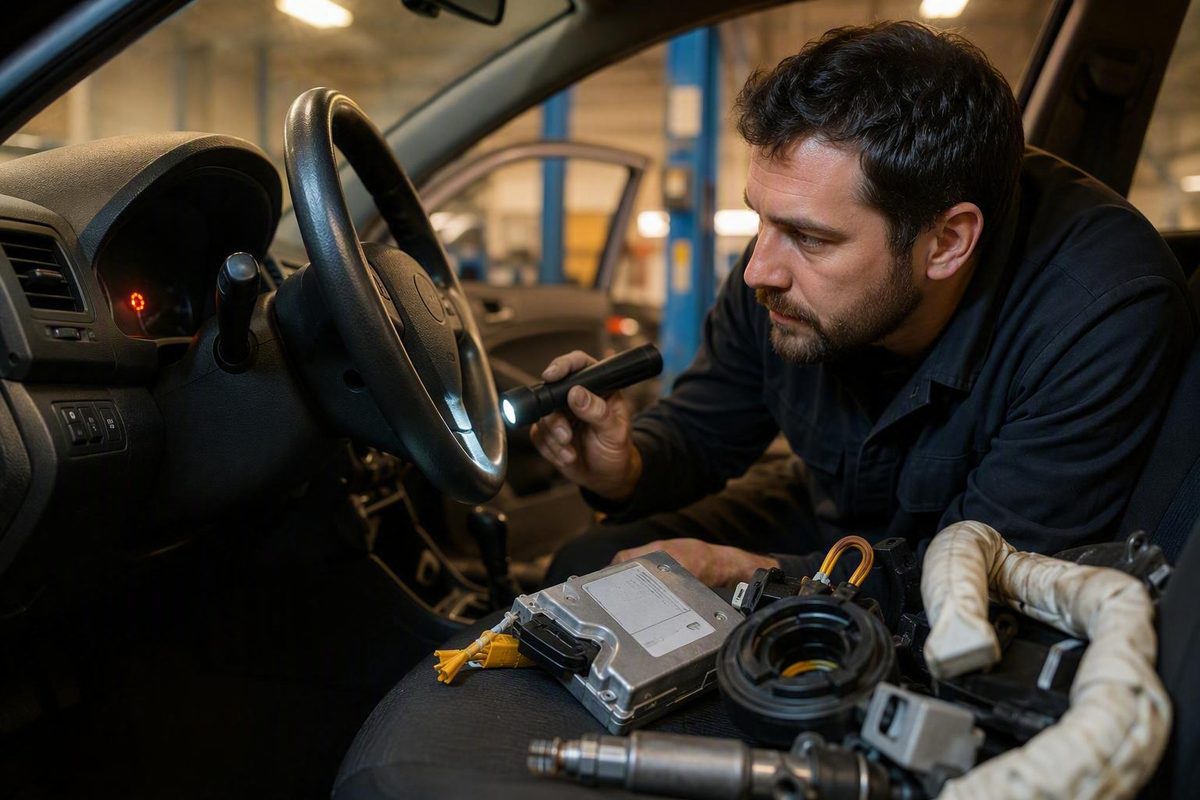
Identify the exact lamp, record its pattern, check the VIN for recalls, and get an SRS-capable scan before clearing codes or replacing parts.
An airbag light flashing—or remaining continuously illuminated—generally means the supplemental restraint system (SRS) has detected a fault that requires prompt diagnosis. The warning alone cannot identify the affected airbag, seat-belt pretensioner, sensor, circuit, or module, and it cannot confirm which restraints will operate as designed in a crash. Identify the exact lamp, document its behavior, check the vehicle for open recalls, and have the appropriate restraint modules scanned before anyone clears codes or replaces parts. This diagnose-first approach is consistent with published SRS warning-light diagnostic guidance.
What to do when the airbag light is flashing
Treat the warning as an active safety concern rather than a nuisance light. Continue wearing your seat belt because airbags supplement seat belts; they do not replace them. Do not assume that every airbag and pretensioner is disabled, but do not assume that all of them will work normally either.
There is no responsible universal answer to whether every affected vehicle can be driven or must be towed. Consult the airbag-warning section of the owner’s manual, check the exact vehicle for recalls, and follow any manufacturer instruction that prohibits driving or carrying a passenger. Such restrictions apply to specific vehicles and campaigns, not automatically to every SRS warning.
Take these steps now:
- Keep wearing seat belts.
- Identify the warning. Determine whether it is the main SRS lamp, a passenger-airbag status indicator, or both.
- Record its behavior. Note when the flashing starts, the exact pattern, how long it lasts, and whether the lamp becomes steady or disappears after a restart.
- Avoid disturbing SRS components. Do not unplug under-seat connectors, probe restraint circuits, remove airbags, or assume battery disconnection makes the system safe.
- Check for an open recall. Use the VIN rather than relying only on the model year.
- Arrange an SRS-capable scan. Confirm that the scanner supports the exact vehicle and its restraint modules.
Those conditions may require inspection and repair beyond retrieving a stored code.
Identify which airbag warning is flashing
First distinguish the main SRS warning lamp from the passenger-airbag indicator.
Because this indicator is associated with passenger-airbag status or occupant detection, it may lead to a different diagnostic path.
Do not interpret a flash count using a generic online list. There is no universal meaning for three flashes, seven flashes, or another sequence. Definitions can vary by manufacturer, model, year, market, and warning lamp. Use the applicable owner’s manual or manufacturer service information.
| Observation | What to record | Why it matters |
|---|---|---|
| Main SRS lamp | Symbol, color, location, and exact sequence | Confirms whether the main restraint-system warning is involved |
| Passenger-airbag indicator | Exact wording and whether it flashes or remains on | May direct diagnosis toward passenger-status or occupant-detection functions |
| Startup behavior | Whether the lamp appears at ignition-on, goes out, flashes, or stays on | Separates the startup check from behavior the manual identifies as a fault |
| Intermittent behavior | Temperature, bumps, seat movement, restarts, and driving conditions | Helps a technician reproduce an intermittent problem |
| Passenger presence | Whether the seat is empty or occupied and whether the indicator changes | Provides context without proving that a sensor has failed |
| Recent vehicle work | Battery, seat, carpet, console, dashboard, steering-wheel, or collision work | Identifies areas that may deserve inspection first |
A phone video of the complete startup sequence can be more useful than a description from memory. If possible, include both the instrument cluster and the passenger-airbag indicator.
Why restarting the car or resetting the light is not a repair
A warning that disappears after a restart can still represent an unresolved restraint-system fault. Intermittent voltage, wiring, communication, or module problems may not be present during every ignition cycle, while stored diagnostic information may remain available.
Land Rover safety recall P046 provides a limited example. In certain U.S.-market LR2 and Range Rover Evoque vehicles, an occupant-classification control-module defect could impair passenger-airbag operation even though the warning condition might clear during a subsequent ignition cycle. The recall associated that specific condition with DTC U0154-00 and a software remedy, but neither the code nor the remedy applies generally to other vehicles. Eligibility also depends on the exact VIN and market, as detailed in the Land Rover P046 safety recall bulletin.
Clearing a code does not repair a loose terminal, damaged harness, failed sensor, calibration problem, low-voltage condition, or defective module. It may erase useful diagnostic context and temporarily turn off the warning until the system detects the fault again.
Before any reset, preserve:
- The identity and location of the warning lamp
- The complete flash sequence and timing
- The conditions under which the warning appeared
- Every DTC and subcode
- Whether each fault is current, intermittent, or stored
- Available event or fault-record data
- Recent battery, seat, interior, steering, or collision work
Codes should be cleared only after the verified fault has been repaired. The vehicle should then undergo the manufacturer’s prescribed verification procedure.
Possible causes, organized by system
These are diagnostic categories, not a ranked list or a diagnosis. The same warning can result from different faults on different vehicles.
Connections and wiring: Possible inspection areas include under-seat connections, connector locking, damaged or pinched harnesses, corrosion, fuses, grounds, and module communication circuits. Seat movement or recent interior work provides useful context but does not prove that a connector caused the warning.
Occupant detection: The diagnostic path may involve passenger-seat sensors, seat-track sensors, associated wiring, an occupant-detection control module, or vehicle-specific calibration. A flashing passenger indicator makes it especially important to identify the exact lamp, but it is not by itself proof that calibration is needed.
Steering-wheel circuits: The clock spring—called a roll connector by some manufacturers—maintains the driver-airbag electrical connection while allowing the steering wheel to turn. This area may warrant attention after steering-wheel or steering-column work, but code-guided testing is still necessary.
Electrical supply and modules: Low system voltage, module power or ground faults, restraint-control module problems, and network communication failures can produce SRS warnings. A weak battery, jump-start, battery replacement, or interrupted module work should be documented rather than treated as the confirmed cause.
Damage or previous work: Seat removal, carpet or console work, dashboard repairs, battery service, collision repairs, flood exposure, previous restraint deployment, and SRS-module replacement may help narrow the inspection area. None identifies the failed component without codes and vehicle-specific tests.
Testing must establish where the fault actually lies before parts are ordered.
The correct diagnostic workflow
A capable shop or equipped technician should use a repeatable process rather than resetting the warning and waiting for it to return.
-
Collect vehicle and symptom details. Record the make, model, year, market, lamp identity, complete flash behavior, battery history, recent repairs, and any collision, flood, or deployment history.
-
Confirm scanner coverage. The tool must support the exact vehicle and communicate with the SRS module and, where applicable, the occupant-detection module. A basic engine-code reader may access powertrain faults without providing restraint-system access.
-
Run and save a full-system scan. Record exact DTCs, subcodes, current or stored status, and available event information before clearing anything. Note related voltage or communication codes in other modules.
-
Follow the vehicle-specific diagnostic procedure. Test the circuit or system identified by the code using current manufacturer instructions. A DTC establishes a diagnostic path; it does not automatically condemn the component named in its description.
-
Repair the verified fault. Depending on the findings, the repair may involve a connector or wiring remedy, component replacement, software work, initialization, or a prescribed calibration.
-
Clear and verify. After repair, follow the applicable ignition-cycle, initialization, calibration, or road-test procedure. Rescan the relevant modules and confirm that the warning and codes do not return.
This sequence—confirming vehicle coverage, saving codes before clearing, repairing the underlying problem, and then rescanning—is also outlined in published scanner-based SRS diagnostic guidance.
When calling a repair facility, ask:
- Can your scanner access the SRS and occupant-detection modules on my exact year and model?
- Can you save DTC subcodes, status, and available event information before clearing?
- Do you have access to the manufacturer’s diagnostic and safety procedures?
- Can you perform any required occupant-detection initialization or calibration?
- Will you verify the repair by rescanning the vehicle?
Confirm those capabilities before scheduling.
Check for an open airbag recall—but do not confuse recall status with diagnosis
A flashing warning does not prove that the vehicle has a Takata inflator recall or any other open campaign. Recall status and the stored SRS fault are separate issues, so check both.
U.S. owners can search using the 17-character VIN or a license plate and state. NHTSA also recommends checking for recalls at least twice per year and offers the SaferCar app for future alerts; its official recall guidance explains the lookup process.
Follow any campaign-specific Do Not Drive or front-passenger restriction exactly. These restrictions are vehicle-specific and do not apply to every car displaying an airbag warning.
Takata illustrates why exact VIN verification matters. That recall concerns the risk that certain inflators may rupture during deployment after long-term exposure to heat and humidity; it does not explain a flashing warning by itself. NHTSA identifies special driving restrictions only for certain high-risk vehicles in its Takata recall guidance.
A clear recall search does not clear the SRS warning. It means only that the lookup did not identify an open campaign for the entered vehicle at that time. The warning still requires diagnosis.
Safe owner checks versus SRS work to leave to a professional
The safest owner contribution is accurate observation and documentation, not opening or testing the restraint system.
| Safe observations | Do not attempt as routine DIY work |
|---|---|
| Identify the exact lamp and its location | Unplug or manipulate SRS connectors |
| Record or video the complete flash pattern | Probe airbag, pretensioner, or igniter circuits |
| Note whether passenger presence changes an indicator | Repair, splice, or bypass restraint wiring |
| Document battery and recent repair history | Disassemble sealed airbags, sensors, or modules |
| Check the VIN for recalls and restrictions | Disable an airbag or defeat occupant-detection logic |
| Give the shop vehicle details and saved codes | Run deployment-related active tests |
Battery disconnection alone does not necessarily make SRS component handling safe. Documented systems can retain electrical energy intended to support deployment after battery power is lost.
For example, Subaru technician material describes capacitors capable of retaining deployment energy after battery-power loss. It instructs technicians to consult the applicable service manual, wait the specified discharge period, replace rather than repair damaged SRS wiring, and avoid disassembling sealed components. These are manufacturer-specific precautions—not a universal waiting time or DIY procedure—but they demonstrate why battery disconnection is not sufficient protection by itself. See Subaru’s Supplemental Restraint System technician reference.
What vehicle information is needed to interpret a specific airbag flash sequence?
Provide the make, model, model year, trim or body style, market, and ideally the VIN. Identify whether the flashing lamp is the main SRS warning or the passenger-airbag indicator, then record the exact sequence, timing, startup behavior, and whether it becomes steady.
Also document passenger-seat occupancy, recent battery or repair work, collision history, and all stored SRS or occupant-detection DTCs and subcodes. Interpretation must come from the owner’s manual or service information for that exact vehicle because flash meanings are not universal.
Can an occupant-detection calibration fix a flashing passenger-airbag indicator?
Possibly, but only if diagnosis and the applicable vehicle procedure call for calibration or initialization. A passenger-airbag indicator can also be associated with sensor, seat-track, wiring, module, communication, or other faults.
Do not use calibration as a blind reset. First preserve the relevant codes, confirm communication with the appropriate module, and follow the exact manufacturer procedure.
Final takeaway: Identify the lamp, record its complete behavior, check the exact VIN for recalls and special restrictions, and preserve the SRS codes before anything is cleared. Diagnose the verified fault before replacing parts, and avoid invasive DIY work because disconnecting the battery does not necessarily remove stored deployment energy.