
Duramax P0087: Test Fuel Supply Before Condemning the Pump
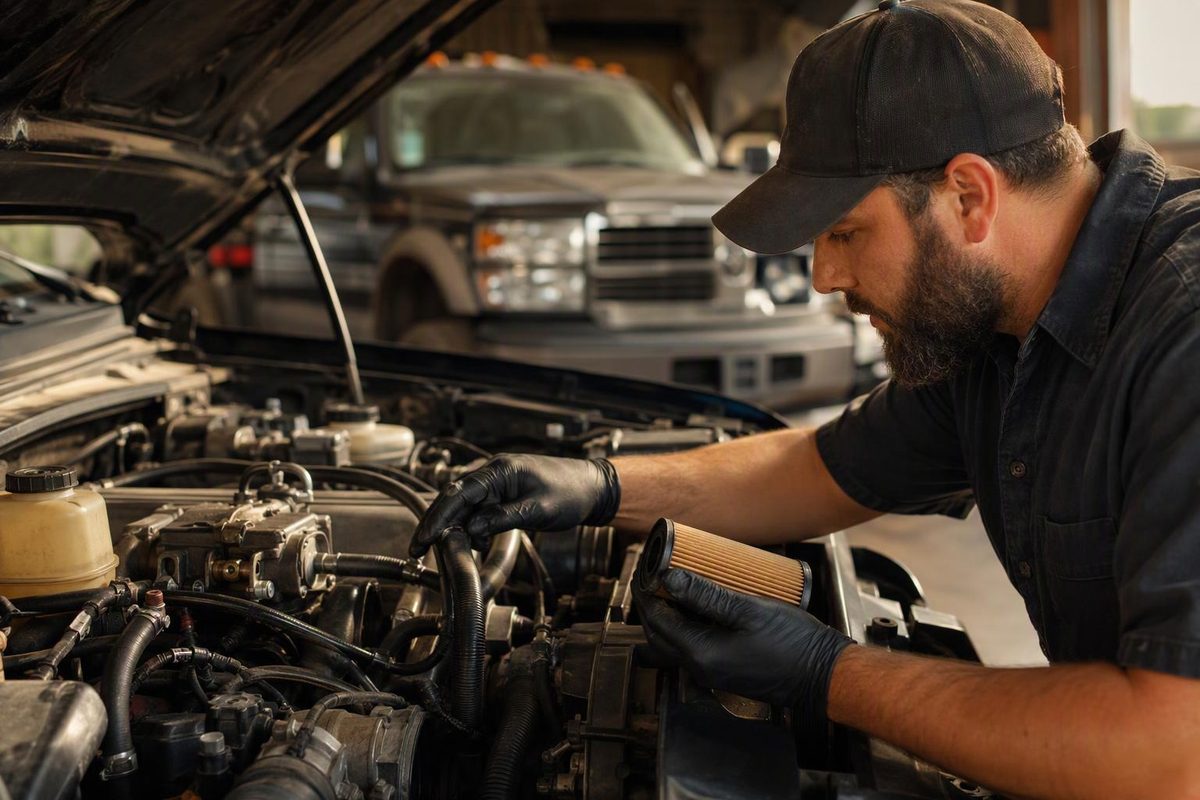
Diagnose 6.6L Duramax P0087 with rail-pressure data, filter and air-leak checks, generation-specific tests, and clear stop points.
P0087 means fuel rail pressure is too low. It does not, by itself, prove the injection pump has failed. On a 6.6L Duramax, diagnosis must separate restricted fuel supply, air entering the supply system, excessive internal fuel leakage, pressure-control faults, and an incorrect pressure signal. Oregon Fuel Injection’s diagnostic guidance describes these diagnostic branches. GM also documents fuel-pressure-sensor connector corrosion as a possible cause on certain L5P trucks. GM bulletin 20-NA-197
Start by saving the codes and comparing desired versus actual rail pressure during the condition that causes the fault—not just at idle. This guide focuses on 6.6L Silverado/Sierra pickups; do not apply its specifications to the 2.8L or 3.0L Duramax.
Stop points before testing
If the truck repeatedly loses power, stalls, or cannot maintain a safe speed, stop towing or demanding heavy acceleration and arrange recovery. A restart that restores power is not proof of a repair.
If you suspect gasoline or DEF was put into the diesel tank, stop running the engine and have the fuel evaluated. GM identifies fuel contamination as a cause of component damage and provides a separate contamination diagnostic path for the listed applications. GM bulletin 18-NA-361
Never loosen a common-rail injector pipe to check for fuel, or use your fingers to locate a leak. These systems operate at pressures capable of causing life-threatening injection injuries. High-pressure component removal and isolation tests require the vehicle-specific safety procedure and equipment. Duramax diagnostic safety guidance
1. Identify the engine and preserve the event
Record the model year, engine RPO, fuel-system modifications, all stored codes, and freeze-frame data before clearing anything. Note whether P0087 appears during a hot restart, sustained towing, acceleration, or immediately after filter service.
The diagnostic path changes with the engine:
| Engine/application | Important distinction |
|---|---|
| LB7, LLY, LBZ and LMM pickups | Original supply systems draw fuel through the filter under suction. An air leak may occur without an obvious wet diesel leak. |
| 2011–2016 LML pickups | Also use a suction-side supply system, but their CP4.2 pump and piezo injectors require different high-pressure and return-flow tests. |
| L5P pickups | Have an electric in-tank supply pump. Check its delivery and control system rather than applying older suction-system limits. |
These differences are described in Oregon Fuel Injection’s generation-specific diagnostics and GM’s 2017 L5P introduction. An aftermarket lift pump or pump conversion changes the test setup; identify it before interpreting readings.
2. Graph desired and actual rail pressure
Use a scan tool that reads both GM rail-pressure parameters. Record RPM, engine load and temperature alongside them. During a no-start, capture cranking data; for a load-only complaint, use a safely controlled test with unattended logging or a second person operating the tool.
- Actual pressure falls behind desired as demand rises: proceed to fuel-supply testing. This does not yet distinguish starvation from internal leakage or insufficient pump output.
- Actual tracks desired while the symptom occurs: do not condemn the pump from a historical P0087. Investigate other codes and the exact symptom.
- The pressure reading jumps intermittently: inspect the sensor circuit and connector before treating the displayed value as a confirmed hydraulic fault.
As one application-specific reference, the 2008 Silverado 2500 2WD 6.6L diagnostic procedure says actual and desired pressure should be within 2 MPa—about 290 psi—as engine speed increases. That is a verification specification for that application, not a universal P0087 setting threshold. Archived ALLDATA procedure
3. Prove that fuel reaches the injection pump
Older suction-fed pickups
Check the filter’s service history, correct fitment, seals, water-drain closure and bleed screw. If the problem began after filter replacement, recheck that work first. Replace an overdue or demonstrably restricted filter, prime according to the vehicle procedure, and repeat the pressure comparison.
Inspect flexible supply hoses for kinks or collapse. GM’s November 2008 PIP4526 specifically identifies collapsed or kinked rubber supply lines as a possible cause of P0087 on the listed 2001–2009 Silverado/Sierra diesel applications. Archived bulletin copy
For a 2008 Silverado 2500 2WD 6.6L, the service procedure specifies:
- Connect the specified CH-48027 pressure/vacuum gauge to the fuel service port.
- Hand-prime to 10 psi. Pressure should not fall below 2 psi in less than one minute; faster loss directs diagnosis toward a leak test.
- At idle, supply vacuum should be 1–3 inHg. More than 3 inHg directs inspection toward a restricted filter or flattened/kinked hoses.
These figures belong to that vehicle and test setup. Do not substitute them for loaded-operation limits or L5P supply-pressure specifications. 2008 fuel-system diagnosis
An acceptable idle reading does not rule out a restriction under load. For a towing-only fault, measure supply restriction during the relevant demand using that application’s procedure and limits; Oregon Fuel Injection distinguishes unloaded and loaded vacuum readings in its LML/LGH diagnostics.
If air entry remains suspected, a technician can install the specified transparent diagnostic hose and isolate the filter housing, engine supply plumbing and chassis line. The 2008 procedure requires running the engine for at least 10 minutes to stabilize and purge air before judging bubbles at idle; an air pocket at the top of the test loop alone is considered normal. Transparent-hose test procedure
L5P pickups
Measure low-side pressure and delivery using the exact model-year procedure, including pump-command and electrical checks. Hearing the pump run does not establish adequate delivery under demand.
Also check bulletin applicability: the September 2020 version of 20-NA-197 covers listed 2017–2020 L5P Silverado/Sierra applications and directs inspection of the fuel-pressure-sensor connector for corrosion or damage. Confirmed connector damage supports connector repair—not automatic sensor or pump replacement. GM connector bulletin
4. Only then test internal leakage and pump output
If fuel supply passes but actual rail pressure still cannot follow desired, the next tests are injector return flow, rail regulator/relief leakage and pump output, using engine-specific procedures. Injector balance rates assess cylinder contribution; they do not replace a return-flow measurement when diagnosing lost rail pressure. Generation-specific diagnostic guidance
LML return testing particularly needs the correct adapters to maintain injector return pressure. Oregon Fuel Injection lists more than 3 mL in 15 seconds as excessive individual return in its specified LML/LGH hard-start-but-runs test, using adapter CH-50378 and beginning measurement after fuel flow is established. This is a specialist test reference, not a complete procedure: do not apply that number to an improvised open-hose test or an LB7/LBZ/LMM engine. LML/LGH diagnostic procedure
LML stop point: if diagnostics lead to injection-pump replacement, GM bulletin 16-NA-102 calls for inspection of fuel-pressure regulator 1 for magnetic debris. Confirmed debris can require extensive component replacement and system cleaning—not merely a new pump. Ordinary dirt does not qualify, and other contamination follows a separate branch. Have a diesel specialist document the finding and use current VIN-specific service information. GM debris-inspection bulletin
Verify the repair under the original conditions
After repair, prime correctly, check for leaks, clear codes only after saving the original data, and repeat the relevant cranking, hot-restart or controlled-load test. Confirm that actual pressure follows desired and P0087 does not return. A smooth idle alone cannot verify a fault that appeared only while towing uphill.