
High-Pressure Fuel Pump Repair Starts With Pressure Data
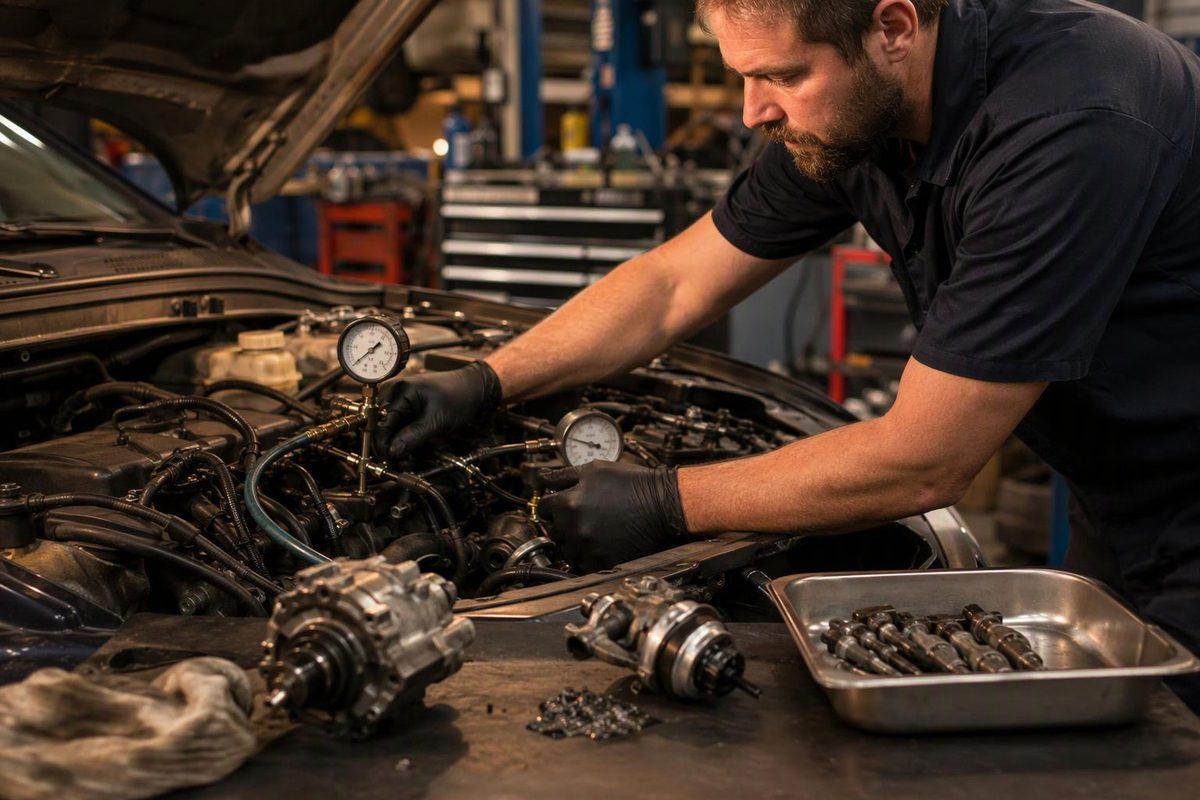
Diagnose an HPFP with low-side and rail-pressure tests, then choose pump replacement, drive repair or contamination cleanup without parts swapping.
A low rail-pressure code does not automatically condemn the high-pressure fuel pump (HPFP). Inadequate tank-pump supply, a restricted filter, leaking injectors, a pressure-control fault, bad sensor wiring, contaminated fuel or a worn mechanical pump drive can produce a similar complaint.
At the OEM service level, “repair” usually means replacing the complete pump after testing proves it failed, then correcting any drive damage or fuel contamination. Opening and rebuilding the pump is not a general DIY procedure. HELLA’s gasoline direct-injection guidance says a defective pump is replaced rather than repaired and calls for inspection of the camshaft, tappet and pump drive before installation of a new pump (HELLA).
Stop before opening a high-pressure line
Do not loosen a rail fitting to see whether fuel comes out. Gasoline direct-injection and common-rail diesel systems can retain dangerous pressure after shutdown. Follow the exact manufacturer pressure-release procedure and use eye protection, approved test equipment and suitable fuel-handling equipment. HELLA limits high-pressure-system repair work to trained specialists.
As a platform-specific example—not a universal specification—Hyundai lists 290–3,626 psi for the high-pressure circuit on the Theta GDI applications covered by its bulletin. It warns that removing components without first releasing residual pressure can cause injury (Hyundai TSB 19-FL-001H). Shut the engine off for an external leak, spraying fuel or fuel mist. A rising oil level with a strong fuel smell also warrants stopping rather than continuing to drive because fuel may be entering the crankcase.
Ford documented that combination on certain 2024–2025 EcoBoost vehicles built from October 1, 2024, through May 31, 2025. Its notice says an internally leaking injection pump can cause extended cranking, fuel odor in the oil, a high oil level and reduced high-pressure-rail pressure (Ford SSM 54138). Applicability depends on the model, engine, build date and VIN.
Test the system in this order
1. Identify the vehicle and fault conditions
Record the VIN, model year, engine code and fuel type. Save all codes, freeze-frame data and the initial scan report before clearing anything. Note whether the problem occurs during a cold start, hot restart, idle or loaded acceleration.
Check the VIN for open campaigns as well. The NHTSA recall lookup shows unrepaired safety recalls for participating manufacturers. It does not show completed recalls, every recently announced VIN, recalls more than 15 years old in most cases, or manufacturer non-safety campaigns.
2. Compare commanded and actual rail pressure
Graph desired and actual fuel-rail pressure while reproducing the condition that sets the fault. The useful result is not a generic PSI number; it is whether actual pressure follows the manufacturer’s target within the specified tolerance for that engine and operating state.
Use current service information for the pass/fail threshold. GDI and diesel pressures differ substantially, and the target changes with cranking, load, temperature and calibration. Before trusting the comparison, confirm that the rail-pressure sensor signal and circuit are plausible.
3. Prove low-side supply first
Using the approved gauge, fittings or scan data specified for the vehicle, check feed pressure and, where required, delivery volume at the HPFP inlet. Compare the result with the exact specification while reproducing the complaint. If supply falls below specification, inspect the filter, tank pickup, lift pump, supply line and pump electrical feed before blaming the HPFP.
This order is explicit on some platforms. Volkswagen’s bulletin for certain 2005–2007 2.0L BPY applications instructs technicians to diagnose low-pressure faults before high-pressure faults and says not to replace the HPFP for a low-pressure fault (Volkswagen TSB 2015153). If the service history suggests a restricted filter, use the vehicle-specific interval and testing approach in How Often Should You Change a Fuel Filter?.
4. Check the sensor circuit and pressure controls
Inspect connectors for spread terminals, corrosion, fuel or oil intrusion, and harness damage. Test reference voltage, ground and signal according to the wiring diagram rather than assuming a rail-pressure code identifies the pump.
For example, a GM bulletin covering specified 2017–2020 Duramax applications lists P0087 and several regulator or pressure-sensor codes, but identifies corrosion or damage at the fuel-pressure-sensor connector as a possible cause (GM bulletin 20-NA-197). Test a metering valve or regulator only by the manufacturer’s procedure; fuel-pressure regulator testing varies with system design.
5. Test leakage and the mechanical drive
On a common-rail diesel, excessive injector return or leakage through a pressure-regulating valve can prevent the rail from reaching target even when the pump is working. Volkswagen’s diagnostic sequence for specified 2013–2016 TDI vehicles requires low-side supply and internal-leakage checks before removing the pump metering valve to inspect for metal (Volkswagen TSB 2041118).
On a cam-driven gasoline pump, inspect the follower, tappet, cam lobe and pump plunger when the service procedure calls for it. The BPY Volkswagen bulletin illustrates the distinction: cam-lobe and follower wear can reduce pump stroke, but that procedure replaces the pump only if its plunger tip is also worn.
Match the repair to the confirmed result
| Confirmed result | Repair direction |
|---|---|
| Feed pressure or volume below specification at the HPFP inlet | Repair the low-pressure supply fault; do not condemn the HPFP yet |
| Implausible pressure signal or failed circuit test | Repair the connector, wiring or sensor as directed by service information |
| Excessive diesel injector return or regulator leakage | Repair the leaking component, then reassess pump output |
| Worn cam, follower or tappet with an undamaged pump | Repair the drive components according to the engine-specific procedure |
| Correct inlet supply and plausible sensor data, but rail pressure cannot follow its target and the specified pump test fails | Replace the HPFP and inspect its drive and fuel system |
| Metal found at the manufacturer-specified pump or fuel-system inspection point | Do not restart the engine; follow the exact contamination procedure |
Metal contamination can turn a pump replacement into a fuel-system repair. FCA’s procedure for affected 6.7L diesel applications calls for replacement of the pump, rail, injectors, connector tubes, specified high-pressure lines and filters, together with prescribed tank and low-pressure-circuit cleaning. It warns against flushing high-pressure parts with brake cleaner or similar harsh solvents (FCA STAR case S2014000002). That parts list is not universal, but a new pump must not be installed into a system that remains contaminated.
Installation and verification
Use current service information for the VIN. Depending on the vehicle, replacement may require a pressure-release routine, a particular cam position, new high-pressure pipes or fasteners, special torque adapters, pump calibration or coding, scan-tool priming, and an oil-and-filter change after fuel dilution. Cap every open fitting immediately and keep the work area clean.
After assembly:
- Prime or bleed the system with the specified procedure rather than relying on extended dry cranking.
- Check carefully for leaks without touching or leaning over a running high-pressure connection.
- Graph commanded and actual rail pressure—and low-side pressure where the vehicle reports it—under the original failure conditions.
- Confirm normal starting, idle and loaded operation.
- Recheck codes, leaks and engine-oil level after the verification drive.
The repair is verified when actual pressure follows its target under the original fault conditions, the underlying supply or drive problem has been corrected, and the system is free of leaks and remaining contamination—not merely when the warning light has been cleared.