
Know When to Stop and What to Test Next
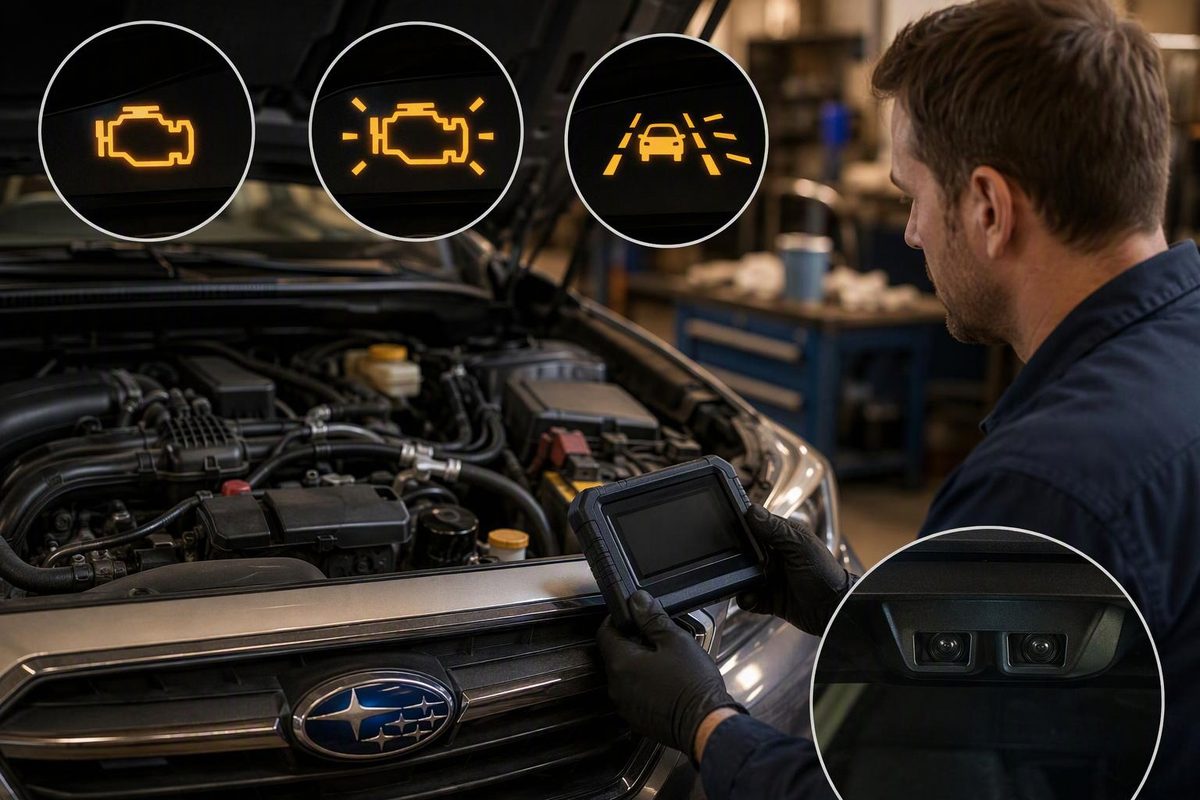
Sort steady and flashing Subaru engine lights, interpret cruise and EyeSight warnings, and choose the next diagnostic test before paying for replacement parts.
A flashing Subaru check engine light means ease off the accelerator and reach a safe stopping place; persistent flashing or rough running calls for a tow. A steady light with smooth running calls for prompt diagnosis, not unrestricted driving. Severe symptoms or an oil-pressure warning mean stop safely and shut the engine off, regardless of the engine-light pattern. Read the codes before buying parts—and distinguish a flashing engine light from a flashing cruise indicator.
Select the engine-light pattern and symptoms to get your next action.
Engine-Light Driving Triage
Arrange Prompt Diagnosis
If your exact model’s manual permits continued travel, keep it short and gentle. Avoid high speed, heavy acceleration and towing.
Save codes and freeze-frame data before clearing anything. A steady light is not permission for normal driving.
Severe symptoms: severe shaking, stalling, substantial power loss, overheating, smoke, strong fuel odor or knocking. Stop safely and shut the engine off if any occur. Do not operate the engine with an oil-pressure warning.
Source: cited Subaru Legacy/Outback owner’s manual; conservative triage guidance in this article. Follow your exact model and year’s manual.
When to Stop or Limit Driving
Subaru’s cited Legacy/Outback owner’s manual distinguishes a steady light, indicating an emissions-control malfunction, from a blinking light, indicating a detected misfire that may damage the emissions system. For blinking, it directs drivers to reduce speed, avoid hard acceleration and steep uphill grades, reduce cargo if possible, and stop towing as soon as possible on the Outback. Both conditions require immediate inspection. Follow the instructions for your exact model and year. Subaru owner’s manual, warning-light and fuel-cap guidance
Use this conservative triage guide rather than treating a steady light as permission for normal driving:
| Warning or Symptom | Next Action |
|---|---|
| Steady light; smooth running, normal temperature and power, no unusual odor or noise | Arrange prompt diagnosis. If your manual permits continued travel, keep it short and gentle. Avoid high speed, heavy acceleration and towing. |
| Flashing engine light | Ease off the accelerator and reach a safe stopping place. If flashing persists or the engine runs roughly, arrange a tow. |
| Either pattern with severe shaking, stalling, substantial power loss, overheating, smoke, strong fuel odor or knocking | Stop safely, shut the engine off and seek assistance. |
| Oil-pressure warning while the engine runs | Stop safely and shut the engine off. Do not keep running it to investigate the check engine light. |
The cited Subaru manual explicitly warns against operating the engine with the oil-pressure warning illuminated. A normal dipstick level does not establish normal oil pressure.
If the engine light flashed and then became steady, record that history. The flashing stopping does not establish that the fault is repaired; see what to do when a check engine light stops flashing.
Cruise and EyeSight Warnings Can Accompany an Engine Fault
Several dashboard warnings do not necessarily mean several components failed.
Engine light plus flashing cruise indicator: the 2023 Impreza manual documents that the cruise indicator flashes when the check engine light illuminates on models equipped with that indicator. It directs the driver not to use cruise control, to avoid high-speed driving and to obtain inspection promptly. A flashing cruise indicator is not the same warning as a flashing engine light. 2023 Impreza owner’s manual
Engine light plus EyeSight warning: Subaru’s cited EyeSight supplement states that EyeSight cannot be used when there is an abnormality with the engine or related systems. Diagnose the engine fault before concluding that the camera needs replacement. Do not rely on EyeSight while it is disabled. Subaru EyeSight supplement
Photograph every warning and message. Do not assume a red brake warning or another critical warning is merely a side effect of the engine fault. If additional warnings remain after the engine repair, have those systems scanned with a Subaru-capable tool.
Check the Fuel Cap, Then Save the Scan Data
If the light appeared after refueling, park safely and switch the engine off. Remove and reinstall the fuel cap, checking for an obstructed seal, and tighten it until it clicks. The cited Legacy/Outback manual notes that a loose or missing cap can illuminate the light and that it may take several driving trips to go out after tightening. This is a worthwhile check, not proof that every Subaru warning is a cap problem.
Before clearing anything, save the evidence that will guide diagnosis:
| Evidence | What to Record |
|---|---|
| Trouble codes | Exact codes and their displayed status: pending, confirmed/stored or permanent, if supported |
| Freeze frame | Available engine RPM, vehicle speed, coolant temperature, load and fuel trims |
| Vehicle history | Model year, engine, mileage and recent repair or refueling history |
| Fault conditions | Cold start, warm idle, acceleration or steady road speed |
Freeze-frame data captures operating conditions when a fault was detected. Clearing codes can erase that snapshot, so export it or take screenshots first. OBD Auto Doctor’s freeze-frame documentation
Let the Code Choose the Test, Not the Part
The Subaru of America bulletins below are model-specific examples, not procedures for every Subaru. Have the shop confirm applicability and check current Subaru service information before using them.
EVAP Codes Need Testing That Protects the Leak-Check Module
After checking the cap, follow the exact code’s diagnostic procedure. Do not automatically buy a cap, purge valve or leak-check module.
For the Electronic Leak Check Module systems covered by Subaru’s 2022 TechTIPS, Subaru specifies a forced EVAP self-test with recorded and graphed results as the first diagnostic step. It warns not to introduce pressure or smoke into the ELCM, because smoke residue can contaminate it. The document includes model-year exceptions and excludes STI from that test method. Leave testing to a shop with the correct procedure and equipment if you cannot isolate and protect the module. Subaru EVAP diagnostic guidance
P0300–P0304 Require Finding the Cause of the Misfire
These misfire codes are not a spark-plug or ignition-coil shopping list. Use the recorded conditions and cylinder-specific misfire data to guide ignition inspection and testing. If ignition checks do not establish the cause, investigate fuel delivery, air leaks and cylinder sealing using the applicable service procedure. Do not deliberately reproduce a severe misfire on the road.
Check model-specific bulletins, too. Subaru bulletin 11-206-25, dated April 8, 2025, covers 2024–2025 Impreza and Crosstrek with the 2.5-liter engine. It addresses rough idle and P0300–P0304 with an ECM update that improves injection timing when carbon has accumulated on intake valves or injectors; Subaru specifies installation in conjunction with carbon-cleaning bulletin 02-193-24R. Ask the shop to check the existing calibration and current procedure—not simply replace coils or assume software alone is the repair. Subaru misfire bulletin
P0420 Does Not Automatically Condemn the Converter
For its listed models, Subaru’s 09-110-23R P0420 procedure starts with a general inspection and a scan for related misfire, fuel-mixture and sensor codes. It then checks oil level, exhaust condition and leaks, and air/fuel-sensor response before specified replacement decisions and monitor verification. Its test limits vary by engine and model year. Subaru P0420 diagnostic bulletin
Ask for those findings before approving a converter. For the broader test sequence, see check engine light and catalytic converter diagnosis.
Verify the Repair Before Calling the Fault Fixed
After repairing the demonstrated fault, follow the applicable verification procedure and rescan. Check for returning codes, normal operation under the original fault conditions, and completion of the relevant monitor.
Do not disconnect the battery simply to extinguish the light. Battery disconnection or code clearing can leave emissions readiness monitors incomplete; an extinguished light immediately afterward is not proof of a successful repair. New York DMV explanation of readiness resets