
Why P0420 Does Not Automatically Condemn the Catalytic Converter
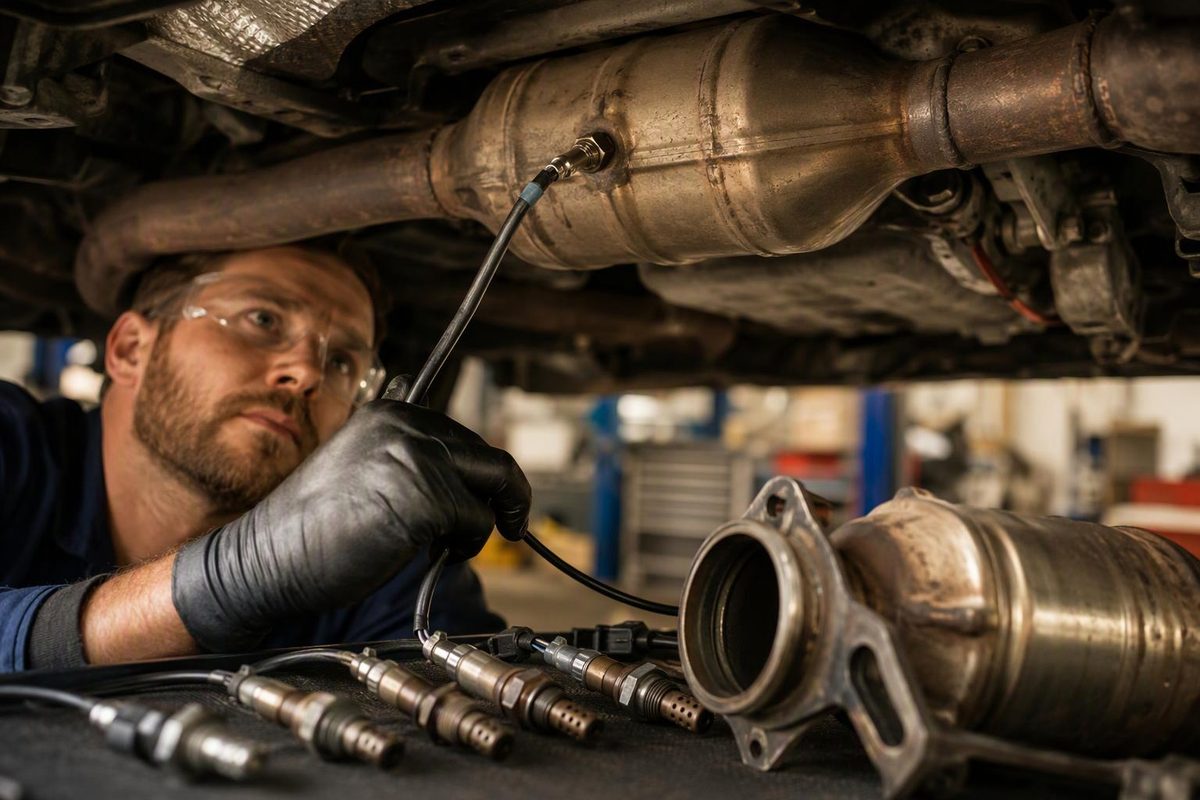
A P0420 or P0430 can flag low catalyst efficiency without proving converter failure. Follow a test order for codes, leaks, sensors, and OEM monitor data.
A check-engine light with P0420 or P0430 means the engine computer judged catalyst efficiency below its calibrated threshold. It does not prove that the catalytic converter is clogged, that an oxygen sensor is bad, or that the converter should be replaced immediately.
- P0420: Catalyst system efficiency below threshold, bank 1
- P0430: Catalyst system efficiency below threshold, bank 2
Bank 1 is the side containing cylinder No. 1; an inline engine normally has only one bank. Confirm the engine, model year, and manufacturer’s code definition in the correct service information before testing.
Choose the light, symptoms, and companion-code status to see the next step.
Recommended Next Step
Retrieve and save all codes and freeze-frame data before clearing anything.
The default selections do not establish whether the converter has failed.
Basis: the diagnostic sequence and manufacturer bulletins cited in the article; exact tests and limits remain vehicle-specific.
First Decide Whether to Drive
A steady light with normal power, temperature, and engine operation usually allows time to retrieve the codes. A flashing light commonly accompanies a misfire severe enough to threaten the converter. Ease off the throttle, reach a safe stopping place, and follow the vehicle manual; see what a flashing check-engine light means.
Stop rather than continue testing on the road if the vehicle is overheating, shaking severely, smoking, losing substantial power, or producing a strong burning odor.
Diagnose P0420 or P0430 in This Order
1. Save the Complete Scan Before Clearing Anything
Record:
- All stored, pending, and permanent DTCs
- Freeze-frame data for P0420 or P0430
- Which bank failed
- Fuel trims, coolant temperature, and loop status
- Misfire counts, if the scan tool exposes them
- Catalyst- and oxygen-sensor-monitor status
Do not disconnect the battery or clear the code yet. That erases useful operating conditions and resets readiness monitors. The catalyst monitor may then require a specific drive cycle before it reports again.
2. Diagnose Companion Codes First
Misfire, rich/lean, air-fuel-sensor, oxygen-sensor-heater, and circuit codes can affect catalyst monitoring or identify the fault that damaged the converter. Subaru’s P0420 procedure for specified 2017–2023 models, for example, directs technicians to diagnose listed misfire, mixture, and sensor codes before continuing. It also calls for checks of engine condition, exhaust leakage, physical damage, and sensor operation before the diagnosis is complete (Subaru bulletin 09-110-23).
If another code identifies an active combustion, mixture, or sensor fault, repair and verify that fault before judging the converter. A replacement converter may be damaged again if the underlying misfire, oil consumption, or fueling problem remains.
Vehicle-specific information matters. For eligible 2017–2019 Honda Pilot and Ridgeline and 2018–2019 Odyssey vehicles, Honda documented PCM interpretation and fuel-injector problems associated with P0420/P0430 and related codes. For P0420 or P0430 alone, its bulletin calls for a cylinder air-fuel test rather than automatic converter replacement (Honda service bulletin 21-010). Do not generalize that repair to other vehicles; use the VIN to check applicability.
3. Check for Leaks and Engine Problems
With the exhaust cold, inspect from the cylinder head through the downstream sensor on the affected bank. Look for:
- Soot at manifold, flange, and flex-joint leaks
- Cracked pipes or converter shells
- Loose fasteners and damaged gaskets
- Melted, stretched, or contaminated sensor wiring
- Evidence of oil or coolant consumption
An exhaust leak can admit outside air and affect sensor readings. Do not dismiss a suspected leak merely because it is quiet. If it is near the cylinder head, use the checks in Exhaust Manifold Leak: Symptoms, Tests, and Repairs.
Land Rover’s published P0420 guidance for specific 2.0-liter Discovery Sport and Range Rover Evoque models likewise requires checks for exhaust leaks, unmetered intake air, misfire, and oil consumption. It says not to replace oxygen sensors or other components that pass their individual tests (JLR SSM74404).
4. Test the Sensors Instead of Inferring Failure
A catalyst monitor uses sensor information, but a catalyst-efficiency code is not an oxygen-sensor circuit code. Check the applicable wiring, heater operation, bias or reference circuits, and sensor response with the OEM procedure.
Avoid a universal rule that the sensor must switch from 0.1 to 0.9 volts. Many newer vehicles use a wide-range air-fuel sensor upstream, and a scan tool may display current, lambda, or a scaled value instead of traditional narrowband voltage. Compare the correct parameter with the manufacturer’s test.
A downstream waveform resembling the upstream waveform may support a weak-catalyst diagnosis, but only after leaks, mixture control, and sensor faults have been excluded. Subaru’s procedure shows why an active test can be stronger evidence: it commands an injection-quantity change and checks whether the front air-fuel sensor reaches the target. It separately checks the rear-sensor harness for an intermittent response.
Replace a sensor when its specified circuit, heater, or response test fails—not merely because P0420 appeared beside its live-data graph.
5. Follow the Exact Catalyst-Monitor or Mode $06 Procedure
If the OEM diagnostic path calls for a catalyst-monitor check, meet the stated enable conditions and read the specified result. Required temperature, speed, fuel level, deceleration events, test IDs, scaling, and pass/fail limits vary by calibration.
There is no responsible universal Mode $06 threshold. Subaru bulletin 09-110-23 lists different limits by engine, model year, and, in one case, transmission. It also requires a prescribed drive pattern before reading the catalyst-deterioration result. Use the test ID, scaling, and limit for the exact vehicle—not a number copied from another make.
Check current service bulletins before buying parts. Ford documented a high-sulfur-fuel condition on certain 2.7-liter EcoBoost F-150, Expedition, and Navigator vehicles. Its procedure records Mode $06 oxygen-storage values, performs a one-time sulfur-removal cycle, and then collects new data; replacement follows only if the specified result does not pass (Ford TSB 22-2260). The cycle includes repeated wide-open-throttle acceleration and is a model-specific service procedure, not a generic DIY converter-cleaning method.
P0420 Does Not Prove the Converter Is Clogged
Efficiency and restriction are different faults. A chemically degraded converter may flow freely but fail the catalyst monitor. A restricted exhaust may cause poor power under load, excessive back pressure, or an abnormal manifold-vacuum response without initially setting P0420.
If the complaint includes severe power loss under load, test for restriction separately. A pressure gauge installed at an appropriate upstream test point can confirm excessive back pressure, but the allowable pressure and test RPM must come from service information for that engine. Then isolate whether the restriction is in a front converter, downstream converter, muffler, or damaged pipe. Follow the fuller procedure in Clogged Catalytic Converter Signs: How to Confirm.
An infrared temperature comparison, odor, or glowing shell can provide a clue, but none reliably identifies catalyst efficiency or the location of a restriction by itself.
When Converter Replacement Is Supported
The vehicle-specific diagnostic tree—not a generic checklist—should determine the final repair. A defensible diagnosis will normally document:
- The exact code, engine, and affected bank.
- The status of related misfire, mixture, and engine-mechanical faults.
- Inspection or testing of the monitored exhaust section for leaks.
- Results for the relevant sensors and circuits.
- The OEM test result or physical finding that condemns the converter.
- Any applicable software updates, recalls, campaigns, or bulletins checked by VIN.
Before authorizing repair in the United States, check the warranty booklet and original sale date. EPA identifies catalytic converters as major emission-control components covered by the federal design-and-defect warranty for 8 years or 80,000 miles, whichever occurs first. The separate performance warranty has additional conditions tied to an approved emissions-test failure. Follow the manufacturer’s claim procedure through an authorized representative, and check for longer state or manufacturer coverage (EPA emissions-warranty guidance).
The final diagnosis should name the failed system and the test result supporting it. “P0420, needs cat” is a code description followed by an assumption—not a completed diagnosis.