
What Toyota’s Crank-Pulley Hammer Test Actually Measures
Learn what Toyota’s Tundra plastic-hammer test measures, how dealers collect three valid strikes, and what OK, Replace, or invalid results mean.
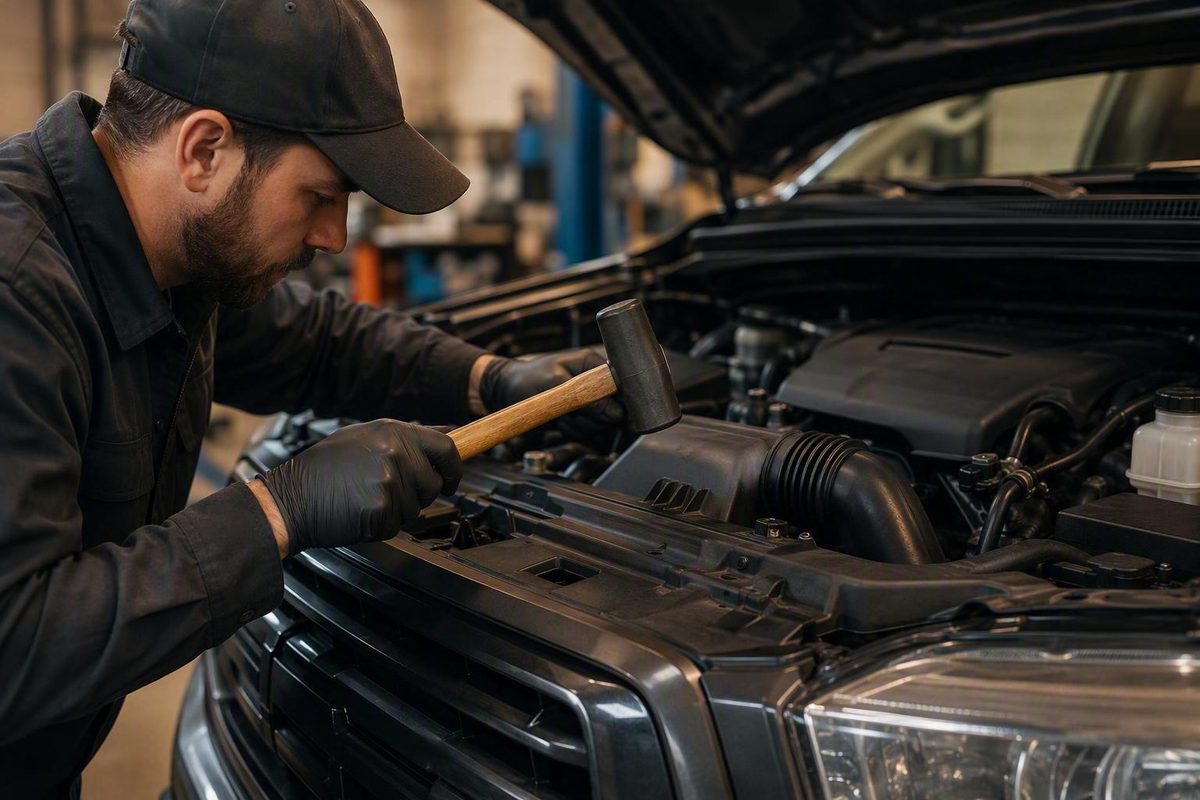
Toyota’s Tundra hammer test checks the No. 1 crankshaft main bearing indirectly on certain 2022–2024 trucks with the V35A twin-turbo V6. A technician strikes the crankshaft pulley with a purpose-built plastic hammer while an accelerometer measures the resonant response at the front of the crankshaft. Toyota’s analysis then returns either “OK” or “Replace” after three valid strikes.
The technician is not listening for a good or bad noise. The hammer provides a controlled input; the accelerometer and diagnostic system measure the resulting vibration. Toyota developed the inspection by comparing engines with and without abnormal No. 1 main-bearing wear, according to The Drive’s report on Toyota’s explanation.
The bearing remains inside the assembled engine. It is not uncovered, photographed or visually inspected. The procedure uses the crankshaft assembly’s resonant behavior to decide whether the covered engine can remain in service under the campaign or must be replaced.
Follow the dealer sequence, explore what the resonance comparison can and cannot show, then mark the records to request.
Review the ten dealer steps, test the limits of the resonance concept, and track the documentation you can request.
This qualitative sandbox shows only that changed bearing support can move resonant behavior away from a reference. It does not predict the direction, frequency, bearing clearance or Toyota result. No public formula or numerical cutoff is available.
| Displayed Status | What It Establishes | What It Does Not Establish |
|---|---|---|
| OK | Replacement is not required under this inspection. | It is not a lifetime guarantee or inspection of every bearing. |
| Replace | The engine cannot be cleared under the procedure and is designated for replacement. | It does not necessarily mean a bearing was visually inspected or found destroyed. |
| Weak/Strong/Doubled | The impact is unusable and must be repeated. | It is neither a pass nor a failure. |
| Serious Symptoms | The truck needs dealer attention and diagnosis. | The screening test does not diagnose every cause of knock, rough running or power loss. |
Source note: Toyota-attributed procedure details summarized in the article’s cited reporting. Exact frequencies, thresholds, accuracy rates and a clearance-to-frequency formula have not been publicly disclosed.
The Test Targets One Front Main Bearing
Toyota-attributed explanations identify the No. 1 main bearing, not every crankshaft bearing, as the inspection target. This bearing supports the crankshaft near the front of the engine, where the accelerometer is attached at the crankshaft bolt.
The campaign addresses a reported manufacturing concern involving machining debris that may remain in certain engines. Debris circulating with the oil can damage crankshaft main bearings. This is a potential condition within the affected vehicle population, not proof that every V35A engine contains debris or will fail.
Main bearings support the crankshaft in the cylinder block while allowing it to rotate. Engine oil maintains separation between the crankshaft journals and bearing surfaces. Debris entering that closely controlled interface can damage a bearing surface, disturb the intended oil-supported separation and contribute to further bearing or crankshaft wear. SlashGear summarizes the debris concern and bearing inspection.
Reported symptoms associated with the underlying engine problem include engine knocking, rough running, a no-start condition and loss of motive power. The hammer test does not directly detect debris, identify every possible cause of those symptoms or evaluate every bearing.
Dealers Must Prepare the Engine Before Striking It
The reported inspection is a controlled dealership procedure rather than a mechanic tapping the pulley and judging its sound. The applicable Toyota instructions govern the exact preparation for each vehicle.
The reported sequence is:
- Change the engine oil.
- Bring the engine to the temperatures specified by the procedure.
- Remove the accessory belts.
- Put the crankshaft in the required position.
- Attach an accelerometer at the crankshaft bolt.
- Strike the crankshaft pulley at the reported 3 o’clock position with the specified plastic hammer.
- Let the diagnostic software grade the impact quality.
- Repeat the process until three acceptable measurements have been collected.
- Send the measurements and available vehicle data to Toyota’s system for analysis.
- Receive an “OK” or “Replace” disposition.
Reports say the software can grade an impact as good, too weak, too strong or doubled. A rejected impact must be repeated. It is not evidence that the bearing passed or failed; it means the impact was unsuitable for analysis.
Three valid measurements are required before Toyota’s system reaches an engine disposition. This strike validation matters because a controlled impact must be repeatable enough to support a comparison with Toyota’s reference data.
Resonant Frequency Changes Can Reveal Changed Support
A plastic-hammer strike sends a brief pulse of energy into the crankshaft assembly. The assembly vibrates in response, and the accelerometer records that motion. Its response can then be compared with patterns established during Toyota’s development work.
A tuning fork is a simplified analogy. Its mass, shape and stiffness give it a characteristic response when struck. Change the physical system, and its resonant behavior can change. An engine’s crankshaft, bearings and block are far more complex, but the diagnostic principle is similar: apply a controlled input and measure the response.
A bearing inside the engine can influence a sensor at the front because the crankshaft, bearings and block act as a connected mechanical assembly. A change in bearing clearance, support or condition can alter the assembly’s resonant response at the crankshaft front.
That does not mean an owner can listen for a special ring. Audible sound may accompany the strike, but the useful signal comes from the accelerometer and Toyota’s analysis—not a technician’s ear.
Public reporting does not disclose the exact frequencies, waveform features, amplitudes or numerical thresholds used to produce “OK” or “Replace.” It also does not disclose a formula that converts a measured frequency into bearing clearance. Any claimed do-it-yourself cutoff would therefore be speculation.
The diagnostic chain is specific:
- Input: Controlled strike with the specified plastic hammer
- Sensor: Accelerometer installed at the crankshaft bolt
- Signal: Resonant response of the connected crankshaft assembly
- Analysis: Strike validation followed by Toyota’s decision process
- Target: No. 1 main-bearing condition in relation to the campaign concern
Removing any of those controls changes the test. A phone accelerometer, ordinary hammer or consumer vibration meter cannot reproduce the validated procedure or access Toyota’s comparison and decision system.
“OK” And “Replace” Are Campaign Dispositions
Once three valid strikes have been analyzed, there is no publicly described monitor or borderline engine category. The returned engine disposition is “OK” or “Replace.” A bad strike is separate because it is a measurement-quality problem, not an engine result.
| Result | Meaning | Next Step |
|---|---|---|
| OK | Analysis does not require replacement under this inspection | Engine remains in service under the campaign disposition |
| Replace | Analysis cannot clear the engine under the procedure | Engine assembly is designated for replacement |
| Invalid strike | Impact was weak, strong, doubled or otherwise unusable | Repeat it until three valid measurements are obtained |
Toyota-attributed reporting describes replacement as necessary when the analysis cannot confirm that the No. 1 main bearing will remain free of abnormal wear associated with the recall issue. That does not necessarily mean the test found a visibly destroyed bearing. It means the engine could not be cleared under the decision rules. Road & Track reports Toyota’s explanation of the replacement standard.
An “OK” result is equally narrow. It means engine replacement is not required based on this inspection. It does not prove that every internal bearing was separately examined, guarantee future reliability or clear an unrelated engine problem.
Published reporting does not provide pass/fail frequencies, false-positive rates, false-negative rates or long-term accuracy figures. There is not enough public data to call the procedure perfectly accurate or inherently unreliable.
Owners Can Verify Records, Not Recreate The Measurement
An owner can verify that the correct campaign was identified for the VIN, ask whether the crank-bearing inspection applies and retain the final repair order. An owner cannot independently validate the resonant-frequency result using driveway tools.
Ask the service writer to identify:
- The campaign open for the truck’s VIN
- Whether it calls for the V35A Crank Bearing Inspection
- Whether three acceptable strikes were obtained
- Whether the final disposition was “OK” or “Replace”
- What completed campaign and result will appear on the repair order
- What remedy follows if the result is “Replace”
Public reporting does not establish whether owners can obtain raw accelerometer measurements, frequency plots or Toyota’s underlying analytical data. Ask, but do not assume those records are available.
Do not strike the pulley yourself. An ordinary hammer can introduce an uncontrolled impact, while a phone or standalone sensor lacks the required engine preparation, crankshaft position, sensor installation, strike-quality checks, reference data and Toyota analysis.
Active Symptoms Require Diagnosis Beyond The Screening Test
The campaign inspection decides whether a covered engine can be cleared or requires replacement under the specified process. It is not a universal diagnostic test for an engine already knocking, stalling or refusing to start.
Contact a Toyota dealer promptly if the truck develops new or worsening knock, rough running, severe abnormal vibration, stalling, loss of power or a no-start condition. Provide the VIN, mileage, warning-light information, when the symptom began and whether the truck stalled or lost motive power.
A recording can help communicate an intermittent noise, but it cannot replace diagnosis. Do not repeatedly run an abnormally operating engine merely to see whether the symptom disappears. Ask the dealer how the truck should be brought in based on its condition; the supplied evidence does not establish one universal towing or no-drive rule for every symptomatic vehicle.
Symptoms do not automatically guarantee replacement. The dealer must confirm the applicable campaign status and follow the current diagnostic and remedy instructions for that VIN. Likewise, an “OK” result does not diagnose accessory-drive noise, misfires, low oil pressure or every other cause of rough operation.
VIN Lookup Determines Whether A Tundra Is Covered
Third-party reporting associates the inspection with certain 2022–2024 Tundras equipped with the V35A twin-turbo V6. Model year and engine family alone do not establish that a particular truck receives the test.
For a U.S.-market vehicle, enter the 17-digit VIN—or the license plate and issuing state—into Toyota’s official recall and campaign lookup. Owners outside the United States should use Toyota’s regional recall resource or contact a local dealer.
If an open item appears, ask the dealer whether it requires the V35A Crank Bearing Inspection, whether anything must be done before the appointment, how long the truck is expected to remain and what paperwork will document the result.
Toyota distinguishes among Safety Recall, Special Service and Limited Service campaigns. Toyota says Safety Recall inspections and repairs are performed at no charge to the owner. That statement should not be extended to unrelated diagnosis, non-covered repairs or every other campaign category.
An empty lookup result is not an engine-health assessment. Contact a dealer if the engine has symptoms even when no open item appears. If campaign work was previously completed, retain the repair order and provide it if knocking, rough running, stalling, power loss or a no-start condition later develops.
Used-truck shoppers should run the VIN and review the service records before purchase. A repair order identifying the completed work is stronger evidence than a seller’s verbal statement. Campaign completion does not replace a normal pre-purchase inspection because this procedure does not evaluate the entire truck.
An Older Tundra Frame Hammer Test Is Different
On first-generation and other older Tundras, “hammer test” can instead mean lightly tapping the frame to locate corrosion-thinned, softened or perforated steel. That check has no connection to the V35A crank-bearing inspection.
| Test | Target | Method | Result Type |
|---|---|---|---|
| V35A engine test | No. 1 main bearing | Pulley strike, accelerometer and analysis | OK, Replace or repeat strike |
| Older-frame check | Frame rails and mounts | Light tapping plus visual inspection | Qualitative suspect area |
Frame tapping relies on changes in sound and material response, followed by closer inspection. Large flakes, obvious softness or penetration are more direct warning signs than sound alone. A sharp sound does not certify structural integrity, and a dull response alone does not prove that replacement is required.
If light tapping releases large flakes, reveals softness or opens a hole, the frame needs professional assessment. Avoid aggressive striking, particularly on a frame that may already be weakened, and obtain permission before touching a seller’s vehicle.
The location and measuring equipment identify which “hammer test” is being discussed. A plastic hammer at the crankshaft pulley with an accelerometer indicates the V35A bearing inspection. Tapping frame rails while looking for flakes, softness or perforation is a preliminary corrosion screen.