
Map Every 2JZ-GE VVT-i Plug and Cylinder
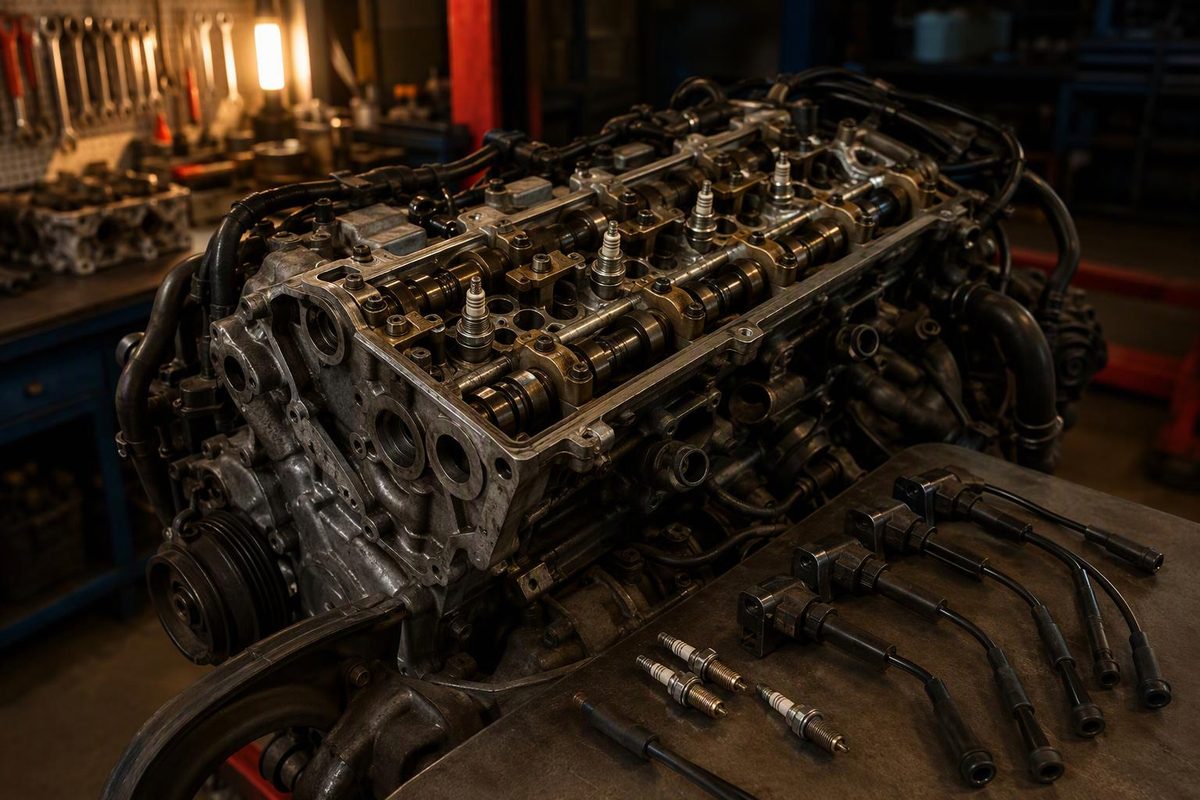
Find each 2JZ-GE VVT-i plug position, decode P0301–P0306, and trace the stock Lexus IS300 coil and high-tension-lead pairings.
On a longitudinal 2JZ-GE VVT-i, cylinder and spark plug No. 1 are at the front, on the timing-belt and crank-pulley end. The numbers run straight back as 1-2-3-4-5-6, ending with No. 6 at the transmission end. In a stock Lexus IS300, No. 1 is nearest the radiator and No. 6 is nearest the firewall.
Use the engine itself as the reference. On a swap, the timing-belt end remains the No. 1 end even if the engine’s relationship to the radiator, firewall or body differs from the original IS300 installation.
Choose a cylinder or misfire code to see its plug position, ignition connection and paired cylinder.
2JZ-GE VVT-i Cylinder And Ignition Lookup
Choose a cylinder from 1 through 6.
Cylinder 1 is the front plug at the timing-belt end.
It is reached by the high-tension lead from factory coil No. 1, physically mounted over cylinder 6.
Ignition pair: cylinders 1 and 6.
Source: Toyota 2JZ-GE ignition documentation and the 2005 Lexus IS300 ignition manual.
Cylinder Numbers Run From Front To Rear
Each spark plug has the same number as the cylinder containing it. There is no separate plug numbering sequence:
| Cylinder | Engine Position | IS300 Reference |
|---|---|---|
| 1 | Timing-belt end | Nearest radiator |
| 2 | Second from front | — |
| 3 | Third from front | — |
| 4 | Third from rear | — |
| 5 | Second from rear | — |
| 6 | Transmission end | Nearest firewall |
This layout is the reliable reference when a valve cover, intake component or wiring arrangement makes the middle cylinders difficult to distinguish. Start at the timing-belt end, identify No. 1 and count each plug opening toward the transmission.
Do not start counting from whichever end is easiest to reach. That can reverse every diagnosis: an actual No. 1 misfire becomes an assumed No. 6 problem, No. 2 becomes No. 5, and No. 3 becomes No. 4. The scan code, plug well and ignition connection must all be matched to the same physical cylinder number.
Cylinder Order Is Not The Firing Order
The two relevant sequences describe different things:
- Physical cylinder order: 1-2-3-4-5-6 from the timing-belt end to the transmission end
- Firing order: 1-5-3-6-2-4
The firing order is the sequence in which the cylinders produce power. It does not describe the physical positions of the plugs, coils or plug leads. Toyota’s 2JZ-GE ignition documentation gives the firing order as 1-5-3-6-2-4 (Toyota 2JZ-GE ignition-system manual).
For example, cylinder 5 fires after cylinder 1, but cylinder 5 is not the next plug behind cylinder 1. Physically, cylinders 2, 3 and 4 sit between them. Likewise, the final number in the firing order, cylinder 4, remains the fourth cylinder from the front.
Do not route the high-tension leads along the valve cover in 1-5-3-6-2-4 order. Each lead must terminate at the plug for its assigned physical cylinder. The firing order is useful for understanding operating sequence, but the front-to-rear cylinder map controls plug identification and misfire-code location.
The Stock IS300 Uses Three Coils And Three Leads
The stock 2001–2005 Lexus IS300 2JZ-GE VVT-i does not have six separate coil-on-plug units. It uses three ignition coils and three high-tension leads. The factory procedure identifies three coil connectors, three coils and a high-tension-cord assembly (2005 IS300 ignition manual).
Each coil sits directly over an even-numbered spark plug and connects to a companion cylinder through a high-tension lead:
| Coil Location | Direct Plug | Lead-To Plug | Cylinder Pair |
|---|---|---|---|
| Over cylinder 2 | 2 | 5 | 2 and 5 |
| Over cylinder 4 | 4 | 3 | 3 and 4 |
| Over cylinder 6 | 6 | 1 | 1 and 6 |
This means plugs 2, 4 and 6 are directly beneath coils. Plugs 1, 3 and 5 receive ignition through leads from the coils over cylinders 6, 4 and 2 respectively.
A plug number therefore does not always identify the physical location of the coil serving it. A P0301 points to the front cylinder and front plug, but that plug is reached by a lead from the coil mounted over cylinder 6 at the rear. A P0305 points to the fifth cylinder, while its lead comes from the coil mounted over cylinder 2.
The complete stock pairing is:
- Cylinder 1 is paired with cylinder 6 and reached by the lead from the coil over No. 6.
- Cylinder 2 is paired with cylinder 5 and sits directly below their coil.
- Cylinder 3 is paired with cylinder 4 and is reached by the lead from the coil over No. 4.
- Cylinder 4 is paired with cylinder 3 and sits directly below their coil.
- Cylinder 5 is paired with cylinder 2 and is reached by the lead from the coil over No. 2.
- Cylinder 6 is paired with cylinder 1 and sits directly below their coil.
Label a removed lead by its destination cylinder, not merely by the coil beside it. That keeps the label tied to the plug the lead must reach when the ignition assembly is reinstalled.
Factory Coil Numbers Do Not Run Front To Rear
The factory coil designations introduce another sequence that must not be confused with cylinder order. On the stock IS300, the physical coil sequence from the radiator toward the firewall is:
| Front-To-Rear Position | Factory Coil | Mounted Over |
|---|---|---|
| 1 | Coil No. 2 | Cylinder 2 |
| 2 | Coil No. 3 | Cylinder 4 |
| 3 | Coil No. 1 | Cylinder 6 |
Consequently, factory coil No. 1 serves cylinders 1 and 6, coil No. 2 serves cylinders 2 and 5, and coil No. 3 serves cylinders 3 and 4. An IS300 forum discussion reproducing and checking the factory diagram reports the same positions and pairings (Lexus IS Forum coil-layout discussion).
Do not call the front physical coil “coil 1” solely because it is the first one encountered. On this system, the front coil is factory coil No. 2. Using only “front,” “middle” and “rear” is clearer during physical inspection; use the factory designation when tracing a diagram or connector circuit.
A useful notation combines all three references. For example, “factory coil No. 2, physically over cylinder 2, serving cylinders 2 and 5” is unambiguous. It prevents a coil designation from being mistaken for either a cylinder number or a front-to-rear position.
P0301 Through P0306 Match Physical Cylinders
A cylinder-specific misfire code uses the physical cylinder number, not that cylinder’s position in the firing order. The codes map as follows:
| Code | Cylinder | Plug Position |
|---|---|---|
| P0301 | 1 | Front, timing-belt end |
| P0302 | 2 | Second from front |
| P0303 | 3 | Third from front |
| P0304 | 4 | Fourth from front |
| P0305 | 5 | Fifth from front |
| P0306 | 6 | Rear, transmission end |
The Lexus diagnostic manual defines P0301 through P0306 as misfires on cylinders 1 through 6 respectively. It lists ignition, injector, fuel-pressure, compression and valve-clearance faults among the possible causes (IS300 service manual).
The code identifies where the misfire was detected. It does not prove that the spark plug, high-tension lead or coil is defective. Replacing the part nearest the coded cylinder without testing can miss a wiring, fuel or mechanical fault.
For P0301, begin at the front plug, but remember that its ignition path includes the lead running from the rear coil over cylinder 6. For P0303, inspect the third plug and its lead from the coil over cylinder 4. For P0305, inspect the fifth plug and its lead from the coil over cylinder 2. The even-numbered cylinders sit directly below their respective coils.
Paired Misfires Change The Test Direction
The factory pairings help organize testing when two cylinder-specific codes appear together. If both cylinders served by one coil are misfiring, their shared ignition components and control path deserve attention:
| Codes Together | Shared Pair | Physical Coil Location |
|---|---|---|
| P0301 and P0306 | 1 and 6 | Over cylinder 6 |
| P0302 and P0305 | 2 and 5 | Over cylinder 2 |
| P0303 and P0304 | 3 and 4 | Over cylinder 4 |
For example, simultaneous P0303 and P0304 codes affect both cylinders served by the coil over No. 4. That pattern supports testing the shared coil, its connector and its control path before treating the two codes as unrelated plug failures.
The pairing is a diagnostic clue, not proof. The service manual’s possible-cause list extends beyond ignition, so two codes do not establish a failed coil by themselves. Confirm the cylinder locations and inspect the shared path before replacing anything.
A single-cylinder code points the first checks differently. If only P0303 is present, cylinder 3’s plug and high-tension lead are unique to that side of the 3-and-4 pair. Cylinder 4’s plug is directly beneath the shared coil. A fault limited to No. 3 can therefore be isolated from a failure affecting both outputs, while injector and mechanical causes remain possible.
The same reasoning applies to the other pairs. P0301 alone directs attention to the No. 1 plug and the lead from the rear coil; P0301 with P0306 makes their shared coil path more relevant. P0305 alone emphasizes the No. 5 plug and its lead; P0305 with P0302 points toward what the pair shares.
Verify Modified And Swapped Ignition Systems Before Rewiring
The cylinder numbering does not change because an engine has been swapped: No. 1 is still at the timing-belt end, and No. 6 is still at the transmission end. Vehicle landmarks can change, however, so “radiator side” and “firewall side” should not replace the engine-based reference outside the stock longitudinal IS300 arrangement.
Modified engines and other 2JZ-GE VVT-i applications may also have different coils, wiring or engine-management arrangements. The three stock IS300 pairings should not be assumed to describe every converted harness or ignition upgrade. Identify the installed hardware and verify its application-specific diagram before moving connector terminals or rerouting leads.
When documenting an unfamiliar setup, record the physical cylinder number first. Then record whether its plug is directly under a coil or reached through a lead, followed by the connector or coil designation shown in the applicable wiring information. Keeping those references separate prevents the 1-2-3-4-5-6 cylinder layout, the 1-5-3-6-2-4 firing order and the factory coil numbers from being mixed together.