
How to Tell Whether Plug Wires Are Causing the Misfire
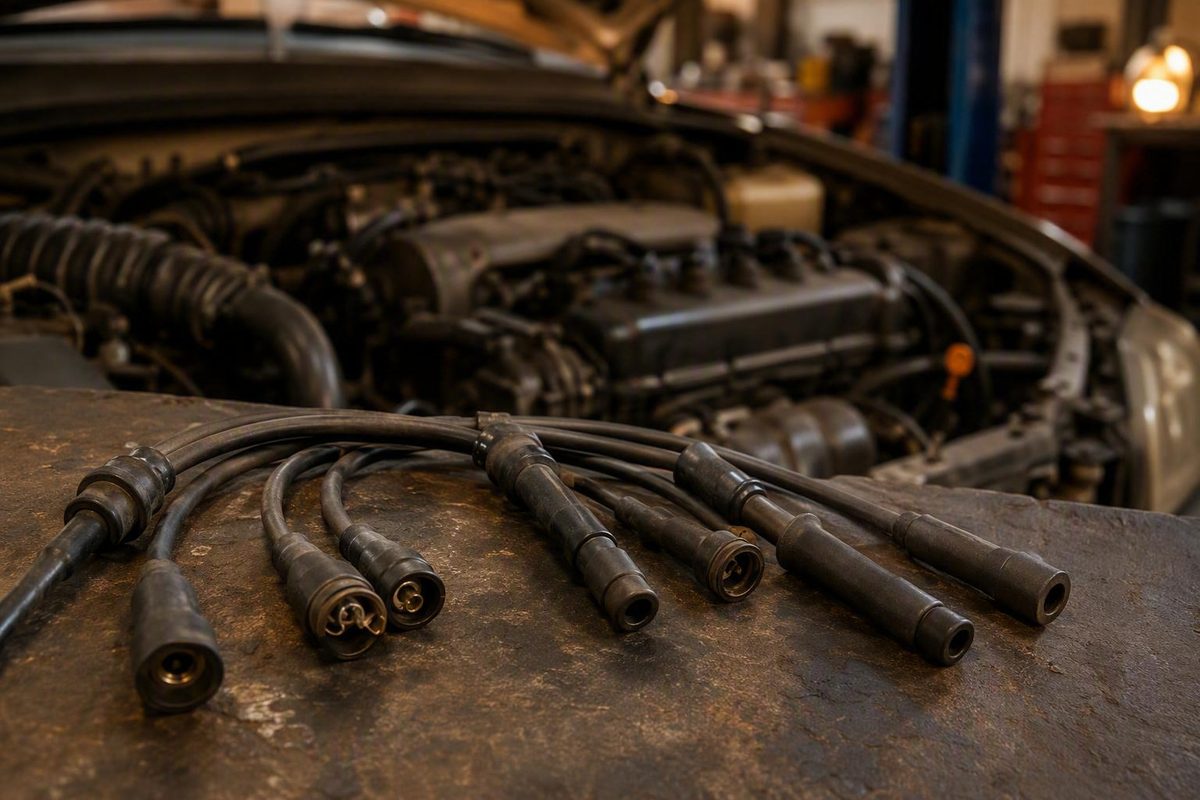
Misfiring, hesitation and stuttering are clues—not proof. Inspect for deterioration, then compare continuity or resistance with vehicle-specific limits.
Faulty spark plug wires are one possible cause of no spark or intermittent spark at an affected cylinder. Misfiring, hesitation, and stuttering can be consistent with that fault, but none proves that the wires are responsible. Begin with an engine-off inspection, compare continuity or resistance readings with service information for the exact vehicle and wire type, and follow the vehicle-specific procedure for using a suitable spark tester. If the wires check out—or replacing them changes nothing—inspect the spark plugs and continue through the applicable ignition, fuel, and mechanical systems.
Symptoms that can point to faulty spark plug wires
The most relevant clue is evidence that spark is absent or intermittent at the affected cylinder. Driving behavior is less specific.
| What you notice | What it may indicate | Proof of bad wires? |
|---|---|---|
| No spark at one cylinder | An open wire, excessive resistance, or another ignition fault | No |
| Intermittent spark | A wire fault or another intermittent ignition problem | No |
| Misfiring | Incomplete combustion caused by an ignition, fuel, or mechanical problem | No |
| Hesitation or stuttering | One or more cylinders may not be contributing consistently | No |
If the wire develops an open circuit or excessive resistance, the plug may receive no spark or only intermittent spark. High-resistance and open ignition wires are listed among the possible causes of no-spark and intermittent-spark conditions in a user-uploaded presentation titled Ignition System Testing and Diagnostics. Its original authorship is not established, so it should not replace the manufacturer’s service information for a particular vehicle.
A forum discussion associates ignition trouble with a misfire becoming more noticeable at higher road speed. That is an anecdotal observation, not diagnostic proof. A speed-related misfire may justify investigating the ignition system, but it does not identify the plug wires as the failed part.
Why symptoms alone cannot confirm bad wires
The same hesitation or stutter can be associated with worn spark plugs, weak coils, distributor components, ignition-voltage problems, pickup-coil or ignition-module faults, valve problems, carburetion, or inadequate fuel delivery. Symptoms can guide the starting point, but testing is needed to distinguish among these possibilities.
The forum discussion provides two useful cautionary examples. In the first, the owner measured and inspected wires described as being in poor condition, replaced them, and reported that the hesitation and stuttering remained. In another participant’s account, a Ford F-150 misfired above 60 mph, but replacing eroded spark plugs—not the plug wires—corrected the problem. Both reports are individual experiences rather than controlled diagnostic evidence, but they show why a high-speed misfire should not be assigned to the wires based on driving feel alone (read the forum discussion).
Even so, replacing a worn-looking component does not establish that it caused the original complaint. The more useful question is whether the repair changed the symptom or corrected a measured fault.
Check the wires before replacing them
- Inspect the wires for visible deterioration. Examine the complete accessible length of each wire without improvising a running-engine test.
- Check continuity or resistance. A multimeter can identify an open circuit and provide a resistance reading.
- Use the exact application specification. Compare the reading with service information for the vehicle and installed wire design.
- Investigate spark with the prescribed equipment. If no spark or intermittent spark is suspected, use a suitable spark tester only as directed by the applicable vehicle procedure.
An open circuit or resistance outside the specified range supports a wire-fault diagnosis. A resistance reading by itself is not meaningful without the correct specification because acceptable results can depend on the application and wire design.
There is no supported universal resistance cutoff for every spark plug wire. The available forum discussion contains conflicting opinions about acceptable resistance and about metal-core versus resistor-type wires. A fixed internet rule should therefore not override the specification for the vehicle and wire set.
External arcing may indicate that voltage is escaping through failed insulation. However, the forum’s suggested water-mist and low-light checks do not include a formal safety procedure.
Spark-tester selection, connection, operating conditions, and interpretation depend on the ignition design. If the exact procedure or safe access is unavailable, stop rather than inventing a connection method. A result obtained under one set of conditions is also only a clue: a normal test does not necessarily exclude an intermittent fault that was not present during the test.
| Test outcome | Meaning | Appropriate next step |
|---|---|---|
| Visible deterioration or observed arcing | The wire warrants investigation | Follow exact service information |
| Open circuit or out-of-spec resistance | The result supports a wire fault | Replace as directed for the application |
| Normal inspection and electrical checks | The wire diagnosis is weaker, not disproved | Continue diagnosis and consider intermittent conditions |
What to diagnose if the wires test correctly
Work through competing causes by system instead of replacing additional parts without test evidence.
Spark plugs
Prioritize the spark plugs because worn plugs can imitate a plug-wire fault. The higher-speed misfire described in the forum discussion was corrected by replacing eroded plugs. Inspect and test the plugs using the procedure and limits specified for the vehicle.
Ignition supply or triggering
Depending on the ignition design, other possible causes of no spark or intermittent spark include:
- Weak ignition coils
- Low or absent coil supply voltage
- Missing coil-negative pulsing during cranking
- Defective pickup coils
- Defective ignition modules
- Distributor-component faults
These components and test points do not exist in the same form on every engine. In particular, coil-voltage and coil-negative pulse checks described for distributor or related electronic ignition systems should not be applied universally. Use the diagnostic sequence for the exact ignition architecture rather than adapting a procedure from a different system.
Fuel delivery
Fuel-delivery and carburetion faults can produce hesitation or stuttering that resembles an ignition problem. If the ignition checks do not identify the cause, investigate the applicable fuel system through the vehicle’s prescribed diagnostic process.
Mechanical condition
Valve problems can also produce uneven operation or hesitation. If the ignition and fuel systems do not explain the complaint, continue with the manufacturer’s mechanical diagnostic procedure rather than assuming that every misfire-like symptom is electrical.
If new spark plug wires did not fix the problem
Do not buy another wire set without new evidence. Return to the original complaint and determine, through the prescribed diagnostic process, whether spark at the affected cylinder is absent, intermittent, or apparently normal when tested.
Recheck the replacement-wire installation according to the exact service information, then use a suitable spark tester if the vehicle procedure calls for one. Treat the result as part of the diagnosis rather than a universal pass-or-fail verdict, especially when the complaint occurs only intermittently or under conditions not reproduced during testing.
Next, inspect and test the spark plugs. Continue with the coil or coils and any applicable distributor, pickup, module, supply-voltage, or triggering components. If the ignition system does not reveal the cause, move to the relevant fuel and mechanical checks.
Persistent symptoms after replacement weaken the original plug-wire diagnosis, but they do not eliminate it by themselves. The decisive evidence is whether application-appropriate inspection and testing identify a wire fault—not whether the wires look old, have already been replaced, or seem like the most likely cause from the driver’s seat.