
Why Diesels Start Without Spark Plugs
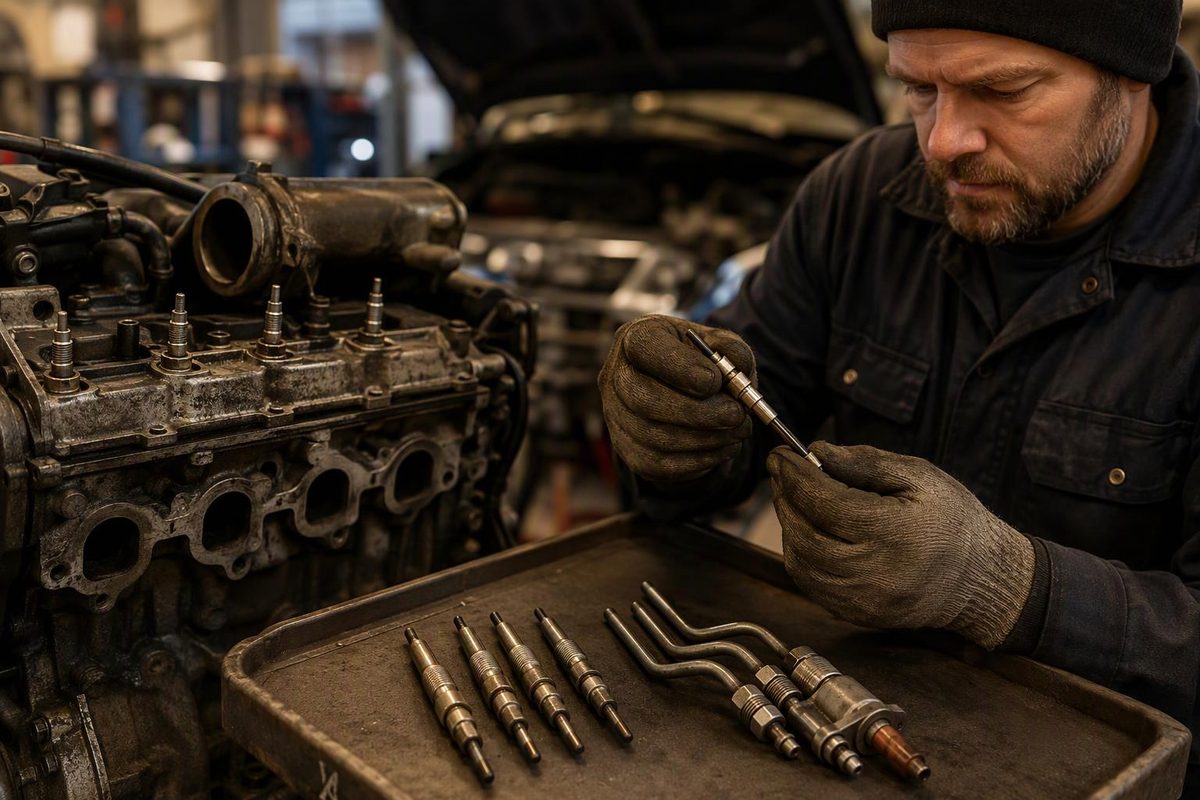
Diesel engines use compression heat, not spark plugs. Compare glow plugs and intake heaters, then follow a safe test order for hard cold starts.
No. A conventional diesel engine does not need or use spark plugs. It compresses air until the air becomes hot, then injects fuel into it. The fuel ignites from compression heat rather than an electrical spark. The U.S. Department of Energy identifies this as the basic difference between spark-ignition gasoline engines and compression-ignition diesel engines (DOE).
A diesel may have glow plugs, but they are heaters rather than spark-producing ignition parts. Other diesels use an intake-air or grid heater. For example, the 2020 Ram 2500/3500 manual describes a cold-start delay associated with the 6.7L Cummins engine’s intake-air heater (Ram owner’s manual). The correct part and test procedure depend on the exact engine.
Choose the symptoms and starting-aid type; the tool identifies the next check.
Diesel Starting-Aid Check
This narrows the next test; it does not identify a failed part without measurements.
Next Check
Identify the starting-aid system, then verify its command and power.
A cold-only problem makes the heater system relevant, but the VIN, engine code and service information must establish whether this engine uses glow plugs or an intake heater.
Sources: U.S. Department of Energy combustion explanation; Bosch glow-plug operating information; 2020 Ram 2500/3500 owner’s manual for the 6.7L Cummins intake-heater example.
Diesel Fuel Ignites From Compression Heat
A gasoline engine generally draws in an air-fuel charge and uses a spark plug to ignite it at a controlled point. A conventional diesel follows a different process: it compresses air, raising its temperature, and then injects diesel fuel into that hot compressed air.
That distinction explains why looking for “diesel spark plugs” leads to the wrong part. A spark plug must create an electrical arc at the correct time for repeated combustion events. A diesel starting aid supplies heat under conditions in which compression alone may not produce enough temperature for a clean, prompt start.
Compression heat depends partly on how effectively the engine turns and seals during cranking. A weak battery, slow starter operation or inadequate compression can reduce the temperature reached in a cold cylinder. That is why long cranking is not proof that a glow plug has failed.
Once a diesel is running normally, continued combustion comes from the compression-ignition process. The presence of glow plugs does not convert it into a spark-ignition engine, and the absence of glow plugs does not mean the engine has no cold-start assistance. Its manufacturer may have chosen an intake heater or another engine-specific strategy.
Spark Plugs, Glow Plugs And Intake Heaters Have Different Jobs
| Component | Common Application | Function |
|---|---|---|
| Spark plug | Spark-ignition gasoline engine | Produces a timed electrical spark |
| Glow plug | Many diesel engines | Heats the combustion area |
| Intake/grid heater | Some diesel engines | Warms incoming air |
A glow plug extends into or near the combustion area and becomes hot when commanded by its control system. It does not arc across a gap once per combustion event. Treating it like an ordinary spark plug can lead to the wrong test, the wrong replacement procedure and damage from applying an unsuitable voltage.
An intake or grid heater works farther upstream. Instead of placing one heating element at each cylinder, this design warms air entering the engine. The 6.7L Cummins example in the Ram manual demonstrates why cylinder count alone cannot determine what should be ordered.
Glow-plug operation is not necessarily limited to the seconds before cranking. Bosch says modern systems can use post-glow during engine operation and regeneration glow to support diesel particulate filter regeneration (Bosch). A glow-system code can therefore appear even when the engine starts, especially when mild weather reduces its need for cold-start assistance.
Not Every Diesel Has Glow Plugs
Many automotive diesel engines use one glow plug for each cylinder, while others use an intake heater or another manufacturer-specific arrangement. The word “diesel” identifies the combustion method, not a universal starting-aid layout.
Confirm the engine before buying parts. Use the VIN, engine code, model year and OEM parts information to determine whether the vehicle has glow plugs, an intake heater or a different system. Two vehicles sold under the same model name can have different engines, and a part listing based only on cylinder count may not establish compatibility.
The dashboard indicator also needs to be interpreted in the context of that engine. A wait-to-start light tells the driver to delay cranking while the control strategy prepares for starting. It does not, by itself, prove that the vehicle has failed glow plugs. On an engine with an intake heater, the delay can relate to that heater instead.
Likewise, the absence of a long wait-to-start period does not establish a fault. Starting-aid duration can vary with operating conditions and control strategy. Diagnosis should begin with the system fitted to the vehicle, not with an assumption about how long an indicator ought to remain on.
Cold-Only Trouble Makes The Starting Aid More Relevant
A diesel that cranks normally but struggles only after a full cold soak presents a different diagnostic pattern from one that also struggles when warm. Cold-only trouble makes the glow-plug or intake-heater system more relevant because the engine has less retained heat available for ignition.
That pattern still does not identify the failed part. Incorrect coolant- or intake-temperature data can cause the controller to choose an unsuitable heating strategy. A shared electrical feed, fuse, relay, controller or high-current connection can also prevent an otherwise serviceable heater from working.
A diesel that cranks slowly needs its battery and cranking system checked before the starting aid is condemned. Slow cranking reduces the compression heat available for ignition. Replacing heater components cannot correct inadequate cranking performance.
If the engine is difficult to start both cold and warm, broaden the test plan. Fuel supply, injector control and engine compression become more prominent possibilities. Cummins lists faulty glow plugs, a defective battery and fuel-system trouble among possible diesel hard-start or no-start causes (Cummins). No one item on that list can be selected from the symptom alone.
Diagnose A Hard-Starting Diesel In A Testable Order
Parts replacement should follow evidence. Preserve the conditions and fault information first, then separate cranking, heater and fuel or mechanical causes.
-
Record when the failure occurs. Note the ambient conditions, whether the engine was fully cold, how long it cranked and whether it starts normally after warming up. A cold-only pattern supports testing the starting aid but does not confirm that it is defective.
-
Scan before clearing codes. Save engine and glow-control fault codes, freeze-frame data and available coolant- and intake-air-temperature readings. On a fully cold engine, compare the indicated temperatures with the actual cold-soak conditions. An implausible input can misdirect the starting strategy even when the heater itself is capable of working.
-
Check cranking performance. Load-test the battery according to the vehicle procedure, measure voltage while cranking and compare cranking speed with the manufacturer’s specification. This separates a weak electrical or starter condition from a heater fault that happens to produce a similar cold-start complaint.
-
Identify the installed starting aid. Use the wiring diagram and OEM service information rather than assuming the engine has glow plugs. Determine whether the circuit controls individual plugs, a common bus, an intake heater or another arrangement.
-
Verify command and power. Inspect the specified fuses, high-current connections, controller or relay, and the glow-plug bus bar or intake-heater circuit. Test both the control command and the power path. A failed shared connection can disable multiple heating elements at once.
-
Test individual components by the OEM method. Glow-plug resistance, current and scan-tool procedures vary with plug and controller design. Use the specified thresholds for that engine. A universal resistance number cannot establish whether every type of glow plug is good or bad.
-
Continue beyond the heater when it passes. Check low- and high-pressure fuel supply, injector control and engine compression against specifications for that exact engine. A successful starting-aid test is evidence to move on, not a reason to replace the parts anyway.
This sequence also helps distinguish one failed heating element from a system-wide supply problem. If every cylinder-related fault appears together, check the common parts of the circuit before assuming that every individual plug failed at the same time. If the shared supply works but one branch differs from the others, follow the manufacturer’s test for that branch and component.
Direct Battery Power Can Damage A Glow Plug
Do not apply battery voltage directly to an unidentified glow plug. Glow-plug designs and control methods vary, so an improvised powered test can damage the plug, create a burn hazard or cause a short circuit.
A resistance test is not automatically safe or decisive merely because it uses a meter. The connector must be identified correctly, the circuit isolated as required and the reading compared with the appropriate specification. Wiring and connector resistance can also affect what is measured from the wrong point in the circuit.
Current testing and scan-tool commands may provide more useful information on some systems, but the correct procedure still comes from service information for the engine. The goal is to verify whether the controller commands the system, whether electrical power reaches it and whether each heating element responds as specified.
Replacement also requires the correct procedure. Glow plugs are installed in the cylinder head, where access and removal conditions differ by engine. Do not treat removal as equivalent to unscrewing an easily reached gasoline spark plug. If testing has not identified a failed plug, removal adds risk without resolving the diagnosis.
White Or Gray Cold-Start Smoke Is A Clue, Not A Verdict
White or gray exhaust during extended cold cranking can indicate unburned fuel. That observation fits a cylinder that is receiving fuel but not reaching suitable ignition conditions, so a failed starting aid is one possibility.
The same appearance can accompany low cranking speed, low compression, injector trouble, incorrect temperature data or inadequate fuel pressure. Smoke color alone cannot identify which condition is present. Pair it with fault codes, live data, measured cranking performance and electrical tests.
The timing matters as well. Brief vapor under cold conditions is not the same diagnostic pattern as persistent smoke after the engine warms. The white exhaust smoke diagnostic guide explains how to separate cold unburned fuel from coolant and normal condensation.
Order Parts Only After Identifying The System
Do not ask for replacement “diesel spark plugs.” Identify the engine and determine whether it uses glow plugs, an intake or grid heater, or another starting aid. Then use its wiring diagram, specifications and test procedure to locate the fault.
If testing identifies one failed glow plug, confirm the manufacturer’s replacement guidance and the condition of the rest of the circuit before deciding the repair scope. If an intake heater is fitted, diagnose its power supply and control path instead of ordering a cylinder-based set of plugs. If the heater system passes, redirect the diagnosis to cranking speed, fuel delivery, injector control or compression.
The practical distinction is simple: spark plugs initiate combustion in spark-ignition engines, while diesel starting aids help create favorable starting conditions for a compression-ignition engine. They are not interchangeable parts, and a hard-start symptom is not enough evidence to replace either one.