
Measure What Is Filling Your DD15 DPF First
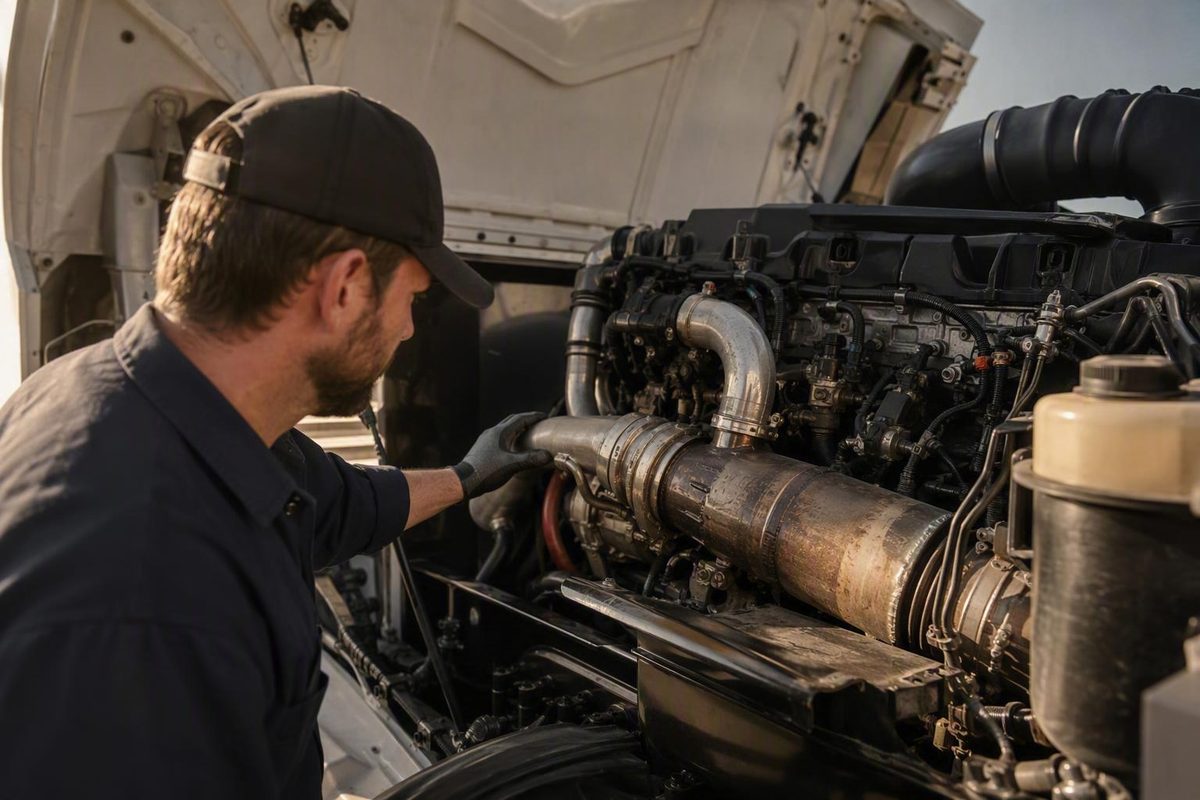
Track regen intervals, soot estimates, pressure and fuel use to distinguish a DD15 Gen 5 calibration concern from a restricted or damaged DPF.
A DPF should not be the first part replaced for DD15 Gen 5 frequent regens. The first move is to document miles between completed regens and how quickly soot and restriction return. A June 26, 2026 lawsuit alleges a calibration defect affects roughly 200,000 trucks, while its plaintiffs say the July 2025 reprogramming response can impose a roughly 2% fuel-economy loss—about $1,400 a year at 100,000 miles. Those are allegations, not findings, but they make one diagnostic distinction financially critical: a new DPF cannot reduce the engine’s soot-production rate (ClassAction.org summary).
Why The Usual DPF Diagnosis Is Reasonable
The conventional diagnosis is not foolish. Frequent regeneration can result from a soot-restricted or ash-loaded DPF, biased pressure or temperature data, leaking injectors, EGR or turbocharger trouble, intake or boost leaks, oil or coolant contamination, interrupted regens, or an idle-heavy duty cycle.
A high-mileage filter can lose usable capacity as noncombustible ash accumulates. Short routes, prolonged idling, light loads and repeated shutdowns can also limit passive regeneration or interrupt active events. If measured restriction remains excessive after soot has been reduced, cleaning or replacement may be justified.
That is where the consensus is right: aftertreatment hardware can fail or become restricted. It is wrong only when the symptom itself is treated as proof of a failed DPF. If the engine is producing soot too quickly, replacing the filter resets capacity without correcting the loading rate.
Detroit does not publish a universal normal mileage between DD15 Gen 5 soot regens in the available DD15 Gen 5 vocational specification sheet. The sheet discusses shorter regen cycles and application-dependent DPF maintenance, but it does not establish a normal distance, time, engine-hour or fuel-use interval between events. The truck’s previous pattern under comparable work is therefore the useful baseline.
Compare The Current Pattern With The Truck’s Own Baseline
Record the odometer or engine hours at each regen, whether the event completed, the route, load, idle percentage and fuel used. A sustained change under similar operation is more meaningful than a generic mileage claim.
The comparison is strongest when it separates three measurements:
| Measurement | What It Answers |
|---|---|
| Miles or hours between regens | How quickly the system calls for soot removal |
| Regen duration and completion | Whether the commanded event finishes |
| Post-regen pressure and soot trend | Whether restriction falls, then how quickly it returns |
If a truck previously completed comparable work between events but now regenerates much sooner, calculate the interval ratio. Moving from 300 miles to 100 miles between completed events is a threefold increase in event frequency. That ratio is not a laboratory soot measurement, because filter capacity, operating conditions and control strategy also affect the interval. It is still valuable evidence that the operating pattern changed.
Enter the truck’s old and current intervals, annual mileage and known costs; the explorer identifies which path the recorded evidence supports.
Compare the truck with its own prior interval. The default example falls from 300 to 100 miles between regens while annual mileage remains 100,000.
| Evidence Pattern | What It Supports | Parts-First Risk | Next Decision |
|---|---|---|---|
| Pressure and soot fall, then return rapidly | Excess soot, changed duty cycle or reduced capacity | Replacement may reload at the same rate | Document interval and test upstream systems |
| Restriction remains high after soot reduction | Ash, contamination, physical restriction or bad data | Replacement without checking contamination source may not last | Verify pressure tubes, filter condition and cleaning history |
| Regens fail or abort | Insufficient heat, interruption, controls or active faults | New DPF may not correct event failure | Capture faults, temperatures and abort history |
| Applicable calibration action is confirmed | Software may affect future engine behavior | Programming cannot remove ash or repair existing damage | Verify calibration and assess hardware separately |
| Repeatable testing confirms permanent restriction or damage | Cleaning or replacement may be justified | Uncorrected soot or contamination can damage the replacement | Correct the upstream cause before release |
Static default: the annual fuel figure is the lawsuit report’s approximately $1,400 benchmark at 100,000 miles. Fuel-price assumptions were not published.
Sources: Detroit DD15 Gen 5 vocational specification sheet; allegations summarized from Fire Chief Transport LLC et al. v. Daimler Truck North America, LLC et al. Figures marked ~ are estimates or reported approximations; — means the source provides no figure.
The calculator deliberately does not invent an aftertreatment quote, fuel price or baseline MPG. The cited report supplies the approximately $1,400 annual figure at 100,000 miles and a claimed 2% economy loss, but it does not disclose the fuel-price and baseline-MPG assumptions behind that estimate. If you enter both fuel price and baseline MPG, the tool can calculate a truck-specific estimate; otherwise it scales the reported benchmark by annual mileage and labels it accordingly.
A Completed Regen Does Not Prove The System Is Fixed
A completed active, parked or service regen can reduce combustible soot. It cannot remove ash, repair a pressure tube, correct a biased sensor, seal a boost leak, restore turbocharger performance, repair EGR operation, correct injector trouble or stop oil and coolant contamination.
When the soot estimate and differential pressure fall during a completed event but rise rapidly afterward, investigate two main paths. The engine may be producing excessive soot, or the filter’s remaining capacity may be low because of ash or contamination. Duty cycle can contribute to either apparent pattern and must be compared with the truck’s prior operation.
When an event fails or stops early, review shutdowns, route length, idle exposure, coolant-temperature behavior, exhaust-temperature response, relevant faults and any available abort information. Repeatedly commanding another service regen can temporarily lower the soot estimate without explaining why the event failed or why the filter reloaded.
Parked and service regens create high aftertreatment temperatures. Whether one is appropriate depends on the truck’s fault state, configuration, measured data and current authorized procedure. They should not be cycled as a substitute for diagnosis.
Soot Rate Separates An Upstream Defect From Filter Capacity
The DPF captures soot produced upstream. If it reloads quickly after a successful event, test the systems that determine combustion and airflow before condemning the filter.
Relevant checks include injector or cylinder performance where supported, commanded-versus-actual EGR behavior, turbocharger response, boost plumbing, intake restriction, air leaks, coolant-temperature behavior and evidence of oil or coolant entering the combustion or exhaust stream. These are diagnostic categories, not declarations that a particular DD15 component has failed.
Pressure and temperature data need the same context. Capture DPF differential pressure under repeatable operating conditions, inspect the sensor tubes and connections, and compare estimated soot load with measured restriction. Review how the exhaust-temperature readings relate to one another before, during and after an event. One unusual displayed value does not by itself condemn a sensor.
The post-regen trend is especially useful:
- If soot estimates and pressure fall, then rise rapidly during similar service, investigate engine-out soot and duty cycle.
- If the reported event completes but pressure does not fall plausibly, investigate ineffective regeneration, ash, contamination, physical restriction and data accuracy.
- If estimated soot and measured pressure disagree, verify sensor tubes, inputs, test conditions and calculation plausibility.
- If restriction remains high after combustible soot is reduced, ash loading or physical damage becomes more plausible.
No current Detroit Gen 5 pressure, temperature, soot or ash limits are supplied in the cited evidence. Use Detroit-compatible diagnostic software and current authorized service information for configuration-specific thresholds.
Soot Burns, But Ash Remains In The Filter
Soot is combustible particulate material. Regeneration raises aftertreatment temperature so accumulated soot can oxidize.
Ash is noncombustible residue. It occupies filter capacity and remains after active, parked and service regens. A filter with substantial ash can still complete a regen yet provide progressively less operating time before the next event.
Do not confuse distance between soot regens with DPF ash-maintenance mileage. Detroit’s specification sheet lists application-dependent DPF maintenance mileages for ash removal, but those figures are not expected distances between regeneration events. Its statement that thermocoasting shortens regen cycles concerns event duration, not a guaranteed reduction in frequency.
Before selecting cleaning or replacement, review DPF age, mileage, engine hours, cleaning history, oil and coolant use, previous engine failures, abnormal-heat events and substrate condition. Compare restriction before and after a completed regen under meaningful, repeatable conditions. An unexplained pressure reading at idle is not enough.
Cleaning may restore capacity when ash is the actual restriction. It will not stop continued contamination from oil or coolant, and it will not correct excessive engine-out soot. Those sources must be repaired for filter service to last.
The Calibration Allegation Changes What Owners Should Preserve
The complaint in Fire Chief Transport LLC et al. v. Daimler Truck North America, LLC et al., case 3:26-cv-1314, was filed June 26, 2026. According to the cited legal-news summary, it alleges that all 2021–2025 Gen 5 DD15 model 472.912 engines built from January 15, 2020 through February 21, 2025 have a calibration defect that produces excessive soot. The alleged population is roughly 200,000 heavy-duty trucks.
The plaintiffs allege that additional high-temperature regens prematurely degrade the DPF, diesel oxidation catalyst and SCR components. Under that theory, damaged aftertreatment parts are downstream symptoms rather than the original cause.
The same report says DTNA began a motor-control-module reprogramming field service campaign on July 22, 2025. The lawsuit alleges that the action does not repair already-damaged components, does not extend warranty coverage and reduces fuel economy afterward. It quantifies a modest 2% fuel-efficiency loss as approximately $1,400 per year for a long-haul operator covering 100,000 miles.
These remain plaintiffs’ allegations. They do not prove that every DD15 Gen 5 is affected, establish causation on a particular truck, amount to a court finding, show a manufacturer admission or establish that the campaign was a recall. The cited report does not provide an official campaign number, eligible VIN list, calibration versions or vehicle-specific repair outcome.
For a potentially affected truck, preserve the VIN, engine serial number, model designation, production date, current calibration and programming history. Verify campaign eligibility through an authorized Detroit source. Check software applicability early, but continue testing for ash, damaged hardware, sensor faults and unrelated engine problems. Calibration and mechanical defects can coexist.
Preserve Diagnostic Evidence Before Clearing Anything
Save active, stored and pending faults before codes are erased or another regen is commanded. Record the SPN and FMI together, occurrence counts, status, available snapshots, engine identification, calibration, regen history, event-completion information, estimated soot load and any supported ash data.
Document the operating side at the same time: odometer, engine hours, fuel used between events, idle percentage, route, average load, ambient conditions, event start and end points, completion status, dash messages, power changes, smoke, odor, oil use, coolant use and recent repairs or programming. Photographs of intermittent dash messages can preserve information that is gone when the truck reaches the shop.
An SPN alone does not identify a failed part. Its meaning depends on the FMI, occurrence count, active or stored status, calibration, operating conditions and supporting measurements. A generic DPF efficiency or pressure description is not authorization to replace the DPF.
Replace The DPF Only When Measurements Support It
DPF cleaning or replacement becomes defensible when repeatable testing supports permanent restriction, contamination, substrate damage or capacity loss, and when upstream loading causes have been corrected. A rapid return of soot and restriction after an effective regen points in a different direction.
The practical order is to preserve fault and regen history, compare the current duty cycle with the truck’s previous pattern, verify applicable software actions, measure restriction and heat response, inspect upstream soot causes, and separate combustible soot from permanent ash. Then choose programming, mechanical repair, sensor repair, professional cleaning or aftertreatment replacement from the findings.
Prompt professional diagnosis is warranted for failed or incomplete regens, recurring parked requests, persistent warnings, derate, power loss, abnormal fuel consumption, high soot or back-pressure readings, implausible temperature response, unexplained fluid consumption or evidence of intake, boost or exhaust leakage.
A new DPF can be the correct repair for a damaged or permanently restricted filter. It is not a test for excessive soot production. When regen intervals stay short because the engine or calibration continues filling the filter at the same rate, the replacement buys capacity without buying a cure.