
Car Smells Like Gas? Rule Out a Leak Before Replacing Parts
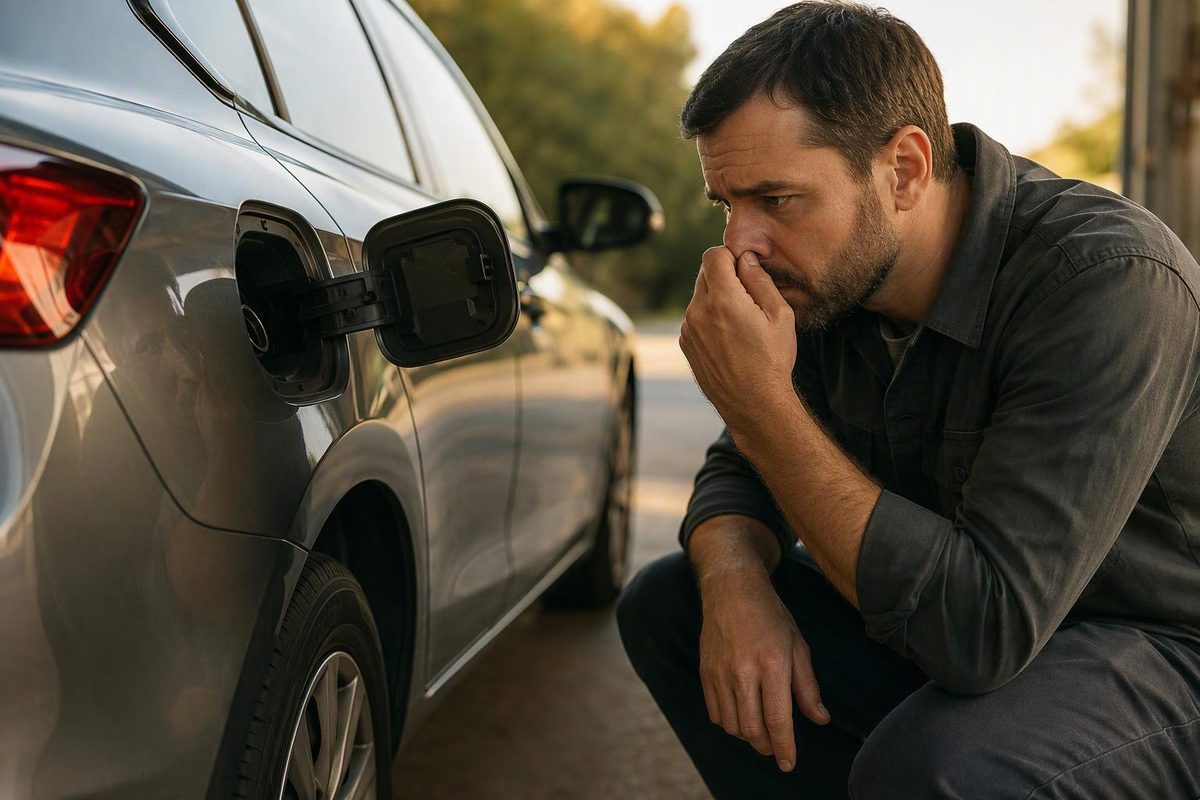
Know when to stop driving, what to check after refueling, and how leak tests and scan data separate fuel leaks, EVAP faults and rich exhaust.
A strong, persistent or unexplained gasoline smell means you should stop driving and rule out a fuel leak first. Possible causes include spilled gasoline, an improperly sealed filler, an evaporative-emissions leak, leaking fuel-system components or fuel-rich exhaust. The smell alone does not identify a failed part.
This guide covers gasoline-powered vehicles, including gasoline hybrids. Start with safety, then use where and when the odor appears to choose the next test.
1. Decide whether to stop and get assistance
If you smell gasoline while driving, pull over somewhere safe, switch the vehicle off and get everyone out. Do not restart it to see whether the smell returns. For a hybrid, switch the vehicle fully off—not just wait for the engine to stop. Avoid smoking, flames and other ignition sources; call roadside assistance and describe the suspected fuel leak. The Motorist Assurance Program recommends stopping and getting assistance, rather than continuing to drive with the odor.
Visible wet fuel, dripping, a strong engine-bay odor or a smell that keeps returning warrants towing—not a drive to the repair shop. Fuel or vapor near hot components can ignite; Ford documents that mechanism in its fuel-injector recall report.
If you suspect a fire, do not open the hood or trunk, return to the vehicle or try to fight it yourself. Move everyone at least 100 feet away and clear of traffic, and call emergency services. These are the U.S. Fire Administration’s vehicle-fire precautions.
No puddle does not clear the vehicle. A vapor leak or a small seep may produce odor without leaving an obvious wet patch. Firestone’s fuel-odor guidance identifies both vapor-system faults and liquid-fuel leaks as possible causes.
If occupants develop headache, dizziness or nausea, move to fresh air and seek urgent medical help. Exhaust entering the cabin is also dangerous: carbon monoxide is odorless, and a small exhaust leak can allow it to accumulate inside a car, according to the CDC. Opening windows is not a repair.
2. Use the odor pattern to choose a diagnostic path
Record what happened before the vehicle was switched off. Do not run it or deliberately inhale fumes to complete this table.
| What you noticed | What to investigate first | What would confirm the cause |
|---|---|---|
| Odor immediately after refueling, localized to the filler or spilled-on clothing | Spillage and filler sealing | An identified spill or a documented filler-seal fault—not timing alone |
| Odor near the rear, especially after filling or parking | Tank, filler neck, pump-module sealing and EVAP plumbing | A localized liquid leak or a controlled vapor-leak test |
| Odor near the engine or through the cabin vents | Fuel lines, rail, injectors and any engine-mounted fuel pump | Inspection that identifies the leaking component or connection |
| Fuel-like exhaust odor with rough running, soot or poor fuel economy | Fuel control and misfire diagnosis, after external leaks are excluded | Codes, live data and targeted fuel or ignition tests |
These are starting points, not diagnoses. Include the year, make, model, engine, fuel level, recent repairs and whether the smell occurred cold, hot or after refueling when arranging service.
3. Limit owner checks to safe, vehicle-off observations
With the vehicle switched off and no strong fumes, active leak or smoke present:
- Look from beside the vehicle for wet patches. Do not crawl underneath an unsupported car or touch suspected fuel.
- Check for an obvious refueling spill. Gasoline on clothing can explain a localized odor; gasoline-soaked upholstery or a leaking container needs safe handling, not air freshener.
- Check the cap, if fitted. Inspect for a missing cap or visibly damaged seal and close it as the owner’s manual specifies. Some cars have capless fillers; do not pry their valves open or insert improvised tools.
- Note recent fuel-system work. Tell the technician if the smell began after injector, pump, tank or line repairs.
Spillage and loose or missing caps are recognized odor sources in Firestone’s guidance. Neither finding justifies dismissing a smell that persists elsewhere.
At future fill-ups, stop at the nozzle’s first automatic shutoff rather than topping off. The 2023 Ford Bronco owner’s manual warns that overfilling can cause overflow or leakage and also prohibits prying open its capless filler valve.
Stop DIY work at suspected leakage. Do not cycle the ignition to pressurize the system, loosen fuel fittings or search for a spray with your hand.
4. Ask for the test that fits the symptom
Rear-of-car odor or EVAP leak codes
The evaporative-emissions system, or EVAP, contains and manages fuel vapor. A leak code is not automatically a gas-cap diagnosis.
For gasoline-powered 2000–2021 GM vehicles, bulletin 21-NA-124 identifies P0442 as a small EVAP leak and explains that P0455 can result from a large leak or purge blockage. Its test order is useful: inspect connection seating and line damage before testing vent and purge valves. It also notes that some leaks appear only under pressure and others only under vacuum. The applicable vehicle’s service procedure still governs the test.
Ask the technician to identify the leak location and document the test conditions. A smoke test must use the vehicle’s specified setup and suitable equipment—not an unrestricted air hose or homemade smoke source. The GM GE-41413-B tester manual requires engine-off testing and nitrogen for EVAP testing, warning that adding oxygen to fuel vapor can create a flammable mixture.
Engine-bay odor
Start with leak localization, not injector cleaner. Where the manufacturer’s procedure calls for pressure or pressure-decay testing, the report should state the measured pressure, elapsed time and vehicle-specific limit. A pressure loss needs further isolation before it condemns a particular injector or pump. There is no single pressure or decay limit suitable for every gasoline fuel system.
Also check model-specific service information. For example, Toyota’s U.S. Customer Support Program 23TE01 addresses engine-bay fuel odor originating at the high-pressure pump on specified models and years. The condition and vehicle eligibility must be verified; it is not a reason to replace every Toyota pump.
Fuel-like exhaust odor and rough running
Once external leakage is excluded, save codes and freeze-frame data before clearing anything. Rich-condition codes P0172/P0175 and negative fuel trims can direct testing toward excess fueling, but do not prove an injector has failed. Negative trim means the control system is subtracting fuel from its calculated delivery. Underhood Service’s fuel-trim diagnostic guide discusses both pressure-regulator and injector faults in this branch.
Compare the affected bank or cylinder, operating temperature and fuel-pressure results before choosing a repair. If the engine also shakes or stumbles, use the rough-idle diagnostic sequence to keep ignition, air leaks and mechanical faults in the investigation.
5. Verify the repair under the original conditions
Ask for the confirmed leak location or failed test, the repair performed and the result of the repeat test. An EVAP repair should pass the applicable leak test; a fuel-system repair should pass its prescribed leak checks. Once the vehicle is safe, confirm that the odor does not return under the original refueling, parking or operating conditions.
For U.S. vehicles, check the NHTSA VIN recall lookup and ask the manufacturer about service campaigns. NHTSA’s VIN tool does not show non-safety customer-service campaigns. Neither a clean recall search nor an extinguished check-engine light proves that a gasoline smell has been fixed.