
A Test-First Guide to Tracking Down a Shaky Idle
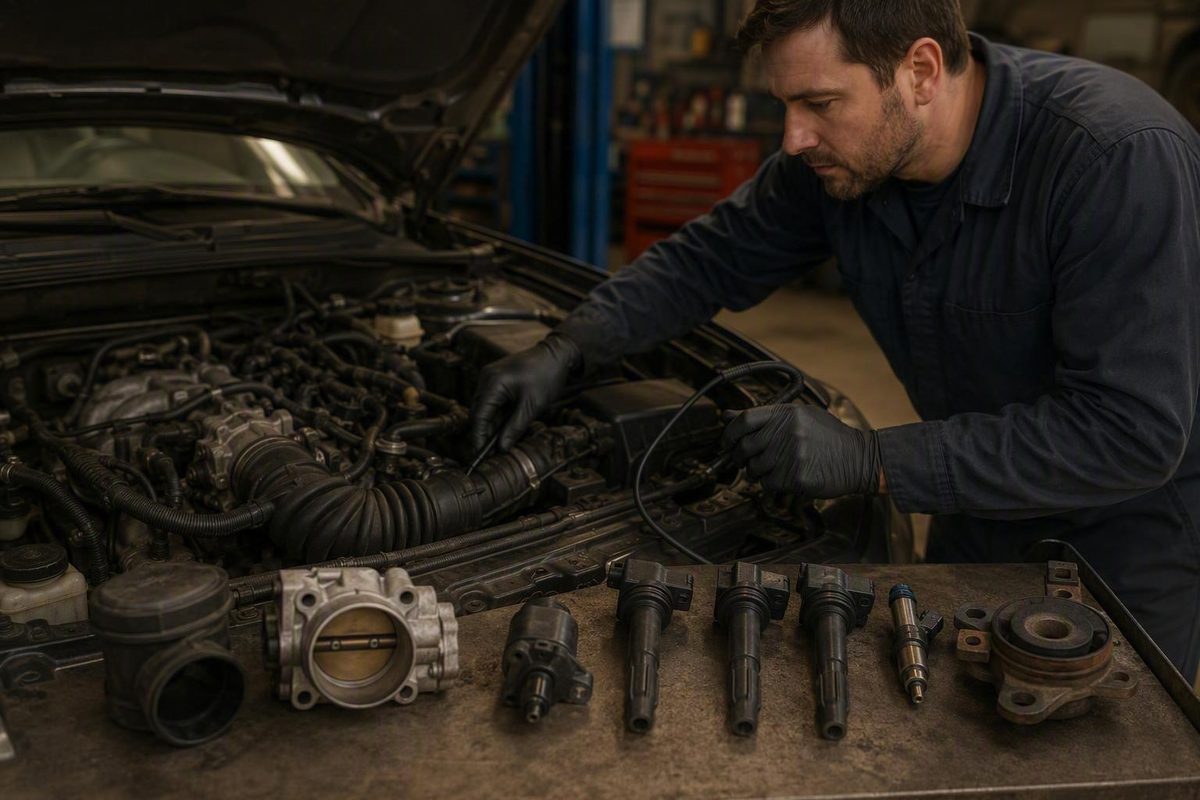
Narrow it down using RPM behavior, trouble codes, live data and targeted tests for air leaks, misfires, fuel faults, idle control or worn mounts.
A rough idle can come from unmetered air, an ignition misfire, incorrect fuel delivery, throttle or idle-control trouble, inaccurate sensor data, low compression, timing faults, or worn engine mounts. Mild roughness does not identify the failed part. A flashing check-engine light, severe shaking, substantial power loss, bucking, or a strong raw-fuel odor calls for stopping or sharply limiting driving. Repeated stalling or severe knocking also warrants prompt diagnosis, with the response based on severity and any accompanying warning signs.
First, decide whether it is safe to keep driving
No general article can declare a particular vehicle safe to drive. Urgency depends on warning-light behavior, symptom severity, stored codes, power loss, odors, noises, and whether the engine can remain running reliably.
A flashing check-engine light can accompany an active misfire. Repeated misfires may send unburned fuel into the exhaust, where it can overheat and damage the catalytic converter. A commercial repair-shop guide advises stopping when rough running is accompanied by a flashing light, substantial power loss, bucking, or a raw-fuel smell; severe shaking belongs in the same high-urgency category because it may indicate significant misfire activity (Seal Beach Auto).
| Urgency | Warning signs | What to do |
|---|---|---|
| Stop or sharply limit driving | Flashing check-engine light, severe shaking, substantial power loss, bucking, or strong raw-fuel odor | Stop in a safe location when practical. Avoid routine driving and arrange prompt diagnosis; towing is a prudent option when the vehicle runs severely rough or lacks power. |
| Arrange prompt diagnosis | Steady check-engine light, persistent roughness, repeated stalling, severe or unfamiliar knocking, hesitation, or worsening symptoms | Retrieve codes soon and avoid unnecessary operation until the cause and severity are understood. If these symptoms occur with any stop-level warning sign, move to the higher-urgency response. |
| Document and investigate | Mild vibration, no warning light, no power loss, and no worsening symptoms | Record the conditions, inspect for obvious faults, and continue watching for changes. |
Do not assume a steady warning light means the problem is harmless. Likewise, a mild vibration with no warning light deserves attention if it is new, persistent, or becoming more noticeable.
Confirm what the car is actually doing
Idle is the condition in which the engine is running while the vehicle is stationary. A rough idle may feel like shaking through the seat or steering wheel, surging, an uneven exhaust note, fluctuating RPM, or a tendency to stall.
A misfire is more specific: one or more cylinders are not burning the air-fuel mixture correctly. A misfire can cause rough idle, but rough idle does not automatically mean the engine is misfiring. Airflow, fuel control, throttle operation, idle control, or vibration transmitted through the vehicle can produce similar symptoms.
Watch the tachometer and listen to the engine:
- RPM rises, falls, or hunts: Suspect unstable combustion, changing airflow, mixture correction, or idle-control operation.
- RPM remains steady while the cabin vibrates: Consider vibration transmitted through an engine or transmission mount.
- RPM drops sharply in Drive or when an accessory engages: The added load may be exposing marginal combustion or inadequate idle compensation.
- The tachometer looks steady but the exhaust note skips: Do not rule out a subtle or intermittent misfire. Scan data may show what the gauge cannot.
Worn mounts can make a normally running engine feel rough, often with more vibration in Drive than in Neutral or Park because drivetrain load changes. Do not blame the mounts until you have checked RPM stability, trouble codes, misfire data, and the engine’s sound.
Record whether the condition occurs only while stopped. Roughness that continues during acceleration or cruising directs the diagnosis away from a purely idle-specific problem.
The systems that can make an engine idle rough
There is no single universally most common cause for every gasoline engine. Vehicle design, mileage, maintenance history, recent work, codes, and operating conditions determine where testing should begin.
Unmetered intake air: A split vacuum or PCV hose, leaking intake gasket, brake-booster plumbing fault, or another leak downstream of the airflow measurement point can admit air the engine computer did not account for. The result may be a rough, high, lean, or unstable idle.
Ignition: Worn or fouled spark plugs, weak coils, damaged boots, defective plug wires on equipped vehicles, moisture, or poor electrical connections can cause intermittent or cylinder-specific misfires. A component may work at one temperature or load and fail at another.
Fuel delivery: Inadequate fuel pressure, restricted supply, uneven injector flow, an electrical injector fault, or a leaking injector can disturb combustion. Depending on the failure, symptoms may include a lean misfire, rich operation, hesitation, surging, fuel odor, or poor response under load.
Throttle and idle control: Deposits around the throttle plate can alter idle airflow. Some vehicles use a separate idle-air control valve, while others regulate idle through an electronic throttle. A sticking mechanism, control fault, or lost adaptation may become most obvious when the transmission is shifted into gear or the air conditioner adds load.
Air-fuel control and sensor inputs: The engine computer may rely on airflow, oxygen, throttle-position, and coolant-temperature information. An inaccurate input can disrupt mixture control, but an unusual value does not prove the sensor failed. An oxygen sensor, for example, may be reporting excess oxygen caused by an intake leak or misfire.
EGR and EVAP: Flow through a system that should be closed at idle can disturb the intake charge. A stuck-open exhaust-gas-recirculation valve or an EVAP purge valve allowing unintended flow is therefore a possibility when symptoms are concentrated at idle.
Mechanical and timing faults: Low compression, leaking valves, worn rings, incorrect valve timing, variable-valve-timing faults, and some exhaust problems can create uneven cylinder output. These faults require mechanical testing or vehicle-specific scan-data analysis.
Engine and transmission mounts: A degraded mount can transmit normal engine pulses into the body even while RPM and combustion remain stable. Mounts are a valid diagnostic category, not a default explanation for every steady vibration.
Every symptom is a clue—not proof that a particular component has failed.
Use when and how it happens to choose the first test
The symptom pattern can narrow the first test, but it cannot confirm the repair by itself.
| Observation | Possible systems—not a diagnosis | Next check |
|---|---|---|
| Rough mainly at idle; improves with slight throttle | Unmetered air, throttle deposits, idle control, EGR, or EVAP purge | Inspect hoses and connections; review fuel-control data; test for intake leakage or unintended valve flow |
| Rough under acceleration or load as well as at idle | Ignition weakness, inadequate fuel delivery, exhaust restriction, or mechanical fault | Check misfire data, ignition condition, fuel delivery, exhaust behavior, and cylinder condition |
| Vibration increases in Drive or with the A/C on | Marginal combustion, inadequate idle compensation, or worn mounts | Watch RPM and misfire data as load changes; inspect mounts if speed stays steady |
| RPM fluctuates or surges | Intake leak, throttle or idle-control fault, or unstable mixture control | Review airflow, throttle, temperature, fuel-control, and idle-command data |
| Problem began after maintenance or intake work | Disconnected hose, loose connector, incorrect installation, or disturbed wiring | Reinspect every area touched during the work |
| Problem began after throttle cleaning or battery disconnection | Lost adaptation or an underlying fault revealed by reset | Determine whether the exact vehicle requires an idle relearn |
| Cold-only, warm-only, or hot-restart problem | Temperature-dependent ignition, mixture, sensor, fuel, or mechanical behavior | Capture codes and live data during the failure condition |
| Symptoms appear after refueling | EVAP purge operation, fuel quality, or a coincidental fault | Record fuel level and timing; test the purge system instead of naming a valve from timing alone |
Likewise, extra load from Drive or the air conditioner can expose weak combustion rather than prove that the mounts or idle controller are faulty.
Before testing, create one diagnostic log containing:
- Year, make, model, engine, mileage, and modifications
- Check-engine light status: off, steady, or flashing
- Stored and pending codes
- Cold, warming, fully warm, or hot-restart condition
- Gear selection and accessory load
- Approximate fuel level
- Recent maintenance, repairs, cleaning, or battery disconnection
- Whether slight throttle changes the symptom
- Whether roughness continues during acceleration or cruising
This log tells you how to reproduce the fault and gives later test results useful context.
Diagnose in stages instead of loading the parts cannon
A productive diagnosis moves from observation to evidence, then from evidence to a targeted test.
Stage 1: Record the operating conditions. Use the diagnostic log to establish when the roughness begins, what the tachometer does, and whether gear selection or accessory load changes it.
Stage 2: Retrieve codes before clearing anything. Read stored and pending diagnostic trouble codes, then save freeze-frame data.
P0300 denotes detected random or multiple-cylinder misfire activity. P0301 through P0308 indicate detected misfire activity associated with cylinders one through eight, respectively, as summarized in the AutoWin rough-idle diagnostic sequence.
A code identifies a detected condition, system, or circuit. It does not automatically identify the part to replace. A cylinder-specific misfire code could result from the plug, coil, injector, wiring, air distribution, compression, or another fault affecting that cylinder.
Stage 3: Perform an engine-off visual inspection. With the engine cool, inspect accessible intake, vacuum, and PCV hoses for loose connections, splits, brittleness, collapsed sections, or poor seating. Check accessible electrical connectors, ignition components, grounds, and recently disturbed areas. One visible fault may be important without being the only fault.
Stage 4: Review live data under the failure conditions. Useful data may include short- and long-term fuel correction, cylinder misfire counters, airflow, throttle position, coolant temperature, oxygen-sensor behavior, and commanded versus actual idle operation. Interpret readings against manufacturer specifications and under the conditions captured in freeze-frame data. Do not apply one generic fuel-trim threshold or idle speed to every vehicle.
Stage 5: Run a targeted system test. Let the codes, observations, and live data choose the test:
- Use a controlled component swap for a cylinder-specific ignition hypothesis.
- Use a professional smoke test when evidence points to unmetered intake air.
- Measure fuel pressure and evaluate injector operation when delivery is suspect.
- Test throttle and idle-control operation when the problem is concentrated at idle or load transitions.
- Test EGR or EVAP purge operation when unintended flow is plausible.
Stage 6: Move to mechanical testing when needed. If air, ignition, and fuel tests do not explain the fault, check compression, cylinder leakage, and valve-timing information using procedures appropriate for the exact engine.
For example, suppose the scanner reports a cylinder-specific misfire. Inspect that cylinder’s plug, boot, connector, and wiring. If the engine uses interchangeable coil-on-plug units and the vehicle procedure permits it, move the suspect coil to another cylinder and reproduce the fault under controlled conditions.
If the detected misfire follows the coil, the coil is implicated. If it remains on the original cylinder, continue testing that cylinder’s plug, injector, wiring, air distribution, and compression. The code supplied a direction; the controlled test supplied the evidence.
Safe owner checks versus technician-level tests
Owner-safe checks should focus on gathering information without creating another fault. You can document symptoms, read codes with a basic scan tool, save freeze-frame data if supported, consult the owner or service information, and inspect accessible hoses and connectors while the engine is off and cool.
A loose, split, disconnected, brittle, collapsed, or poorly seated hose is relevant evidence. Pay particular attention to recently serviced areas, but avoid pulling aggressively on aged plastic fittings.
For intake-leak testing, use a controlled automotive smoke test rather than unlit propane, carburetor cleaner, brake cleaner, uncontrolled pressure, or homemade smoke. A Motor Vehicle Maintenance & Repair Stack Exchange discussion illustrates why improvised methods are poor general recommendations: flammable materials introduce fire risk, while uncontrolled pressure can worsen deteriorated hoses or fittings (community discussion).
Running-engine work can expose you to moving belts and fans, hot surfaces, electrical hazards, and pressurized fuel. Do not perform a test unless you have the vehicle-specific procedure, suitable equipment, and the skill to control those hazards. Fuel-pressure testing, injector evaluation, compression testing, leak-down testing, and many manufacturer-specific relearn procedures are advanced tasks.
Do not clean a throttle body solely because the engine idles roughly. Cleaning will not repair a vacuum leak, weak coil, leaking injector, inaccurate temperature input, or low compression. Some vehicles also require an idle relearn after throttle cleaning or related work, so verify the procedure for the exact model and engine before disturbing the throttle assembly.
If you hand the diagnosis to a technician, provide the diagnostic log along with:
- Codes and freeze-frame data
- Whether RPM fluctuates or remains steady
- Maintenance history and recent work
- Fuel or exhaust odors
- Knocking, hissing, popping, or rattling
- Any stalling, hesitation, or power loss
A rough idle is a starting clue, not a parts verdict. Distinguish changing RPM from steady-RPM vibration, retrieve codes before clearing them, and let the evidence determine whether to test for an air leak, ignition misfire, fuel problem, control fault, mount issue, or loss of compression. Stop or sharply limit driving for a flashing check-engine light, severe shaking, substantial power loss, bucking, or a strong fuel odor; treat persistent stalling or severe knocking as reasons for prompt assessment rather than assuming the vehicle is safe.
Can a bad oxygen sensor cause a rough idle?
Yes. An inaccurate or slow upstream oxygen sensor—or another oxygen sensor used for closed-loop fuel control on that vehicle—can contribute to incorrect mixture correction and rough idle.
An unusual oxygen-sensor reading or related code does not prove the sensor is defective. The sensor may be accurately reporting excess oxygen caused by an intake leak, cylinder misfire, inadequate fuel delivery, or exhaust leak. Review codes, fuel-control data, sensor response, and the rest of the air-fuel system before replacing it.
Can an ECM update or manufacturer campaign fix a rough idle?
Yes, but only when the manufacturer has documented a calibration issue for the exact vehicle. ECM programming is not a general-purpose rough-idle repair.
Subaru campaign WQW-58R documented revised ECM logic intended to improve idle smoothness and quality for certain 2015 WRX 2.0L DIT and 2014–2015 Forester 2.0L DIT vehicles. The bulletin also prescribed additional diagnostic work, and model year alone did not establish coverage; applicability required VIN confirmation in the official Subaru service-program bulletin hosted by NHTSA.
Check recalls, campaigns, technical bulletins, and calibration updates using the exact VIN. Even when an update applies, existing ignition, fuel, air, or mechanical faults may still require separate diagnosis.