
What a RAV4 Hybrid Traction-Battery Job Really Costs—and What to Verify First
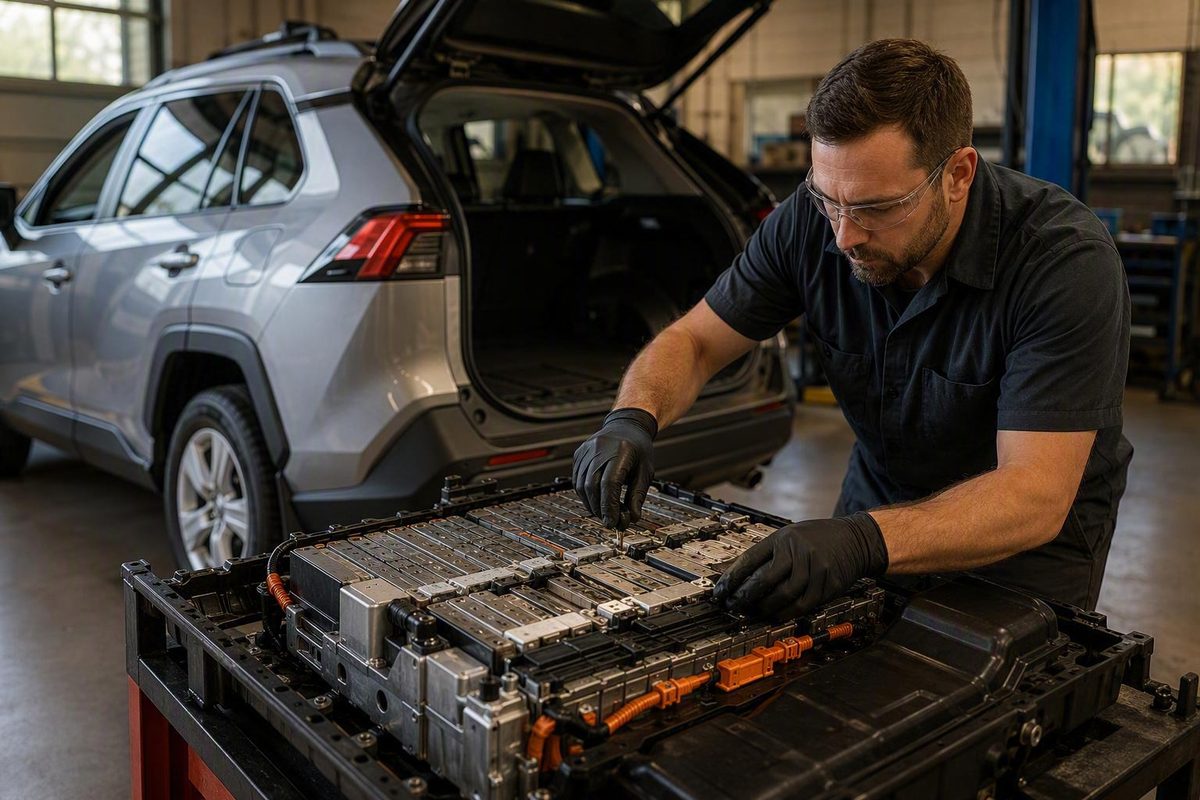
An illustrative $3,049 subtotal still excludes diagnosis, taxes, towing, freight-related charges, core costs and warranty upgrades.
A Toyota RAV4 Hybrid battery replacement does not have one dependable price for every vehicle. Before comparing quotes, identify which battery is at issue, confirm the diagnosis, check Toyota warranty eligibility, and verify the replacement pack against the VIN.
The advertised battery price is only one part of the bill. Pack condition matters too: genuine Toyota original equipment, new aftermarket, used, and remanufactured batteries are not equivalent products.
Treat every price below as a seller or dealer snapshot rather than a guaranteed current rate. Listings can change, and the strongest concrete merchant examples in the available evidence apply only to 2016–2018 RAV4 Hybrids.
First identify which RAV4 battery needs attention
“RAV4 battery” can refer to three substantially different components:
- The 12-volt auxiliary battery. This conventional low-voltage battery supports vehicle electronics and startup functions.
- The RAV4 Hybrid high-voltage traction battery. This pack supports the gasoline engine, powers the electric motor, and stores energy recovered during braking.
- The 2012–2014 RAV4 EV propulsion battery. This belongs to the battery-electric RAV4 EV, not the gasoline-electric RAV4 Hybrid.
That distinction prevents expensive comparison errors. A tutorial for a 2021 RAV4 Hybrid that covers locating the battery and disconnecting or reconnecting terminals is expressly a 12-volt battery guide. It is not a procedure for removing or replacing the high-voltage traction pack. The CarCareKiosk guide identifies its subject as the 12-volt battery and terminals.
The RAV4 EV creates another source of confusion. Greentec advertises a 2016–2018 RAV4 Hybrid pack at $2,850 but lists a refurbished 2012–2014 RAV4 EV pack at $9,999. Those products serve different vehicles and battery systems, so the EV price is not evidence of what a RAV4 Hybrid pack should cost. Greentec’s RAV4 listings show the two products separately.
Before requesting prices, record:
- Exact model: RAV4 Hybrid, not RAV4 EV or RAV4 Prime
- Model year and trim
- Full VIN
- Current mileage
- Battery or system named in the diagnostic report
- Trouble codes and supporting test findings
- Part number shown on the quote, if any
- Whether the quote concerns a 12-volt battery or a high-voltage pack
Do not treat high-voltage work as routine battery maintenance. The available evidence does not provide a safe owner-level traction-battery replacement procedure, service-disconnect sequence, torque specification, or internal repair method. Use a technician trained and equipped for hybrid-system diagnosis and replacement.
How much can RAV4 Hybrid traction-battery replacement cost?
The available figures support seller examples and broad commercial estimates—not a national average. Price can vary with model year, trim, battery chemistry, part availability, provider, location, labor scope, warranty, and pack condition.
| Source and product | Advertised figure | What the figure covers | Important exclusions or limits |
|---|---|---|---|
| Best Hybrid Batteries, fully remanufactured 2016–2018 pack | $2,549 | Battery pack with an advertised three-year, unlimited-mileage warranty | Installation excluded; seller says professional installation typically costs about $500 |
| Greentec, 2016–2018 replacement pack | $2,850 | Advertised battery product | Do not assume installation, taxes, delivery charges, or core-related costs are included without a written quote |
| Santa Cruz Toyota, new RAV4 Hybrid battery estimate | $3,000–$8,000 | Broad dealer estimate | No model-year, labor, tax, or fee breakdown |
| Santa Cruz Toyota, used Toyota hybrid battery estimate | $1,500–$3,500 | Broad dealer estimate for used hybrid batteries | Not itemized by RAV4 year, pack, labor, or fees |
| Greentec, remanufactured pack estimate | $2,000–$2,850 | Vendor’s general estimate | Commercially interested estimate; exact product and inclusions may differ |
| Greentec, new Toyota OEM estimate | $3,000–$9,000 | Vendor’s general estimate | Labor and other charges may be additional |
| Greentec, labor estimate | $500–$1,000 | Vendor’s installation estimate | Actual labor depends on provider and location |
Best Hybrid Batteries lists its remanufactured 2016–2018 pack at $2,549 and says professional installation is excluded but typically costs about $500. That creates an illustrative subtotal of approximately $3,049 before diagnosis, taxes, towing, freight-related charges, core costs, or warranty upgrades. The seller’s product page provides the pack price, labor estimate, fitment limits, and base warranty.
$2,549 pack + approximately $500 installation = approximately $3,049
Santa Cruz Toyota publishes estimates of $3,000–$8,000 for a new RAV4 Hybrid battery and $1,500–$3,500 for a used Toyota hybrid battery. Its page does not separate those figures by model year, parts, labor, taxes, or other fees. The dealership presents both figures as broad replacement-cost estimates.
Greentec separately estimates $2,000–$2,850 for a remanufactured RAV4 Hybrid pack, $3,000–$9,000 for a new Toyota OEM battery, and $500–$1,000 for labor. These are estimates from a company that sells replacement batteries, not independently established market averages. Greentec’s cost guide provides those pack and labor ranges.
The figures overlap, but they do not establish one current price for every generation, trim, chemistry, region, or provider. A defensible comparison requires VIN-specific written quotes for equivalent products and services.
Build the total from more than the advertised pack price
A low product-page price may become less competitive once the entire transaction is included. Ask each provider to complete the same itemized template:
| Quote item | Amount | Refundable? | Due when? | Notes |
|---|---|---|---|---|
| Initial diagnosis | Include scanning, testing, and written findings | |||
| Battery pack | Identify OE, new aftermarket, used, or rebuilt | |||
| Installation labor | State mobile or in-shop | |||
| Taxes | ||||
| Towing | If the vehicle cannot be brought in normally | |||
| Outbound freight | Seller to customer or installer | |||
| Residential or lift-gate surcharge | ||||
| Remote-area surcharge | ||||
| Core deposit | State refund conditions | |||
| Core-return freight | State who pays | |||
| Packaging or pallet charge | Include damage rules | |||
| Disposal or recycling fee | ||||
| Optional warranty upgrade | Attach complete terms | |||
| Programming or setup | Confirm whether required | |||
| Out-the-door total | Include every nonrefundable charge |
The $2,549-plus-$500 example shows why product price and installed cost are not interchangeable. Even the approximate $3,049 subtotal remains incomplete until all applicable charges have been identified.
“Free shipping” also needs qualification. It may cover only outbound freight within a defined service area.
Greentec’s shipping terms provide a concrete example: shipping orders carry a refundable $500 core deposit, the old pack must be returned within 45 days, and return-shipping costs are deducted from the refund. The listing also states that continental U.S. shipping may carry an additional $200 residential-delivery charge. Those terms affect both the cash required at checkout and the final net cost. Greentec states the deposit, deadline, refund deduction, and residential-delivery charge in its terms.
A waived deposit does not necessarily eliminate the exchange obligation. Best Hybrid Batteries says domestic DIY buyers do not pay a core deposit but must still return the old pack. Its 2016–2018 listing also describes the pack as fully assembled, with electronics included and no programming required; lists part numbers G9510-0R030 and G9510-0R020; includes a three-year unlimited-mileage warranty; and offers a six-year option for an additional $765. Those representations apply only to that advertised product and remain subject to exact VIN verification. The product listing provides the fitment, component, core-return, part-number, and warranty details.
Request a written, VIN-specific out-the-door quote that states:
- What is included now
- What may be invoiced later
- Which deposits are refundable
- What conditions control the refund
- Who pays return freight
- What happens if the core is late, incomplete, or damaged
- Whether the quote expires
- Whether the price can change after inspection
Only compare providers after reducing each offer to the same complete format.
Diagnose the fault before ordering a traction battery
A warning light or performance change can justify investigation, but it does not by itself prove that the complete traction pack must be replaced.
Greentec identifies these as possible indicators of traction-battery trouble:
- A hybrid-system warning
- Reduced fuel economy
- Sluggish acceleration
- Frequent gasoline-engine operation while idling
- Large state-of-charge fluctuations
- A loud or continuously operating battery fan
These are possible indicators, not a complete diagnosis. Different systems or components may be involved, so the appropriate next step is documented testing rather than immediate parts ordering. Greentec’s guide presents these observations as warning signs rather than conclusive tests.
Greentec also advertises diagnostic services for warning codes including P0A80 and P0A7F. The available evidence does not establish that either code automatically requires complete-pack replacement. A trouble code belongs in the diagnostic record, but it is not a substitute for a written conclusion identifying the failed system and explaining the recommended repair.
Ask the technician to document:
- Which battery or system was tested
- Every relevant code and accompanying data
- Whether the 12-volt auxiliary battery was evaluated
- Whether other hybrid-system faults were considered
- Why the evidence supports complete-pack replacement
- Whether the recommendation is for a full pack, another component, or further testing
- Whether any operational restrictions are recommended pending repair
When practical, separate diagnosis from procurement. An independent diagnostic conclusion gives you an opportunity to evaluate a battery seller’s recommendation before committing to a product with substantial freight costs, return restrictions, or core deadlines.
Do not open or disassemble the high-voltage pack to reproduce a seller’s testing. The supplied evidence does not support publishing internal repair steps or a safe DIY traction-battery replacement procedure.
Compare genuine OE, new aftermarket, used, and rebuilt packs
Pack labels affect price, provenance, and buyer exposure. They should not be treated as interchangeable.
- Genuine Toyota OE: A manufacturer-approved factory replacement corresponding to the original equipment.
- New aftermarket: A non-Toyota pack containing unused modules. “New” describes module condition; it does not necessarily establish Toyota provenance.
- Used: A previously operated pack sold for reuse. Do not assume that it has been rebuilt, balanced, or comprehensively tested.
- Rebuilt, reconditioned, refurbished, or remanufactured: A previously used pack that a seller says has undergone restoration or testing. These terms are not consistently standardized among vendors.
One hybrid-battery vendor describes reconditioning as testing or replacing modules, balancing voltage, and load testing. That is a useful list of processes to ask about, but it does not establish that every seller performs the same work merely because its product is called “remanufactured.” The Hybrid Geek explains its distinctions among reconditioned, new, and genuine OE packs.
| Category | Provenance and module condition | Typical upfront-price position | Fitment and test evidence to request | Warranty exposure to examine | Documentation uncertainty |
|---|---|---|---|---|---|
| Genuine Toyota OE | Toyota-approved factory replacement; confirm whether all supplied modules are new | Often quoted above used or rebuilt alternatives, but obtain an actual VIN-specific price | VIN match, Toyota part number, supersession information, installation records | Labor, mileage, transferability, exclusions, claim process | Depends on whether the exact part and governing coverage are documented |
| New aftermarket | Third-party pack; confirm that every module is unused | Seller-specific | VIN, part number, chemistry, configuration, manufacturing and final-test records | Who diagnoses, supplies, ships, removes, and installs a failed replacement? | Depends on manufacturer identity, records, and local support |
| Used | Donor or used-parts pack with previously operated modules | Often marketed as a lower-price option | Donor details where available, VIN fitment, part number, state-of-health or load-test records | Duration, labor, shipping, exclusions, refund or replacement remedy | Higher when age, prior use, and testing are undocumented |
| Rebuilt or remanufactured | Previously operated pack, possibly with replaced or matched modules | Seller-specific; the cited 2016–2018 example is $2,549 | VIN, rebuild configuration, module matching, balancing, load testing, rebuild date | Repeat labor, towing, freight, replacement remedy, local service | Depends on process transparency, test records, and warranty support |
The final column is not a reliability ranking. Uncertainty depends on the specific supplier, provenance, test documentation, fitment evidence, and written warranty—not solely on the category label.
Ask every vendor:
- Is every module new, used, or a mixture?
- If used modules are installed, how are they matched?
- Are weak modules replaced individually or in groups?
- What balancing and load testing were completed?
- Can I receive the final test record?
- Which battery-management electronics, sensors, enclosure components, and cooling hardware are included?
- When was the pack manufactured or rebuilt?
- Who performed the rebuild?
- Is the serial number documented?
- Is the advertised product genuine Toyota OE, even if it is called new?
The available evidence does not provide independent comparative durability data. It therefore cannot establish a particular lifespan for any category or prove that one is universally more reliable. Choose according to documentation, installed cost, ownership horizon, warranty protection, and the expenses you would bear if the replacement failed.
Confirm model-year, chemistry, part-number, and VIN fitment
RAV4 Hybrid traction packs should not be generalized across the entire model line. Vendor material says nickel-metal hydride or lithium-ion packs may be used depending on model year and trim. That makes the exact year, trim, configuration, and VIN essential.
The clearest supplied merchant fitment applies only to the 2016, 2017, and 2018 RAV4 Hybrid. The seller’s listed part numbers, included electronics, fully assembled configuration, and no-programming statement should not be applied to other years without verification.
Before authorizing an order, require the seller or installer to confirm in writing:
- Full VIN
- Model year and trim
- Hybrid battery configuration
- Battery chemistry
- Exact replacement part number
- Any superseded or interchangeable part numbers
- Whether the pack is complete or requires transferred components
- Which electronics are included
- Whether programming, initialization, or setup is required
- Whether the installer accepts responsibility for confirming fitment
Do not extrapolate a 2016–2018 listing to a 2019 or newer vehicle. Likewise, do not use the RAV4 EV’s battery price, chemistry, part numbers, or fitment as a comparison for a RAV4 Hybrid.
For a freight delivery, add two provisions to the quote:
- Written fitment guarantee: The seller confirms that the identified product fits the supplied VIN.
- Wrong-part remedy: The quote states who pays return freight, replacement shipping, storage, and duplicated labor if the supplied pack is incorrect.
Where the seller’s terms permit, verify the shipment before accepting or opening it. Photograph the packaging and identifying labels before installation.
Check Toyota coverage and evaluate the replacement warranty
Check Toyota coverage before authorizing a paid replacement. Santa Cruz Toyota states that new RAV4 Hybrids receive an enhanced hybrid-battery warranty of 10 years or 150,000 miles from the original date of first use, replacing an earlier 8-year or 100,000-mile warranty. This is a dealership’s summary, not the governing warranty document for every RAV4 Hybrid. Santa Cruz Toyota provides the cited coverage figures and date-of-first-use language.
Eligibility can depend on model year, original in-service date, current mileage, market, and the Toyota terms governing the specific vehicle. Because the supplied evidence does not include official Toyota warranty guides by model year and market, obtain an official VIN-specific determination rather than treating the dealer page as universal policy.
Ask a Toyota dealer or official warranty record to confirm:
- Original in-service date
- Current warranty status
- Applicable time and mileage limits
- Whether the diagnosed condition is covered
- Whether prior repairs or vehicle history affect the claim
- Any inspection or authorization requirements
Do not approve customer-pay replacement until that check is complete. If coverage is denied, request the reason in writing and compare it with the applicable Toyota warranty documentation.
For an aftermarket replacement, duration is only one part of warranty value. Compare:
- Time and mileage limits
- Transferability to a subsequent owner
- Components covered
- Diagnostic requirements
- Approved installers
- Required maintenance or records
- Removal and reinstallation labor
- Towing
- Outbound replacement shipping
- Return freight for the failed pack
- Core handling
- Commercial-use exclusions
- Geographic service limits
- Repair, replacement, or refund remedy
- Coverage of downtime or other consequential costs
The cited 2016–2018 remanufactured product illustrates why full terms matter: its base and optional warranty choices change the upfront price, but a duration badge alone does not reveal who pays for diagnosis, freight, removal, repeat installation, or towing.
Product-specific terms also cannot be transferred between listings. Greentec’s refurbished 2012–2014 RAV4 EV battery advertises a 36-month unlimited-mileage warranty, but that does not establish the warranty offered on a RAV4 Hybrid pack.
Save the complete warranty document in effect on the purchase date, invoice, serial number, installation record, diagnostic report, and core-return receipts. Do not rely only on a product-page badge or verbal summary.
Use a written checklist to choose a provider and make the final decision
Copy this checklist into an email and require written answers from the dealer or hybrid specialist.
Diagnosis and fitment
- [ ] Provide the complete diagnostic findings and relevant trouble codes.
- [ ] Identify the failed system and explain why full-pack replacement is recommended.
- [ ] Confirm whether the 12-volt battery and other plausible hybrid-system faults were evaluated.
- [ ] Confirm fitment using my full VIN.
- [ ] State the exact model year, trim, chemistry, battery configuration, and part number.
- [ ] Explain the remedy if the supplied pack does not fit.
Pack identity and condition
- [ ] Identify the pack as genuine Toyota OE, new aftermarket, used, or rebuilt/remanufactured.
- [ ] Name the manufacturer, supplier, or rebuilder.
- [ ] State whether every module is new, used, or mixed.
- [ ] Explain how used modules are matched.
- [ ] Provide the manufacture or rebuild date.
- [ ] List the electronics and other components included.
- [ ] State whether programming or setup is required.
- [ ] Provide available balancing, load-test, and final-inspection documentation.
Installed cost
- [ ] List diagnosis, battery, installation, and taxes separately.
- [ ] List any towing charge.
- [ ] List outbound freight and delivery surcharges.
- [ ] List the core deposit, return freight, and packaging costs.
- [ ] List disposal or recycling fees.
- [ ] List optional warranty upgrades.
- [ ] Identify every amount that may become due later.
- [ ] Provide the complete out-the-door total.
Installation and service area
- [ ] State whether installation is mobile or in-shop.
- [ ] Confirm service availability for my location.
- [ ] State whether installation is included in the advertised price.
- [ ] Identify the technician or facility responsible for the work.
- [ ] State the anticipated scheduling and vehicle-downtime requirements.
Warranty exposure
- [ ] Provide the complete warranty document.
- [ ] State the time and mileage limits.
- [ ] Confirm whether coverage is transferable.
- [ ] Identify covered components and exclusions.
- [ ] State who performs and pays for warranty diagnosis.
- [ ] State who pays for removal and repeat installation.
- [ ] State who pays for towing and freight.
- [ ] Explain the remedy if the replacement pack fails.
- [ ] State whether service is available locally or requires shipment.
- [ ] Explain whether any downtime-related costs are covered.
Core return
- [ ] State whether the old pack must be returned.
- [ ] Identify the return deadline.
- [ ] Provide packaging and pallet requirements.
- [ ] Name the required or approved carrier.
- [ ] State who schedules pickup and pays freight.
- [ ] Explain freight-damage responsibility.
- [ ] Show how the refund will be calculated.
- [ ] Identify when the deposit may be reduced or forfeited.
Compare dealer and independent-specialist quotes only when they cover equivalent pack categories and the same scope of work. A genuine OE installed quote is not directly equivalent to a used part-only price. A remotely shipped rebuilt pack without local labor support is also a different purchase from an in-shop installed pack with repeat-labor coverage.
For the repair-versus-sell decision, consider:
- Total installed battery cost
- Present vehicle value
- Overall mechanical and cosmetic condition
- Other pending repairs
- Expected ownership period
- Available cash or financing cost
- Strength of the replacement warranty
- Likely out-of-pocket cost if the replacement fails
- Downtime and transportation needs
Replacement is not always financially preferable. A lower-cost battery may make sense for an otherwise sound vehicle, while a high installed quote can be difficult to justify when substantial unrelated repairs are pending. The answer depends on the individual RAV4, not a vendor’s general recommendation.
Settle the old pack’s disposition in writing. Sellers commonly collect it during installation or require its return as a core. Greentec says removed batteries are sent to its recycling operation, illustrating why core handling belongs in the transaction plan rather than being treated as an afterthought.
Frequently asked questions
What is a realistic Toyota RAV4 Hybrid battery replacement price?
There is no single supported price for every RAV4 Hybrid. The strongest concrete examples in the available evidence concern 2016–2018 vehicles, and even those advertised pack prices are not complete installed totals.
Use the cited figures above only as starting points. Obtain a current VIN-specific quote that includes diagnosis, the exact pack category, installation, taxes, freight, core obligations, and warranty choices.
How can I tell whether I need a 12-volt battery or the high-voltage traction battery?
Read the diagnostic report and ask the technician to identify the failed system explicitly.
Do not infer the answer from the word “battery” on a generic quote. Provide the VIN and require the recommended part and system to be identified in writing.
Does a P0A80 or P0A7F code mean the complete battery must be replaced?
Not on the evidence available here. A seller advertises diagnostics involving those codes, but the supplied material does not establish either one as an automatic order to replace the entire pack.
Request a written explanation identifying the failed system, tests performed, and evidence supporting complete-pack replacement before purchasing a freight-heavy or restricted-return battery.
Is my RAV4 Hybrid traction battery still covered by Toyota’s warranty?
Possibly, but coverage must be checked for the individual VIN. Model year, original in-service date, mileage, market, and governing Toyota terms can affect eligibility.
Have a Toyota dealer or official warranty record confirm coverage before authorizing customer-pay replacement.
Do I have to return the old battery if there is no core charge?
You may. “No core charge” can mean the seller waives the upfront deposit while still requiring the old battery.
Obtain the exchange obligation, return deadline, packaging requirements, freight responsibility, damage rules, and refund calculation in writing before ordering.
Pause before buying a pack: identify the battery, obtain a documented diagnosis, check VIN-specific Toyota coverage, and compare written installed quotes for equivalent pack categories and warranty scope. The lowest advertised price may not represent the lowest total risk once fitment, labor, freight, core return, downtime, and repeat-repair costs are included.