
Confirm the Failure, Choose the Right Turbo, and Plan the Swap
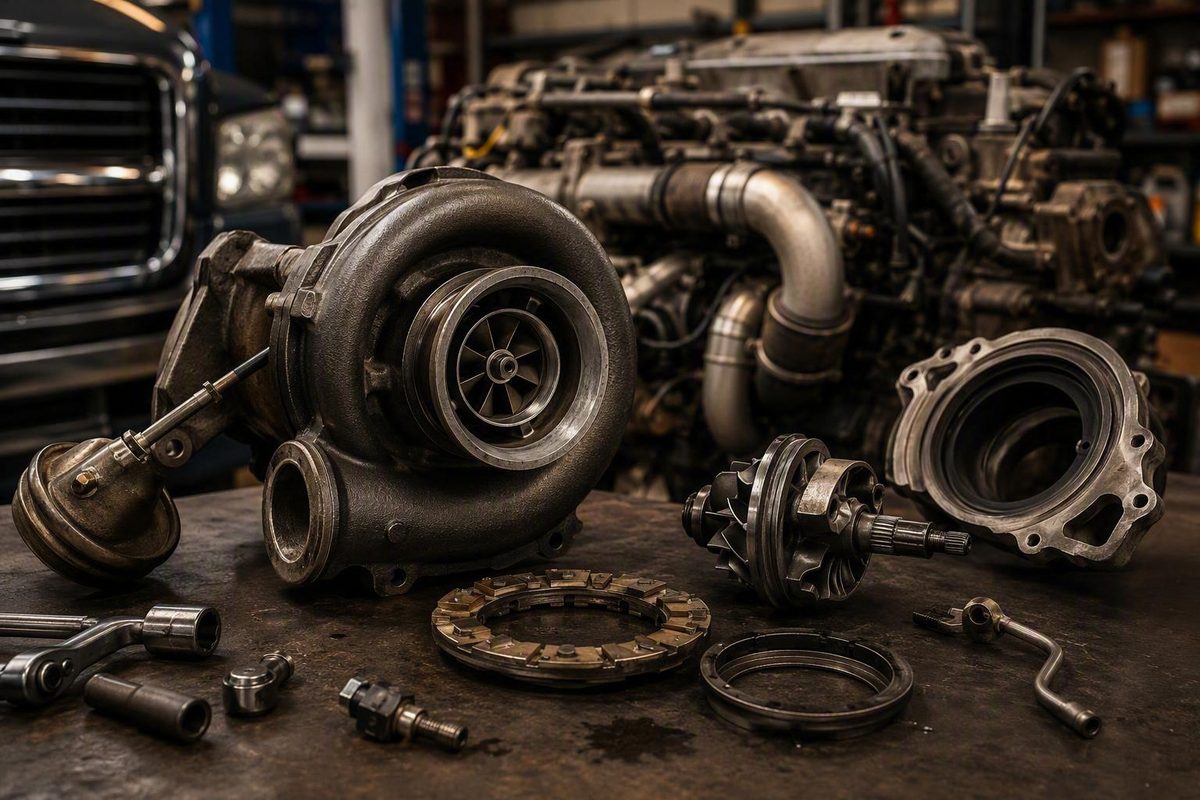
Diagnose actuator, vane, charge-air and oil-supply faults; verify VIN fitment, compare options, and calculate parts, labor and core costs.
Confirm the failure, choose the right turbo, and plan the swap.
A 6.7 Cummins turbo replacement should begin with diagnosis, not a parts catalog. Low boost, limp mode, sluggish response, inconsistent boost, a weak exhaust brake, or a turbo-control code may point toward the variable-geometry turbocharger (VGT), but none proves that the complete assembly has failed.
The sensible process is to separate actuator or wiring trouble from restricted vanes, charge-air leakage, inadequate oil supply, and internal turbo damage. Only then should you match a replacement by VIN and original identifiers, compare stock and upgrade paths, and calculate the complete installed cost.
Start Here: Does the Complete Turbo Actually Need Replacement?
Use this diagnosis-first decision tree:
- Retrieve all active, pending, and history codes and preserve freeze-frame data.
- Inspect external systems: wiring, connectors, grounds, boots, couplers, clamps, intake restrictions, and charge-air plumbing.
- Evaluate actuator command and feedback with an appropriate scan tool and application-specific information.
- Determine whether the vane mechanism moves correctly using the procedure for the exact turbo and truck.
- Inspect the oil-feed and drain paths.
- Check for physical turbo damage before authorizing complete replacement.
Reported turbo- or actuator-related codes include P003A, P00AF, P0046, P0299, P2262, and P226C. Loss of power, limp mode, inconsistent boost, slow spool, and weak exhaust braking may accompany these faults. However, a code identifies a circuit, control, or performance problem—not necessarily the failed component. Wiring faults, calibration problems, carbon-restricted vanes, and actuator defects can produce overlapping symptoms, according to HD Turbo’s actuator guide.
Branch 1: Actuator or wiring fault
Inspect the harness, pins, connector seals, power and ground paths, and areas exposed to heat before replacing anything. Compare commanded and reported vane position where the scan tool supports it. An external actuator may be replaceable without replacing a mechanically healthy turbo, but it must match the turbo and its calibration strategy.
Branch 2: Carbon-restricted vane mechanism
Soot or corrosion can restrict the variable-vane mechanism. Removing the actuator and evaluating vane movement may help distinguish an actuator problem from an internal restriction, but this is a model-specific diagnostic concept—not a universal procedure. Use service information for the exact turbo. Do not substitute an informal “stop-to-stop” test or an invented travel limit for the specified inspection.
Branch 3: Charge-air leak
A split boot, loose clamp, leaking coupler, damaged charge pipe, or intercooler leak can produce low boost and poor performance even when the turbo works correctly. Inspect the complete pressurized-air path and perform the appropriate leak test before condemning the charger. Use safe, application-specific equipment and limits rather than assuming one test pressure applies to every truck.
Branch 4: Restricted oil supply or drain
The replacement decision must account for oil delivery and drainage. Inspect the feed line, fittings, sealing washers, and any application-specific restriction point; inspect the drain for contamination, damage, or kinking. A commercial repair guide specifically recommends checking the charge-air system and oil supply before condemning the turbo and correcting a restricted feed before installation (Turbo Diesel of Oklahoma’s replacement guide).
If the original turbo failed mechanically, investigate whether contamination or inadequate lubrication contributed.
Branch 5: Mechanical center-section or wheel damage
Findings that generally support complete replacement include:
- Cracked housings
- Broken, bent, or eroded compressor or turbine blades
- Wheel-to-housing contact
- Seized rotation
- Confirmed bearing failure
- Irreparable vane-pack damage
- Internal damage that cannot be restored through a documented repair process
These criteria are supported as practical replacement indicators by the same commercial repair guide, but they remain planning guidance rather than a substitute for the exact inspection limits and service procedure for the truck.
Do not rely on an unverified finger-feel rule for shaft play. A meaningful assessment requires the correct inspection method and OEM limits; the available evidence does not establish a universal allowable radial or axial measurement.
The diagnostic endpoint should be one of three decisions:
- Continue diagnosis because the evidence does not isolate the fault.
- Consider cleaning or actuator-only service because the center section, wheels, housings, and vane mechanism remain serviceable.
- Replace the complete matched assembly because mechanical damage is confirmed or the vane mechanism is beyond an appropriate repair.
Match the Replacement to the Truck, Not Just the Engine Name
“Fits a 6.7 Cummins” is not enough information. Model year narrows the search, but VIN, chassis type, original turbo identifiers, hardware arrangement, and calibration determine whether a unit is suitable.
| Broad application group | Turbo family broadly associated with it | What still requires verification |
|---|---|---|
| 2007.5–2012 Ram 2500/3500 | HE351VE | VIN, pickup or cab-and-chassis, Holset tag, OEM number, actuator connector, flange, oil-port location, emissions configuration, ECM calibration |
| 2013 and newer Ram 2500/3500 | HE300VG | VIN, chassis configuration, original Holset and OEM identifiers, connector, flange, oil and coolant ports, sensors, calibration, year-specific revisions |
Turbo Diesel of Oklahoma associates the HE351VE with 2007.5–2012 trucks and the HE300VG with 2013-and-newer applications. Its guide also reports differences in oil-feed-port location, actuator connector, and mounting flange, so the two families should not be treated as interchangeable. That is broad commercial fitment guidance, not a substitute for VIN- and part-specific confirmation.
Before ordering, collect:
- Full VIN
- Model year and build information
- Ram 2500 or 3500
- Pickup or cab-and-chassis designation
- Two-wheel-drive or four-wheel-drive configuration
- Original Holset model, tag, and serial number
- OEM part number and any superseding number
- Actuator connector photographs
- Mounting-flange photographs
- Oil-feed-port and coolant-port locations
- Stock or modified emissions configuration
- Current ECM calibration or known tuning
- Photographs of sensors, elbows, and fittings that may transfer
Seller listings can conflict internally. One BD product title describes a remanufactured HE300VG for 2019–2024 pickup and cab-and-chassis applications, while its FAQ narrows the stated coverage and advises additional factory-part-number confirmation for a 2024 truck. The listing cross-references 68444771AA through 2021 and 68444771AB beginning in 2022. Treat those numbers as references for that product listing, not as a universal application chart (BD’s HE300VG listing).
Before placing the order, ask the supplier to confirm in writing:
- Fitment for the supplied VIN and chassis type
- Matching original Holset and OEM numbers
- Connector, mounting-flange, and oil-port compatibility
- Compatibility with the emissions configuration and ECM calibration
- Whether the actuator and speed sensor are included
- Whether the actuator is calibrated, self-calibrating, or requires a relearn
- Which gaskets, studs, seals, fittings, and mounting hardware are included
- Which original fittings must be transferred
- Core-return eligibility and conditions
- Installation and warranty requirements
Choose the Repair Level: Cleaning, Actuator, or Complete Turbo
Several different services are casually described as “rebuilding the turbo,” but they are not equivalent.
- Cleaning removes deposits from an otherwise serviceable vane mechanism.
- Actuator replacement replaces the external electronic control unit while retaining the turbo.
- Rebuilding may mean a limited repair using selected replacement components; the scope varies.
- Comprehensive remanufacturing should involve complete disassembly, cleaning, inspection, replacement of critical wear parts, balancing, actuator testing or calibration, and functional testing.
- Complete assembly replacement installs a matched turbo and actuator when the actuator is included.
Cleaning may be reasonable when carbon restriction is suspected but the actuator, bearings, shaft, wheels, housings, and vane components remain serviceable. It is not a repair for cracked housings, damaged wheels, bearing failure, or severe corrosion. The available evidence does not establish a dependable long-term success rate, so ask what inspection, cleaning process, and post-service testing will be performed.
Actuator-only replacement may make sense when electrical testing isolates the actuator and the vane mechanism moves as specified. A new actuator cannot free irreparably seized vanes or repair internal wheel and bearing damage. It may also require product-specific programming, calibration, or a relearn.
A recently replaced actuator followed by new codes does not automatically prove that the complete turbo has failed. The replacement actuator could be incompatible, incorrectly calibrated, affected by wiring trouble, or attempting to operate a restricted vane mechanism. A charge-air leak or unrelated control fault could also remain.
A credible remanufactured unit should include documentation describing what was replaced and tested. One seller’s overview distinguishes comprehensive remanufacturing from a limited rebuild by calling for disassembly, cleaning, inspection, critical-wear-part replacement, balancing, and functional testing. Buyers still need proof that the specific unit received that process (HD Turbo’s OEM-versus-remanufactured overview).
| Observed condition | Tests still needed | Plausible repair level | Why not jump to complete replacement? |
|---|---|---|---|
| Turbo-control code with no physical inspection | Wiring, connector, power/ground, command/feedback, charge-air integrity | Continue diagnosis | A code does not identify the failed part by itself |
| Electrical actuator failure; vanes and center section serviceable | Confirm compatibility and setup procedure | Actuator-only replacement | The turbo may remain mechanically sound |
| Restricted vane movement without wheel or bearing damage | Application-specific inspection and cleaning feasibility | Cleaning or professional vane service | Deposits may be removable, although durability is uncertain |
| Low boost with evidence of charge-air leakage | Inspect boots, couplers, clamps, pipes, and intercooler | Repair the leak first | External leakage can imitate inadequate turbo output |
| Suspected lubrication problem | Verify feed, drain, oil condition, and contamination source | Correct the supply or drain fault before deciding | The root cause may remain after a new turbo is installed |
| Cracked housing, damaged wheel, contact, seized rotation, or confirmed bearing failure | Identify the cause and inspect connected systems for contamination | Complete matched turbo assembly | Mechanical damage is not corrected by an actuator or cleaning |
| Unknown-quality prior rebuild | Inspect identifiers and obtain process documentation | Documented remanufactured or new replacement | Existing repair quality cannot be assumed |
Compare Stock VGT, Upgraded VGT, Fixed-Geometry, and Compound Options
The correct category depends on how the truck is used—not merely on which turbo advertises the most airflow. The following is a qualitative planning comparison; exact fitment, exhaust-brake operation, and supporting requirements must be confirmed for the specific product.
| Category | Intended use | Exhaust brake | Low-speed response | Installation complexity | Likely supporting work | Relative fitment risk |
|---|---|---|---|---|---|---|
| Direct-fit stock-style VGT | Stock commuter, work truck, towing | Can be retained when exact documentation confirms support | Closest category to factory behavior | Lowest | Seals, hardware, fluids, possible relearn | Lowest after VIN and part-number verification |
| Mild upgraded VGT | Mild performance while retaining stock location | May be retained; verify the exact product | Product- and setup-dependent | Moderate | Calibration review, intake/exhaust checks, monitoring | Higher than stock replacement |
| Fixed-geometry S300/S400-style conversion | Modified street or performance build | Factory function may be lost | Depends heavily on sizing and setup | High | Manifold, piping, oil lines, downpipe, tuning, charge-air work | High |
| Add-a-turbo or compounds | Substantially modified, higher-power application | Configuration-dependent | Can combine small- and large-turbo behavior | Highest | Piping, supports, heat management, fuel and calibration changes | Highest |
A verified stock-style VGT is generally the most straightforward option for factory-like drivability, daily use, and towing. Its central advantage is preserving the factory operating strategy and exhaust brake when the exact replacement is documented to support them.
A mild upgraded VGT can retain the stock location and may preserve exhaust-brake operation. Claims about no-tuning installation, faster spool, lower exhaust-gas temperature, horsepower capacity, or durability are vendor-specific, however. They should not be treated as independent test results.
A fixed-geometry S300- or S400-style charger is not automatically a direct substitute for the factory VGT. Depending on the kit, it may require another manifold, oil plumbing, intake and charge-air pipes, a downpipe, tuning, or other supporting hardware. It can also eliminate factory exhaust-brake operation—a consequential compromise on a towing truck. Retailer guidance treats stock replacements, drop-in VGT upgrades, and compounds as distinct categories with progressively more supporting work rather than equivalent bolt-on choices (Diesel Power Products’ buyer’s guide).
Add-a-turbo and compound systems belong in a different planning category. They are generally suited to substantially modified or higher-power applications, not routine replacement on an otherwise stock work truck.
Keep emissions-compliant and modified trucks separate when comparing products. A seller’s claim that one identified VGT or compound kit retains specified emissions equipment cannot be generalized to every year, chassis, configuration, product, or jurisdiction. Confirm the exact application and applicable requirements before purchase.
Recommendations by use case
- Stock commuter: Choose a verified stock-size VGT with clear actuator, calibration, and warranty documentation.
- Heavy towing truck: Prioritize documented exhaust-brake retention, factory-like low-speed response, and service support over advertised peak airflow.
- Mild performance truck: Consider a documented upgraded VGT only after confirming tuning, emissions, exhaust-brake, and supporting-hardware requirements.
- Dedicated high-power build: Evaluate fixed-geometry or compound systems as complete engineered packages, not isolated turbo purchases.
What a 6.7 Cummins Turbo Replacement Can Cost
There is no defensible universal installed price. Advertised products differ in year coverage, actuator inclusion, hardware, remanufacturing quality, warranty, core terms, and installation requirements.
Use the same worksheet for dealer, independent-shop, rebuilder, and online-parts quotes:
| Cost category | Quote A | Quote B | Quote C |
|---|---|---|---|
| Advertised turbo price | |||
| Actuator | |||
| Refundable core deposit | |||
| Cash due before core refund | |||
| Expected core refund | |||
| Final net parts cost | |||
| Gaskets, seals, studs, fittings | |||
| Oil and filter | |||
| Coolant | |||
| Air or crankcase-breather filters | |||
| Diagnostic labor | |||
| Replacement labor | |||
| Calibration or relearn | |||
| Shipping and core-return freight | |||
| Taxes and shop supplies | |||
| Broken-fastener contingency | |||
| Total cash required | |||
| Net total after core refund |
A captured marketplace listing showed $935.98 for a seller-claimed 2013–2018 replacement. That price did not establish actuator inclusion, calibration, installation hardware, warranty duration, fitment accuracy, or equivalence to an OEM or documented remanufactured unit (the marketplace listing).
At the other end of the comparison, one vendor catalog listed a 2007.5–2018 OEM Holset-style replacement at $2,520, staged units for that broad period at $2,640–$3,040, and 2019–2024 staged listings at $3,329–$3,729. The same catalog showed a $1,665 build-and-upgrade service, illustrating why work performed on an existing core cannot be compared directly with a complete ready-to-install assembly (Turbo Time USA’s catalog).
The captured BD remanufactured HE300VG listing displayed a $2,668.46 product price, a refundable $1,000 core deposit, and a listed 12-month parts warranty. Checkout cost can therefore be materially higher than eventual net cost, assuming the returned core qualifies under the seller’s current terms (BD’s HE300VG listing).
Labor examples vary as well. One commercial guide estimates approximately three to four hours for a 2012 truck and four to five hours for a 2016 application where more components require removal. A 2008 demonstration lists about four hours, while the BD page gives conflicting estimates of 4.5 hours and 6 hours 36 minutes. None is a universal allowance; chassis configuration, emissions hardware, corrosion, previous modifications, seized fasteners, access method, and shop workflow can change the total.
An owner in an August 2023 forum discussion reported an independent-shop quote of approximately $4,000 installed and a dealer quote exceeding $6,000. These were dated anecdotes from one repair situation, not current national benchmarks (the owner’s quote discussion).
Require every quote to state whether it includes:
- Diagnostic time
- Turbo actuator
- Calibration or relearn
- Gaskets and seals
- Studs, nuts, and clamps
- Oil, filter, and coolant
- Air and crankcase-breather filters
- Shop supplies and taxes
- Core deposit and return freight
- Broken-fastener or damaged-line contingencies
- Labor coverage if the replacement part fails
Parts, Fluids, Tools, and Information to Gather Before the Job
Do not assume one universal installation kit fits every 6.7L Cummins truck.
Procurement checklist
- Correctly matched turbocharger
- Actuator, if applicable
- Turbine-inlet or mounting gasket
- Oil-return gasket or seals
- Oil-feed sealing washers
- Required mounting studs and nuts
- Coolant-line seals
- Product-specific clamps and mounting hardware
- Engine coolant meeting the truck’s specification
- Correct engine oil and filter
- Air filter if condition or warranty terms justify replacement
- Crankcase-breather filter if due, contaminated, or required
- Replacement oil-feed or drain line if damaged or restricted
- Charge-air boots, couplers, or clamps found defective
- Approved cleaning supplies and caps for open lines
- Core-return packaging and shipping documents
Some assemblies include a calibrated actuator, speed sensor, mounting kit, gaskets, seals, or studs; others include only the turbo. A 2008 instructional example included gaskets, seals, studs, a calibrated actuator, and a speed sensor, but that package does not establish what another seller supplies (GP Sorensen’s 2008 demonstration). Even when a listing says “installation kit included,” obtain an itemized contents list.
Before work begins, obtain:
- VIN-specific service information
- Verified torque specifications
- Electrical connector diagrams
- Correct oil and coolant specifications
- Replacement-manufacturer priming instructions
- Actuator calibration or relearn instructions
- Written warranty conditions
- Core-return deadline and packaging rules
Instructional videos may show ordinary sockets, wrenches, pliers, and picks handling portions of the work, but their lists are not complete for every year or configuration. Access tools, line wrenches, scan equipment, fastener-extraction tools, lifting support, and cooling-system equipment may also be required.
Stop work if:
- Fitment cannot be confirmed.
- The connector, flange, sensor, or oil-port arrangement differs.
- An oil or coolant line is damaged.
- Oil supply cannot be verified.
- Hardware is seized and the only apparent solution involves uncontrolled heat or force.
- Required torque information is unavailable.
- The actuator requires calibration equipment that is unavailable.
- Internal debris indicates that the intake, exhaust, or charge-air system needs further inspection.
These are conservative planning boundaries. Battery isolation, coolant handling, line disconnection, priming, torque, and calibration must follow VIN-specific service information and the replacement manufacturer’s written instructions.
Replacement Workflow and Access Routes
This is a repair-planning overview, not a complete procedure for every model year.
The major stages are generally:
- Verify the diagnosis and replacement fitment.
- Allow the engine to cool and isolate both battery-negative connections according to vehicle-specific instructions.
- Drain coolant as required by the applicable procedure.
- Remove the necessary intake and charge-air components.
- Disconnect actuator, sensor, and related electrical connectors.
- Clean around and disconnect oil-feed, oil-drain, and coolant connections.
- Separate the downpipe or other exhaust connection.
- Remove turbo mounting hardware.
- Extract the assembly using the access route appropriate to the chassis.
- Transfer only fittings, elbows, or sensors approved by the replacement manufacturer.
- Install specified new seals and hardware.
- Prime the turbo, refill fluids, complete calibration requirements, and perform leak checks.
A 2008 instructional demonstration shows that broad sequence and emphasizes oil delivery, clean coolant passages, new seals, and post-installation checks. Its procedure and approximate four-hour estimate apply only to the demonstrated 2008 Ram 2500, not every 6.7L Cummins (GP Sorensen’s demonstration).
Top-side access may be workable when surrounding components can be removed safely and the vehicle configuration provides clearance. Passenger-side wheel-well access may improve access on some trucks after removal of the right-front liner, but the evidence does not establish that the complete turbo can always be extracted that way.
Forum participants reported useful access through the right-front fender opening. One four-wheel-drive owner also reported moving the upper shock mount and shock, but that is a vehicle-specific anecdote—not a standard requirement or complete documented extraction procedure (RamForum’s wheel-well discussion).
An older quoted procedure for a 2008 application called for right engine-mount removal, while a forum participant reported obtaining clearance by removing mounting studs instead. Neither method should be transferred to another year or configuration without exact service information (the 2008 removal discussion).
Stud cutting, uncontrolled heating, shield bending, drilling, or prying are hazardous, example-specific techniques—not general recommendations. If corrosion or clearance makes such measures appear necessary, stop and reassess the vehicle-specific service procedure, tooling, and available professional support.
A 2015 instructional demonstration also cannot establish the process for a stock truck because the example vehicle had modified emissions equipment and its EGR system had already been removed. The presenter also used example-specific clearance techniques, so disassembly on an emissions-intact truck may differ substantially (Dark Iron Diesel’s 2015 demonstration).
Do not borrow torque values from a different model year, and do not assume that a workflow demonstrated on a 2008 or modified 2015 truck applies unchanged to every 6.7L Cummins.
Protect the Replacement Before the First Startup
Oil-feed inspection is a central failure-prevention and warranty-planning step, not optional cleanup.
Before installation:
- Check the feed path for restriction, deposits, line damage, and contamination.
- Inspect the drain path for obstruction or deformation.
- Renew application-specific sealing washers and gaskets.
- Determine whether the original failure released debris or oil into connected systems.
- Follow the replacement manufacturer’s instructions for line replacement, cleaning, or inspection.
- Confirm the required oil and filter service.
Instructional evidence supports pre-lubricating the turbo with clean engine oil or verifying oil delivery before startup, but the exact method must come from the replacement manufacturer and vehicle-specific service information. In the 2008 demonstration, the presenter disabled injection and cranked the engine to check oil delivery; that is an example, not a universal instruction.
Refill and bleed the cooling system using the specified vehicle procedure. Confirm that coolant lines are routed without twisting, abrasion, or contact with hot components.
Calibration requirements differ by product. BD says the actuator on its matched remanufactured HE300VG is calibrated and tested before shipment, while Turbo Diesel of Oklahoma recommends a compatible scan-tool VGT relearn after installation. A 2008 instructional example also describes its supplied actuator as calibrated. These sources do not establish a universal rule.
Obtain written confirmation of whether the exact product is:
- Pre-calibrated as a matched assembly
- Self-calibrating under documented product instructions
- Subject to a specified installation routine
- Dependent on a VGT relearn
- Compatible with the truck’s ECM software
- Required to use a particular diagnostic tool
For first startup, follow the manufacturer’s procedure and use a controlled initial idle where specified. Before normal load, inspect for:
- Oil-feed or drain leakage
- Coolant leakage
- Exhaust leakage
- Charge-air leakage
- Abnormal wheel, bearing, or actuator noise
- Warning lights or returning codes
- Incorrect vane-position behavior
- Cooling-system level changes
The cited 2008 demonstration used post-installation idle, fluid checks, and an operation check, but its exact sequence remains application-specific. Do not apply normal load until fluid levels, codes, actuator operation, and leak checks are satisfactory.
Retain the invoice, product serial number, core-shipment record, tracking information, maintenance receipts, oil and filter documentation, calibration report, and any photographs required by the written warranty. If a claim arises, these records may be as important as the failed part.
Final Buying and Shop-Quote Checklist
Use this consolidated checklist before approving a 6.7 Cummins turbo replacement.
Fitment
- [ ] Full VIN supplied
- [ ] Model year and build configuration confirmed
- [ ] Pickup versus cab-and-chassis confirmed
- [ ] Original Holset model, tag, and serial number recorded
- [ ] OEM part number and supersessions checked
- [ ] Actuator connector matched
- [ ] Mounting flange matched
- [ ] Oil-feed and coolant-port locations matched
- [ ] Emissions configuration disclosed
- [ ] ECM calibration or tuning disclosed
- [ ] Seller confirms exact fitment in writing
Assembly contents
- [ ] New, rebuilt, or remanufactured status identified
- [ ] Actuator inclusion confirmed
- [ ] Actuator calibration status documented
- [ ] Speed sensor inclusion confirmed
- [ ] Mounting-kit contents itemized
- [ ] Gaskets and seals itemized
- [ ] Studs and nuts itemized
- [ ] Required transferred fittings identified
- [ ] Installation instructions included
Technical preparation and quality
- [ ] Oil-feed and drain inspection planned
- [ ] Priming procedure supplied
- [ ] Cooling-system refill procedure available
- [ ] Required scan tool identified
- [ ] Relearn requirement confirmed
- [ ] Torque specifications obtained
- [ ] Critical wear-part replacement documented for a remanufactured unit
- [ ] High-speed balancing documented
- [ ] Actuator testing documented
- [ ] Functional testing documented
Price
- [ ] Turbo price
- [ ] Actuator price
- [ ] Core deposit
- [ ] Core-return freight
- [ ] Labor hours and rate
- [ ] Diagnostic charges
- [ ] Gaskets, studs, and hardware
- [ ] Oil, coolant, and filters
- [ ] Shipping and taxes
- [ ] Calibration or relearn
- [ ] Shop supplies
- [ ] Broken-fastener contingency
- [ ] Checkout total
- [ ] Net total after expected core refund
Features and compatibility
- [ ] Exhaust-brake operation confirmed
- [ ] Tuning requirements confirmed
- [ ] Emissions-equipment compatibility confirmed
- [ ] Additional manifold requirements identified
- [ ] Additional piping or downpipe identified
- [ ] Charge-air changes identified
- [ ] Intended towing or performance use disclosed
Warranty
- [ ] Duration
- [ ] Parts coverage
- [ ] Labor coverage
- [ ] Oil-feed inspection requirements
- [ ] Priming requirements
- [ ] Maintenance-documentation requirements
- [ ] Tuning exclusions
- [ ] Emissions-modification exclusions
- [ ] Contamination exclusions
- [ ] Core and return procedures
- [ ] Claim authorization process
Red flags include ordering solely by model year, unexplained part-number substitutions, no balancing or calibration documentation, ambiguous actuator inclusion, unclear core terms, and unsupported claims of universal fit or no tuning.
The right 6.7 Cummins turbo replacement is the result of diagnosis and fitment verification—not a fault code or model-year label alone. Confirm whether the actuator, vanes, charge-air plumbing, oil supply, or turbo itself has failed. Then match the replacement by VIN and original identifiers, compare the true installed cost, and verify exhaust-brake operation, included hardware, calibration, core, and warranty terms before authorizing the repair.
Can I replace only the actuator on a 6.7 Cummins turbo?
Yes, if testing isolates an actuator fault and confirms that the wiring, vane mechanism, wheels, housings, shaft, and bearings remain serviceable. An actuator cannot repair seized or damaged vanes, wheel contact, or bearing failure. Confirm exact actuator compatibility and the required calibration, programming, or relearn procedure before ordering.
How much does a 6.7 Cummins turbo replacement cost with labor?
There is no universal installed price. Captured parts listings range from about $936 to more than $3,700, but they represent materially different marketplace units, stock replacements, upgraded products, and build services. The cited August 2023 owner report described approximately $4,000 installed at an independent shop and more than $6,000 from a dealer, but those figures are anecdotal rather than current market benchmarks. Labor, actuator inclusion, core deposits, fluids, hardware, shipping, tax, calibration, and seized-fastener work can substantially change the total.
Does a replacement 6.7 Cummins turbo actuator need calibration or a relearn?
It depends on the exact product. BD describes the actuator on its matched HE300VG assembly as calibrated and tested before shipping, while another commercial guide recommends a compatible scan-tool VGT relearn after installation. Product-specific documentation may also describe a supported self-calibration process. Obtain written manufacturer instructions identifying the approved procedure and scan tool; do not assume actuator inclusion means no setup is required.
Can a 6.7 Cummins turbo be removed through the passenger-side wheel well?
The wheel well may provide useful access on some trucks after removal of the right-front fender liner. Forum owners have reported working through that opening, but the available discussion does not independently document complete turbo extraction on every configuration. Whether removal is practical depends on model year, chassis, drivetrain, emissions hardware, suspension configuration, and the components removed. Treat it as an access option to evaluate against VIN-specific service information, not a universal shortcut.
Should a towing truck keep a VGT turbo and factory exhaust brake?
A compatible VGT is generally the most straightforward category when low-speed response and factory exhaust-brake operation are priorities. A fixed-geometry conversion may eliminate the factory exhaust brake and require additional hardware and calibration. Verify that the exact VGT product supports the truck’s exhaust brake, emissions configuration, and ECM calibration rather than relying on a category-wide claim.