
Thermostat Stuck Open Symptoms: Confirm the Cold-Running Fault
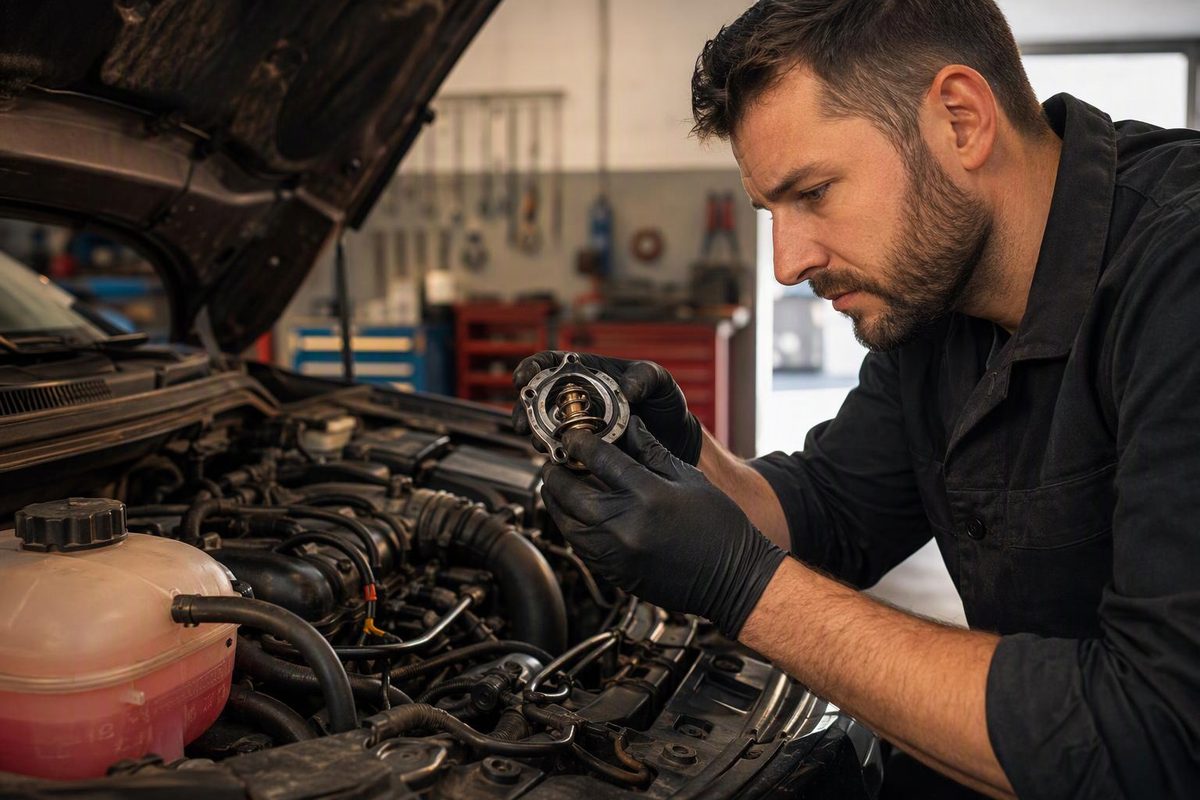
Slow warm-up, weak cabin heat and temperature drops at highway speed can suggest an open thermostat. Check coolant and scan data before replacing it.
The strongest thermostat stuck open symptoms are slow engine warm-up, coolant temperature that stays below the vehicle’s specified range, and temperature that drops during highway driving. Weak cabin heat and a check-engine light with P0128 can accompany that pattern. But a low gauge reading or P0128 alone does not prove the thermostat has failed. AutoZone’s P0128 guide identifies slow warm-up, high-speed temperature drops and several alternative causes.
A stuck-open thermostat allows radiator circulation before the engine needs that cooling. A thermostat that opens too early or does not seal properly can produce a similar cold-running pattern without being completely jammed open. For example, Subaru bulletin 09-56-13 documents premature thermostat opening as a cause of P0128 on specified Subaru applications.
Which symptoms matter most?
| Observation | Diagnostic value |
|---|---|
| Engine takes unusually long to warm up on a familiar route | Suggests excessive cooling, especially if conditions are comparable to previous trips. |
| Temperature rises in town but falls at steady highway speed | Supports a thermostat that is leaking through or opening too early. Confirm the drop with live coolant-temperature data. |
| Heater stays lukewarm or heat fades while cruising | Supports under-temperature operation if engine coolant temperature also stays low. |
| Check-engine light with P0128 | Indicates coolant temperature below the expected regulating temperature; it is not a parts-replacement instruction. |
| Fuel economy worsens | Can accompany cold running, but is too nonspecific to diagnose a thermostat. |
Poor heater output and reduced fuel economy are recognized thermostat-fault symptoms in AutoZone’s thermostat guide. The highway-temperature-drop pattern is also described by Identifix.
Overheating is not the usual stuck-open pattern. If the gauge climbs into the hot zone, steam appears, or coolant is escaping, stop safely and shut the engine down. Do not keep driving on the assumption that an “open thermostat” makes the cooling system safe. Use the broader cooling-system diagnostic sequence.
Confirm the fault from a cold start
You need a scan tool that displays live engine coolant temperature—usually labeled ECT—and service information for the exact model year and engine. An infrared thermometer can provide a supporting surface-temperature check.
1. Check coolant before running the test
With the engine completely cold, check coolant at the points specified in the owner’s manual. Look for leaks and note any recent cooling-system work. Low coolant must be investigated before interpreting temperature readings or replacing the thermostat.
Never remove a radiator or pressurized reservoir cap while hot. AutoZone’s P0128 procedure specifically puts the cold coolant-level check ahead of component replacement.
Stop point: If coolant is low, find and correct the loss, refill and bleed according to the vehicle procedure, then repeat the warm-up check.
2. Save codes and check the starting temperature
Before clearing anything, record stored and pending codes and available freeze-frame data. Note coolant temperature, outside temperature, vehicle speed and engine load where available.
After an overnight soak, switch the ignition on without starting. Compare ECT with intake-air temperature and the actual outside conditions. They should be reasonably close after temperatures have equalized; use the manufacturer’s tolerance rather than an invented universal limit. A large unexplained difference calls for sensor and wiring checks before blaming coolant flow. Identifix describes this cold-start comparison.
A sensor can mislead the thermostat diagnosis: an FCA May 2021 diagnostic communication specifically calls for an additional coolant-temperature-sensor check before thermostat replacement when the preceding cooling-system checks find no issue. Use the diagnostic routine for your vehicle, not that sensor test as a universal procedure.
3. Record warm-up under repeatable conditions
Start cold and log ECT during a normal drive. Keep heater settings consistent and record outside temperature, elapsed time and driving conditions. Set up logging before moving; do not operate the scanner while driving.
Compare the result with the vehicle’s specified warm-up behavior and operating range:
- ECT rises and stabilizes normally, but the dashboard gauge stays low: investigate the indication problem rather than replacing the thermostat on the gauge reading alone.
- ECT stays low or drops repeatedly during steady cruising: check for premature radiator circulation and abnormal cooling-fan operation. Compare fan operation with the vehicle’s diagnostic procedure; continuous running alone is not a verdict.
- ECT is normal but cabin heat is weak: follow the heater-system diagnosis, including coolant flow and air-temperature controls.
There is no universal “must reach this temperature in five minutes” rule for every gasoline or diesel engine. Do not treat prolonged idling in cold weather as a definitive thermostat test.
4. Use radiator temperature as supporting evidence
Identify the thermostat and coolant-flow layout from service information; do not assume it is always at the upper radiator hose.
On a conventional system, monitor accessible radiator-side hose or inlet surfaces with an infrared thermometer from a safe position. A clear temperature rise as the thermostat opens is useful evidence. Premature radiator-side warming can support leakage through the thermostat—but surface readings are not coolant readings, and heat conduction and vehicle-specific bypass arrangements prevent this from being a standalone verdict.
Keep hands and tools away from belts and fans; electric fans can start unexpectedly. AutoZone describes scan-data and infrared checks as alternatives to removing the thermostat.
When replacement is justified
Replacement is supported when coolant level and temperature readings are credible, the cooling system has no other identified cause of overcooling, and testing shows the thermostat remains open when it should close or opens below specification.
For a removable conventional thermostat, follow the service-manual bench test: heat it gradually in water with a thermometer, record when it begins opening, and verify closure as it cools. Simply dropping it into boiling water proves little about whether it opens too early. Identifix emphasizes testing the opening temperature, not just whether it opens.
Check applicable service bulletins before buying parts. For example, Mazda bulletin 01-021/13 attributes P0128 on specified models to PCM control logic, with eligibility depending on model and, in some cases, freeze-frame readings.
Use the correct thermostat rating or housing assembly, renew the specified seals, and follow the exact torque, coolant-fill and bleeding procedures. Verify the repair by repeating the cold-start drive and checking for stable temperature, restored heater output, leaks and returning codes.
Can you drive while it is running cold?
A confirmed under-temperature fault without leaks or overheating is generally less urgent than an overheating engine, but arrange repair promptly rather than leaving it indefinitely. Identifix classifies P0128 as moderately urgent, not automatically a tow situation.
That does not establish a safe mileage allowance. Stop if temperature rises abnormally, coolant is lost, or windshield defrosting is inadequate. Until the readings and coolant level have been checked, “it only runs cold” remains a symptom—not a confirmed diagnosis.