
Burnt Smell From Car? Follow the Timing to the Right Check
Separate oil leaks, slipping belts, electrical faults, hot brakes and clutch slip with safe checks—and know when a burnt smell means stop driving.
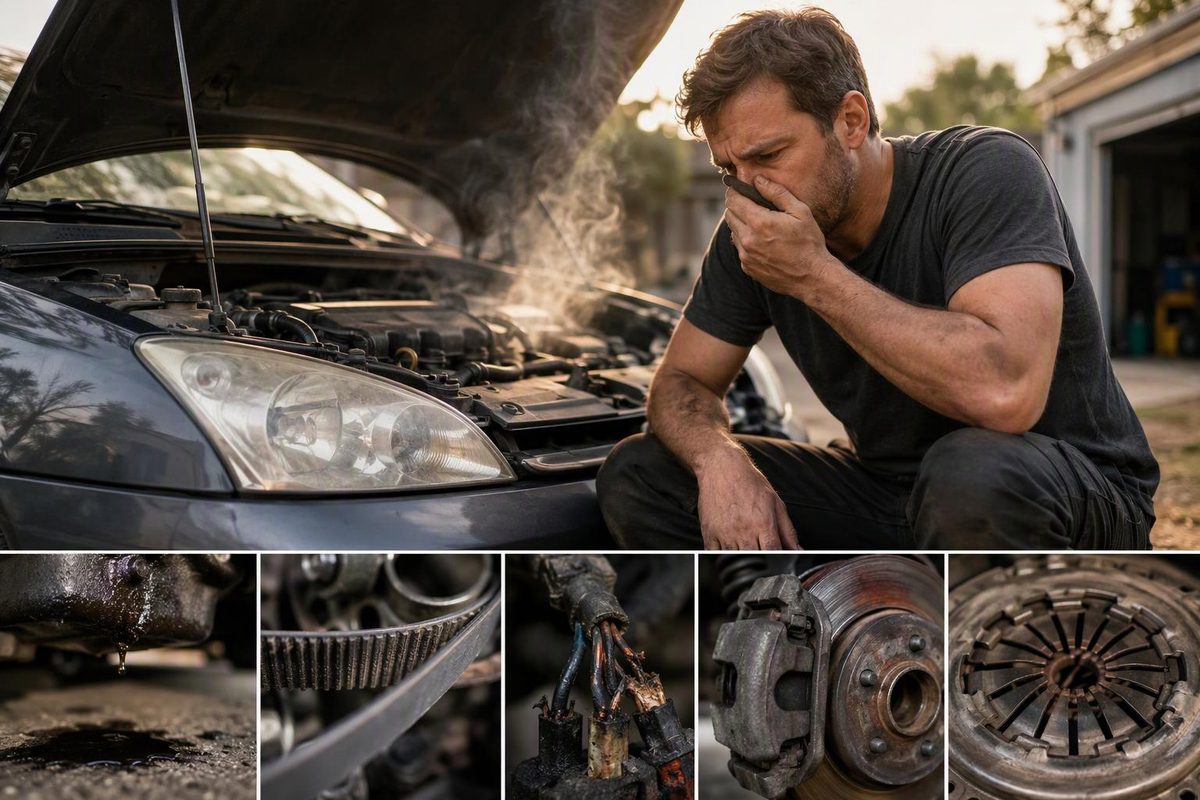
A burnt smell from a car can come from oil on the exhaust, a slipping accessory belt, overheated wiring, hot brakes or a slipping clutch. The smell alone does not identify the failed part. Where it appears, when it starts and what changes with it are more useful clues.
Start with safety, then follow the branch that matches your symptoms. Do not deliberately reproduce a strong burning smell to prove a diagnosis.
Stop driving or inspect after cooling?
Pull over safely and switch off the engine if the odor is strong, persistent or worsening, or if it comes with smoke, abnormal braking, power loss, an oil-pressure warning or an overheating indication. Suspected electrical burning also warrants stopping rather than continuing to test accessories. Arrange roadside assistance or a tow instead of driving on. Firestone’s burning-odor guidance identifies these as reasons to stop and get assistance.
If you suspect a fire: get everyone out, stay well away from traffic and move at least 100 feet from the vehicle. Do not return for belongings. Call emergency services—911 in the United States. These are the steps in the NFPA car-fire safety sheet. Do not open the hood to investigate a suspected fire; adding air can intensify it. Mobil’s car-fire guidance explains that risk.
A faint odor without those warning signs may allow a cooled, stationary visual inspection—not permission to keep driving indefinitely. Park outside on a firm surface away from dry grass, switch off the ignition and keep the key away from the vehicle. Do not touch hot exhaust parts, belts, fans or brakes, open a hot cooling-system cap, or crawl under a car supported only by a jack.
Record the conditions before choosing a test
Note your vehicle’s year, model, engine and transmission, then record:
- Timing: cold start, fully warm, after parking, after braking, during a hill start, or with the cabin blower running.
- Location: engine bay, one wheel, underneath, tailpipe or dashboard vents.
- Other evidence: smoke location, fluid spots, squealing, warning messages or RPM rising without matching acceleration.
- Recent work: oil change, belt work, brake service or exhaust repairs.
Treat odor descriptions—rubber, plastic, oily or burnt paper—as clues, not pass/fail tests.
Oily smell after warm-up or parking
First question: is oil burning outside the engine or passing through it?
An external leak can put oil onto a hot exhaust manifold or another heated surface, producing an odor and sometimes engine-bay haze. Blue smoke from the tailpipe instead points toward oil entering combustion, though it does not identify which internal component is responsible. AAA describes oil-level loss, burning odor and bluish exhaust smoke as useful observations.
With the engine cool:
- Check the oil level using the owner’s manual procedure; record the reading rather than adding oil blindly.
- Inspect accessible areas around the filler cap, valve cover, filter housing and recent service points for fresh wetness.
- Look for a visible route from that wetness toward the exhaust. Oil on a lower component does not prove that component is leaking.
Spilled oil after an oil change is possible, but so is an active leak. Firestone lists both spills and leaking filters, gaskets and seals. Have residue cleaned safely and the suspected source rechecked. Fresh oil returning after cleaning supports an ongoing leak; odor alone does not justify a gasket replacement. Do not run the engine to test a leak that is dripping onto hot exhaust parts.
Rubber smell with squealing from the engine bay
Follow the accessory-drive system, not the timing belt by default. Low accessory-belt tension can cause slipping, noise, high temperatures and premature wear. Gates explains these effects and its tensioner inspection checks.
With the engine off and cool, inspect accessible belt edges for fraying, contamination and abnormal tracking. Also look for a displaced hose or plastic debris near hot components—both can produce a similar odor.
A damaged belt is a finding, but it may be the result rather than the cause. Before fitting another belt, have pulley alignment, tensioner movement and bearing condition checked. Gates’ bearing check is performed with the engine off and belt removed: noise, resistance or roughness while turning the tensioner pulley supports bearing wear. Belt removal and spring-loaded tensioner handling require the correct vehicle procedure.
Do not reach toward a running belt or spray products onto it to silence the symptom.
Burnt plastic smell from vents or the dashboard
A failing blower motor, resistor, connector or wiring circuit is a possibility—not a diagnosis. Engine-bay odors can also enter through the ventilation system. Firestone identifies HVAC components and overheated wiring among electrical burning-odor sources.
Record which fan setting or accessory was operating when the smell began, then leave it switched off. Do not cycle it repeatedly to confirm the pattern.
Ask for inspection of the affected circuit’s connectors and wiring. Once the circuit is safe to energize, a technician can use voltage-drop checks against the vehicle’s service information to locate excessive resistance. Fluke explains why these checks can reveal faults a visual inspection misses. Melted insulation identifies heat damage; the repair still needs to establish why it overheated. Do not install a higher-rated fuse or keep replacing a fuse that blows repeatedly.
Smell near a wheel after braking
Heavy braking or a long descent can overheat brakes. A smell during ordinary driving without heavy braking raises concern for brake drag. Firestone distinguishes these patterns.
Do not touch a wheel or rotor to compare temperatures, and do not continue driving to see whether it clears. Request a brake inspection if the smell persists, one wheel is smoking, or braking feels different.
The inspection should check caliper function, pad and rotor condition, and whether the affected brake releases. Confirm the source of drag before ordering a caliper.
Burnt-paper smell after a manual-transmission hill start
Clutch slipping can overheat the friction material and create a sharp burning odor. Firestone describes this manual-transmission pattern.
Record whether engine RPM rose without a matching increase in road speed while the pedal was fully released. Do not attempt a high-gear stall test or repeated hard launches. Persistent slip needs inspection; the smell by itself is not enough to authorize a clutch kit. For the RPM distinction, see diagnosing acceleration loss versus transmission slip.
Diesel exhaust odor: check for regeneration
On some DPF-equipped diesels, a hot metallic odor can occur during regeneration. Ford’s diesel-particulate-filter guidance describes that odor and metallic clicking at low speed or idle as normal during the process.
Check your exact vehicle’s manual and any regeneration indication before treating this as normal. Do not initiate a parked regeneration simply to test a smell. A confirmed regeneration does not explain away leaking oil, melted wiring, a smoking wheel or an overheating warning.