
Fuel-filter intervals range from no routine replacement to 15,000-mile diesel service
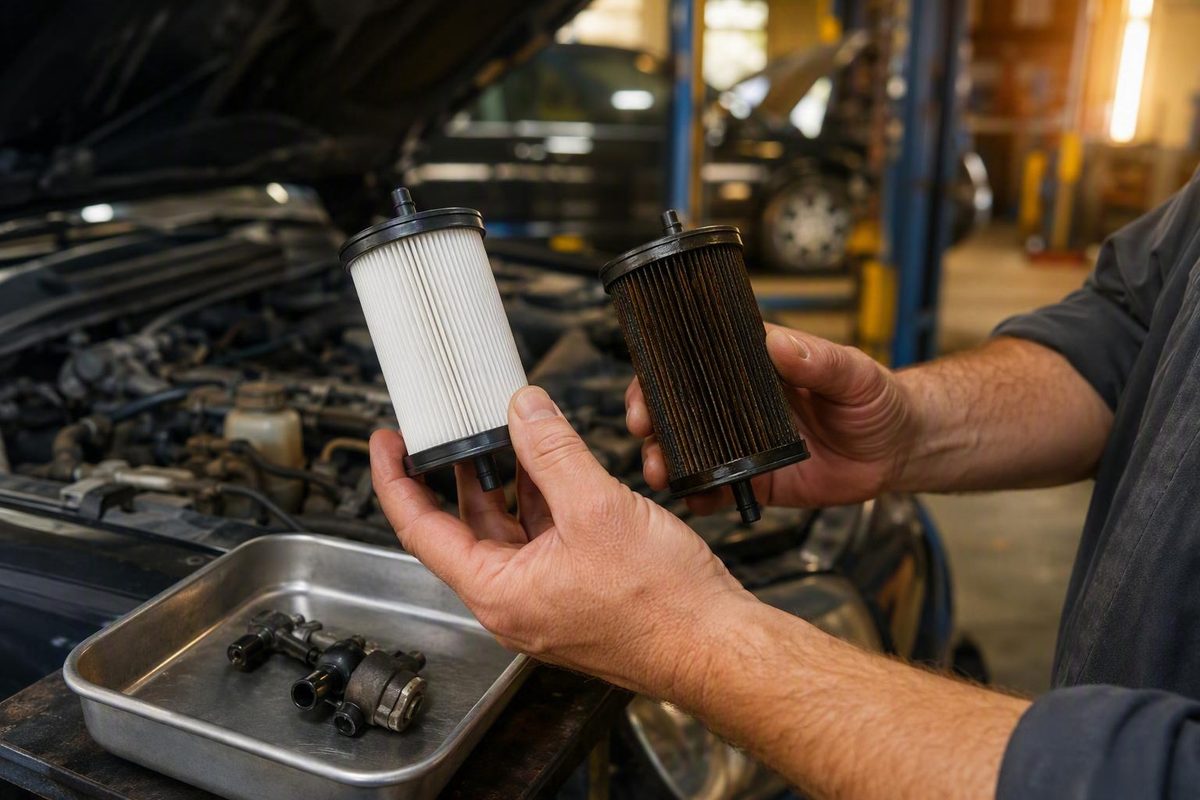
There is no universal fuel-filter interval. Use the exact owner’s manual, filter-life monitor and fuel-pressure tests before replacing the filter.
Change the fuel filter at the interval listed for your exact year, engine and drivetrain—or when the vehicle’s filter-life system tells you to. There is no reliable universal mileage.
Some gasoline vehicles use an in-tank filter with no scheduled replacement. Other versions of what appears to be the same vehicle may have a serviceable filter. Diesel schedules can call for replacement by mileage, time or engine hours, and severe use can shorten the interval.
Why “every 30,000 miles” is not a safe general rule
Filter design and maintenance requirements can differ within one model line. In one Ford owner’s manual, the 2.0L and front-wheel-drive 3.0L versions have a lifetime filter integrated into the tank, while the all-wheel-drive 3.0L version requires replacement at its scheduled interval (Ford). That is why make and model alone are not enough; engine and drivetrain matter.
Use this order:
- Find the maintenance schedule for the exact model year, engine, fuel type and market.
- Search both the main owner’s manual and any diesel supplement.
- Look for a normal schedule, severe-duty schedule and time or engine-hour limit.
- Check the dashboard for a fuel-filter-life percentage or change message.
- If no replacement interval is listed, confirm whether the filter is part of the in-tank module before ordering parts.
This follows the same vehicle-specific approach used in a broader car maintenance checklist.
Diesel filters often have shorter, condition-dependent schedules
Do not apply a gasoline vehicle’s “lifetime filter” logic to a diesel. As one concrete example, a Ford diesel severe-use schedule calls for both engine-mounted and frame-mounted fuel filters every 15,000 miles, six months or 600 engine hours under conditions including frequent low-speed operation and extended idling (Ford). That is an example, not a specification for every Ford diesel or every truck.
Some diesels calculate filter life instead. The 2022 GM 3.0L Duramax supplement says its system estimates remaining useful life based on driving conditions and displays CHANGE FUEL FILTER when life is low. It also says the display must be reset after replacement and does not reset itself (General Motors). Treat that message as a service instruction, not merely a suggestion to inspect the filter.
If the history is unknown, diagnose before replacing
An unknown service history does not prove that the filter is clogged. Before using a filter as a guess for hard starting, hesitation or low power:
- scan for all stored and pending codes and save freeze-frame data;
- inspect the filter housing, fuel lines and connectors for leakage, damage or air entry;
- check for a filter-life or low-fuel-pressure message;
- measure supply pressure or restriction under the operating condition that produces the symptom, using the manufacturer’s test point and specification;
- on a diesel water separator, follow the manual’s procedure if a water-in-fuel warning is present.
Replace the filter when the specified interval or monitor calls for it, when inspection finds contamination or damage, or when a vehicle-specific pressure/restriction test supports a restricted filter. If pressure remains out of specification afterward, continue testing the supply pump, tank pickup, lines, pressure control and electrical circuit rather than installing another filter.
After replacement, use the specified filter, seals, torque and priming procedure. Check carefully for leaks with the engine running, and reset a filter-life monitor only after the new filter is installed.