
How to Recognize an Internal Engine Leak—and What the Symptoms Cannot Tell You
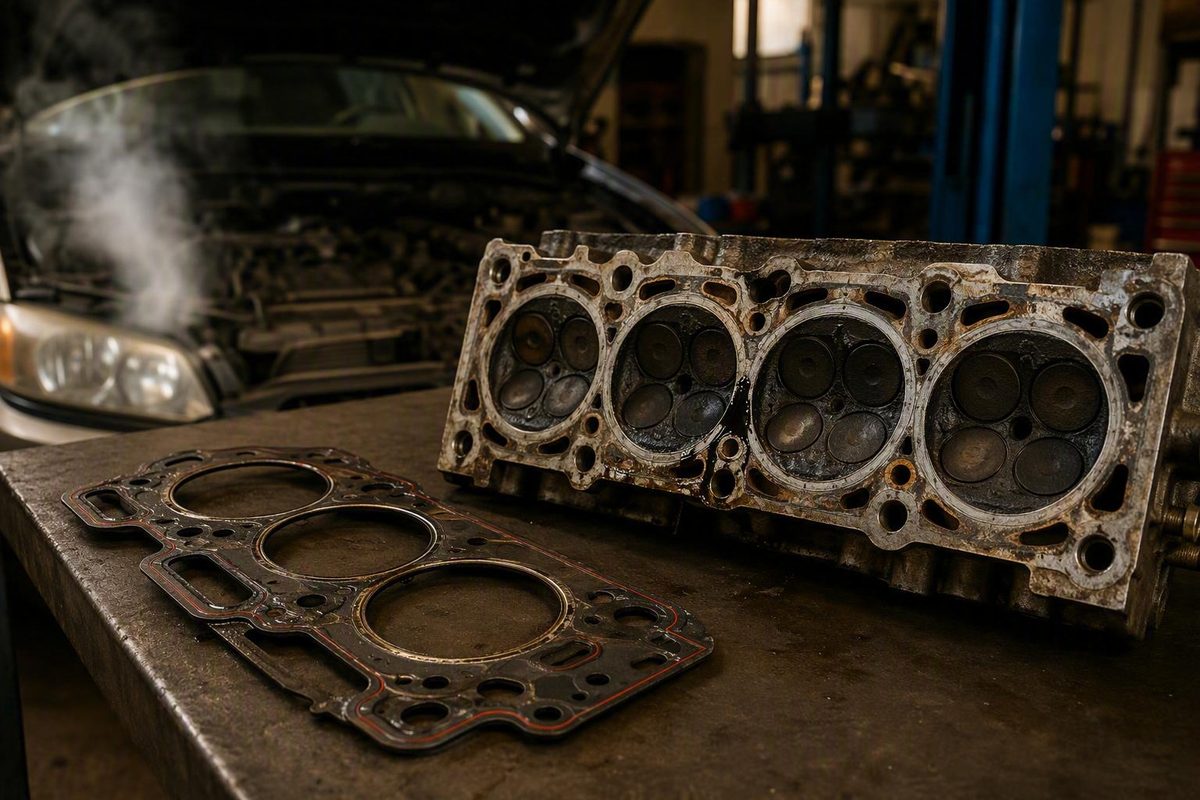
Recurring overheating, unexplained coolant loss, persistent white exhaust, cooling-system bubbles and contaminated oil can occur with either failure.
The short answer: the symptoms overlap
A blown head gasket and a cracked cylinder head can cause nearly identical symptoms. Recurring overheating, unexplained coolant loss, persistent white exhaust, cooling-system bubbles, contaminated oil, misfires, rough running, and reduced compression can occur with either failure. Symptoms can establish suspicion, but they usually cannot identify the damaged part.
The components are different:
- The head gasket seals the joint between the engine block and cylinder head. It retains cylinder pressure while keeping coolant and oil in their intended passages.
- A cracked cylinder head is a fracture in the metal of the cylinder head itself.
- A cracked engine block is a separate structural failure, not another name for a cracked cylinder head.
A failed gasket or cracked head can create an abnormal path between a combustion chamber, coolant passage, oil passage, adjacent cylinder, or the outside of the engine. What you observe depends more on the location and severity of that path than on whether it passes through gasket material or cylinder-head metal.
For example, coolant entering a cylinder can produce white vapor and a cold-start misfire. Combustion pressure entering the cooling system can cause bubbles, coolant displacement, and abnormal pressure. A breach between adjacent cylinders can reduce compression in both. None of those patterns identifies the failed component by itself.
No single symptom—and no informal count of symptoms—proves that the gasket is blown or the head is cracked. Even several related symptoms may establish only that an internal sealing failure is likely. Definitive crack identification can require cylinder-head removal and machine-shop pressure testing because small cracks may not be visible during an ordinary inspection (Fel-Pro’s comparison of cracked heads and failed head gaskets).
| Observable sign | Likely leak path or problem | Common alternative causes | Urgency | Useful next test |
|---|---|---|---|---|
| Rapid or recurring overheating | Combustion gas entering coolant, coolant loss, or impaired circulation | Low coolant, thermostat, fan, pump, belt, radiator, cap, or hose leak | Shut down safely if the temperature rises abnormally | Cold inspection, pressure test, combustion-gas test |
| Coolant loss without a puddle | Coolant entering a cylinder or oil, or a hot-only external leak | Hose, radiator, reservoir, cap, heater circuit, or water pump | Diagnose promptly; shut down if loss is rapid | Cooling-system pressure test |
| Thick white exhaust after warm-up | Coolant entering a combustion chamber | Cold-weather condensation or another source of moisture | Shut down if heavy, persistent, or accompanied by overheating | Plug inspection, pressure test, combustion-gas test |
| Continuous coolant bubbles or reservoir overflow | Cylinder pressure entering coolant | Trapped air, incorrect filling, or boiling from another cooling fault | High concern, especially with rapid pressurization or overheating | Combustion-gas or leak-down test |
| Milky oil throughout the dipstick or sump | Coolant entering an oil passage or crankcase | Intake-gasket leak on applicable engines | Do not continue running the engine | Fluid inspection and pressure testing |
| Oily coolant | Oil entering a coolant passage | Oil-cooler failure or residual contamination | Avoid normal driving until diagnosed | Pressure testing and component-specific checks |
| Cold-start misfire or rough running | Coolant entering a cylinder or loss of compression | Ignition, fueling, injector, valve, piston, or ring problem | Shut down for severe misfire or a flashing Check Engine light | Code scan, plug inspection, compression test |
| Low compression in adjacent cylinders | Cylinder-to-cylinder breach | Valve, piston, ring, or other mechanical damage | Diagnose before continued normal use | Leak-down test |
| Fluid trace near the head-to-block joint | External gasket leak | Hose, valve-cover gasket, housing, pump, or fluid running from above | Depends on leak rate and temperature behavior | Clean, inspect, and pressure-test cold |
Preliminary testing can often identify the leak path. It may show that cylinder pressure is reaching the cooling system, for example. What it may not show is whether the path runs through the gasket, a crack, a warped sealing surface, corrosion, or another defect. If that distinction changes the repair, removal and specialist inspection may be necessary.
The main warning signs and what causes each one
The clearest way to interpret the signs of a blown head gasket or cracked head is to group them by what is crossing a barrier inside the engine.
Repeated overheating or an abnormally rising temperature gauge
Combustion pressure leaking into coolant can displace coolant, create gas pockets, raise system pressure, and interfere with cooling. Coolant loss through another leak path can also leave the engine unable to control temperature.
The cause-and-effect relationship can run in either direction. An internal leak can make the engine overheat, but a cooling-system failure can overheat the engine first, damage the gasket, distort sealing surfaces, or crack the cylinder head. A complete repair must therefore address both the internal damage and any fault that initiated or worsened the overheating.
Steam or reservoir overflow may accompany coolant loss or impaired circulation, but neither identifies the failed component.
Unexplained coolant loss
Coolant can disappear without leaving a puddle if it enters a combustion chamber, mixes with oil, or escapes only when the engine is hot and pressurized. A small internal leak may open only at a particular temperature, pressure, or engine load.
Document repeated coolant loss under consistent conditions. Check the level only when the engine is fully cold. An occasional correction after cooling-system service differs from a level that repeatedly falls.
No visible puddle does not prove an internal leak. A hose connection, radiator seam, cap, water-pump seal, or another external component may leak only while hot. Coolant can spray, evaporate on a hot surface, or collect away from the visible source.
Persistent thick white exhaust after warm-up
Coolant entering a combustion chamber can vaporize and emerge from the tailpipe as dense, steam-like exhaust. This is more concerning when it continues after warm-up and appears with falling coolant, a startup misfire, overheating, or abnormal cooling-system pressure.
Brief white vapor during a cold or wet start may simply be condensation. Color and odor are not proof. A supposedly sweet smell cannot distinguish a cracked head from a gasket breach, and the apparent color or density can vary with weather and lighting.
A small temperature-sensitive leak may be most visible at startup. Coolant can seep into a cylinder while the vehicle sits, cause a brief misfire and vapor cloud after starting, and then become less obvious as the engine warms.
Continuous bubbles, abnormal pressure, or reservoir overflow
Combustion gas entering a coolant passage can cause sustained bubbling, rapid pressure buildup, coolant displacement, or overflow. The important distinction is between continuous or repeatable gas release and ordinary coolant movement.
Bubbles alone remain inconclusive. Trapped air after cooling-system work, an incorrect filling procedure, or boiling caused by another cooling fault can also disturb the coolant.
Milky or emulsified oil and oily coolant
Coolant mixed throughout the engine oil can produce a tan, brown, or milky emulsion. The dipstick level may appear unexpectedly high if coolant has entered the sump. Oil can also move in the opposite direction and leave a film or sludge in the cooling system.
Cross-contamination compromises both fluids. Emulsified or diluted oil cannot lubricate normally, while contaminated coolant may not transfer heat as intended. Widespread coolant contamination in the oil creates a risk of bearing and lower-engine damage and is a reason to shut the engine down (Hagerty’s technical discussion of internal fluid mixing and leak paths).
Residue confined to the underside of the oil-filler cap is less specific. Short trips, condensation, cold operating conditions, or a crankcase-ventilation problem can create cap residue without widespread coolant contamination. Milky material on the dipstick or throughout drained oil is substantially more concerning.
An intake-gasket leak can also allow coolant contamination on engines with that possible path. Fresh, verified cross-contamination supports an active or recent abnormal connection, but historical residue after an earlier repair must be ruled out before assuming the leak is current.
Startup misfires, rough idle, difficult starting, or a flashing Check Engine light
Coolant that collects in a cylinder while the engine is parked can wet or contaminate the spark plug and interfere with combustion on startup. A sealing breach can also reduce compression. Either condition may cause rough running, hesitation, difficult starting, or a cylinder-specific misfire.
Timing matters. A misfire that is strongest immediately after a cold start and then clears may fit a small coolant leak, especially if coolant is also disappearing. A continuous misfire may reflect a larger leak, but ignition, injector, wiring, valve, piston, ring, or other mechanical problems remain possible.
Power loss and low compression
A cylinder cannot produce normal power if pressure escapes during compression or combustion. The result may be weak acceleration, rough running, or a low compression-test reading.
Two neighboring cylinders with similarly low compression can be consistent with a breach between them. That pattern does not independently prove a failed gasket; valve damage, cracked or warped metal, and other mechanical faults remain possible.
External oil or coolant near the head-to-block joint
A gasket can leak outward rather than between internal passages. Coolant staining, wetness, crusty residue, or oil along the joint may support an external head-gasket leak.
Trace the fluid before assigning the source. Oil from a valve-cover gasket or coolant from a hose, housing, pump, or nearby connection can run down the engine and collect at the head-to-block seam. Cleaning the area and conducting an appropriate pressure test is more reliable than judging the lowest wet point.
The absence of a classic sign does not clear the engine. Either a failed gasket or a cracked head can exist without milky oil, visible white exhaust, obvious bubbles, or an external leak. Symptoms reflect the particular areas connected by the failure.
When to stop driving immediately
Treat these as stop-now conditions:
- The temperature gauge rises abnormally or enters the hot zone.
- Steam comes from the engine bay.
- Thick white exhaust remains heavy after warm-up.
- The engine misfires or shakes severely.
- The Check Engine light flashes.
- The dipstick shows widespread milky contamination or an unexplained increase in oil level.
- Coolant is being lost rapidly or expelled from the reservoir.
Move out of traffic and shut the engine off as soon as it is safe. Continued operation during overheating can worsen gasket damage, distort sealing surfaces, warp or crack the cylinder head, and expand the repair beyond the original failure. Published guidance on suspected head-gasket failure likewise recommends stopping when overheating, steam, or persistent white exhaust appears rather than continuing to drive (CRC Industries’ symptom and shutdown guidance).
Coolant-contaminated oil is another reason not to run the engine. Bearings depend on proper lubrication, and diluted or emulsified oil cannot provide normal protection. Continued operation can add bearing or broader lower-engine damage to the original repair.
Coolant passing through the exhaust may also affect oxygen sensors and the catalytic converter. Coolant passing out through the exhaust will require oxygen sensor replacement and possibly catalytic converter replacement Identifying Blown Head Gaskets & Cracked Heads | Fel-Pro Gaskets.
Never remove a radiator cap or another pressurized cooling-system cap while the engine is warm or has just been shut off. Wait until the engine is fully cold and follow the vehicle manufacturer’s procedure; opening a warm pressurized system can release hot coolant (Bar’s Leaks’ cooling-system safety warning).
There is no universal safe driving distance. Arrange towing or professional assistance if the engine overheats, loses coolant rapidly, runs with a severe misfire, shows contaminated oil, or produces heavy persistent white exhaust. The fact that an engine still runs does not mean continued driving is safe for the engine (BookMyGarage’s guidance on driving with suspected head-gasket failure).
Some patterns are less dramatic but still require prompt inspection before normal driving continues:
- Gradual, repeatable coolant loss
- An intermittent cold-start misfire
- Recurring cooling-system bubbles
- White vapor that lasts longer than ordinary condensation
- A small external leak near the head-to-block joint
- Unexplained cooling-system pressurization
These signs may reflect an early, intermittent, or temperature-sensitive leak. Delaying diagnosis gives the problem more opportunities to develop into overheating or lubrication failure.
Safe preliminary checks with the engine cold
These checks establish a pattern; they do not diagnose a gasket or crack by appearance alone.
1. Let the engine cool completely
Park on level ground and wait until the engine and cooling system are fully cold. Do not open a warm pressurized system.
2. Record the coolant level
Check the reservoir and, only where the manufacturer’s cold-check procedure permits, the radiator or designated fill point. Photograph or mark the level so later comparisons are meaningful.
Look for dried coolant residue, staining, dampness, or deposits around:
- Radiator and reservoir seams
- Upper and lower hoses and connections
- Thermostat housing
- Water-pump area
- Heater hoses
- Coolant outlets and crossover pipes
- Head-to-block joint
An external leak that appears only when the system is hot or pressurized may leave residue without a fresh puddle.
3. Inspect the oil condition
Remove the dipstick, wipe it, reinsert it, and check the oil consistently. Look for widespread tan or milky emulsion, droplets that do not resemble normal oil, or a level that has risen unexpectedly.
Inspect the filler cap too, but interpret it separately. A small amount of pale residue confined to the cap is not equivalent to contamination throughout the sump. If the dipstick and visible oil show widespread emulsion, do not restart the engine merely to see whether it clears.
4. Treat any running observation cautiously
If the vehicle has not overheated, the fluids appear normal, coolant is at the correct cold level, and the manufacturer’s procedure permits operation, note whether ordinary cold-start vapor clears. Shut the engine down immediately if the temperature becomes abnormal, steam appears, coolant is expelled, or the engine begins running severely rough.
Do not keep an overheating engine running to complete an observation. Persistent exhaust after warm-up can be useful evidence, but deliberately maintaining an unsafe condition is not.
5. Record when each symptom occurs
Note whether the problem appears:
- Only after the vehicle sits overnight
- During the first few seconds after startup
- After warm-up
- Under acceleration or load
- At idle
- Continuously
Temperature and pressure can change a sealing gap or the behavior of a small crack. Intermittent symptoms remain relevant even if the engine seems normal during a brief inspection.
6. Scan for diagnostic trouble codes
If a scan tool is available, record stored, pending, and current codes before clearing anything. Cylinder-specific misfire data can help identify the affected cylinder.
A trouble code does not identify a blown gasket or cracked head. It identifies the cylinder or system in which the control module detected a problem. Ignition, fueling, wiring, airflow, and other mechanical faults can generate similar codes.
7. Build a diagnostic record
Write down:
- Cold coolant level and rate of consumption
- Temperature behavior
- Whether exhaust vapor clears
- Cold-start versus warm misfire behavior
- Trouble codes and affected cylinders
- Dipstick, filler-cap, and reservoir condition
- Evidence of external leaks
- Recent overheating or cooling-system repairs
This record helps a technician interpret the test results together rather than treating each observation as an isolated symptom.
Tests that locate the leak path
There is no universal first test for every engine. Access, engine design, symptom history, coolant condition, and whether the fault appears only when hot can all influence the sequence. The practical approach is staged: identify affected cylinders, test sealing, look for combustion-to-coolant leakage, and check the cooling system for pressure loss.
Code scan and spark-plug inspection
Misfire codes can identify the cylinder most affected. Comparing spark plugs may reveal one that is unusually clean, wet, crusted, or otherwise different from the others. Coolant contamination can contribute to that appearance.
Neither observation proves the failed component. Fuel, oil, ignition trouble, injector failure, or another mechanical problem can also affect a plug. Plug evidence is most useful when it agrees with coolant loss, startup behavior, and another leak test.
Compression test
A compression test compares each cylinder’s ability to build pressure while cranking. A substantially low cylinder indicates lost sealing, but the escape path could involve a valve, piston, rings, gasket, cracked metal, or another defect.
Two adjacent low cylinders may suggest a breach between them. If coolant loss or abnormal cooling-system pressure is also present, an internal head-area failure becomes more concerning. The readings still do not separate a failed gasket from cracked or otherwise damaged metal.
Normal compression does not completely exclude a small coolant leak. A leak that opens only when hot, under higher pressure, or after a heat soak may not appear during a cold cranking test.
Cylinder leak-down test
A leak-down test places regulated compressed air into a cylinder positioned for testing and allows the technician to observe where pressure escapes.
Bubbles appearing in the radiator or reservoir during the test support communication between the pressurized cylinder and the cooling system (Hagerty’s explanation of compression, leak-down, and coolant testing).
That is strong evidence of a cylinder-to-coolant path. It still may not reveal whether the route passes through a gasket breach, crack, warped surface, or another defect.
Combustion-gas or chemical block test
A chemical block tester samples gas from the cooling system through a test fluid designed to change color when combustion gases are detected. A positive result supports combustion leakage into coolant.
The result must be interpreted in context. A small or intermittent leak may not release detectable gas during the test.
A positive result identifies a combustion-to-coolant relationship, not automatically a blown gasket. A cracked head or another internal sealing defect can create the same path.
Cooling-system pressure test
This test applies controlled pressure to the cooling system with the engine off and monitors whether pressure falls.
Pressure loss establishes leakage but does not identify its source. The cause could be a hose, radiator, cap interface, heater component, water pump, gasket, cracked head, or another cooling-system part. If coolant appears in a cylinder during the test, that localizes the path further but still may not identify the failed material.
Fluid cross-contamination checks
Fresh coolant in oil or oil in coolant supports an abnormal mixing path. The next task is to identify the possible routes for that engine.
Historical residue is not the same as evidence of an active leak.
Combine the findings
Diagnostic confidence comes from agreement among independent observations. For example:
- Coolant loss plus a cold-start misfire suggests a possible cylinder-entry path.
- A misfire code and unusual spark plug help identify the affected cylinder.
- Cooling-system bubbles during leak-down support communication between that cylinder and the coolant.
- A positive combustion-gas test independently supports combustion leakage into the cooling system.
Together, those findings provide stronger evidence of a cylinder-to-coolant breach than any one observation. They still may not show whether the gasket, cylinder head, or sealing surface is responsible. Compression, combustion-gas, plug, code, and cross-contamination checks are diagnostic aids rather than a symptom-only shortcut (AutoZone’s overview of head-gasket leak testing).
Negative findings also require restraint. A small, intermittent, load-sensitive, or temperature-dependent leak may evade one compression, chemical, pressure, or leak-down test. Another suitable test—or repeating a test under controlled conditions—may be needed before ruling out an internal fault.
When head removal and machine-shop testing become necessary
Non-invasive tests can establish that an internal leak exists without showing its physical route. Once testing supports cylinder-to-coolant, cylinder-to-cylinder, or coolant-to-oil communication, the remaining possibilities may include:
- A failed section of head gasket
- A cracked cylinder head
- A warped cylinder-head sealing surface
- Corrosion, erosion, or other surface damage
- A defect in the engine block or another component
If the repair requires head removal, the removed parts provide evidence that external testing cannot.
The corresponding head and block surfaces should be examined for tracking, corrosion, distortion, and damage.
A visible crack is direct evidence of structural damage, but ordinary visual inspection cannot reveal every crack. This is why specialist pressure testing may be necessary even when no crack is obvious after removal.
Depending on the head’s material, design, suspected crack location, and the specialist’s procedure, machine-shop evaluation may include:
- Thorough cleaning and visual inspection
- Flatness and dimensional checks
- Pressure testing
- Dye-penetrant inspection
- Other material-appropriate crack-detection methods
In dye-penetrant inspection, penetrating dye enters a surface-opening crack and is made visible during the inspection process. Pressure testing is another commonly used specialist method for investigating leakage from concealed passages after removal; the appropriate procedure depends on the head and suspected defect (overview of cracked-cylinder-head testing).
Do not assume that every cracked head can be repaired or that every crack requires replacement.
A severe overheat should widen the inspection. Head-gasket replacement or cylinder-head work may not be the complete repair if the engine also suffered lubrication loss, major thermal distortion, cylinder damage, or lower-end distress. Oil condition, compression history, bearing evidence, and overall engine condition may affect whether repair, rebuilding, or replacement is practical.
Keep the diagnoses separate throughout this process: a cracked or warped cylinder head is not a cracked engine block. Both can create internal leak paths, but they involve different components, inspections, and repair decisions.
Common problems that can mimic these symptoms
An internal sealing failure is only one explanation for overheating, coolant loss, vapor, contaminated-looking residue, or poor running. Ruling out alternatives can prevent unnecessary disassembly and may uncover the fault that caused the engine damage.
Cooling-system faults
Overheating may result from:
- Low coolant
- A split hose or loose connection
- A leaking or ineffective water pump
- A broken or slipping pump-drive belt
- A stuck or malfunctioning thermostat
- An electric-fan or fan-control failure
- A restricted or damaged radiator
- A faulty pressure cap
- Air trapped after service
- Another external leak or circulation problem
Some leaks occur only when coolant is hot and pressurized. The fluid may spray, evaporate, collect on an undertray, or leak while driving, leaving no obvious cold puddle. A dry driveway therefore does not establish an internal leak.
Overheating alone does not prove that a gasket has failed. However, an unresolved cooling-system fault can eventually produce gasket damage, warpage, or cracking. Diagnosis may reveal both an initiating cooling fault and a resulting internal leak.
Normal condensation
White tailpipe vapor during a cold or wet start may be water condensation in the exhaust. It should generally become less prominent as the exhaust warms.
Thick vapor that continues after warm-up, especially with measurable coolant loss or a startup misfire, is more concerning. Persistence raises suspicion but still does not distinguish a cracked head from a gasket breach.
Oil-cap condensation and crankcase-ventilation problems
A pale emulsion under the filler cap may result from moisture that has not evaporated during repeated short trips. A crankcase-ventilation problem can also contribute to moisture and sludge.
Compare the cap with the dipstick and oil in the sump. Cap-only residue is less persuasive than emulsion throughout the oil. If coolant is genuinely entering the oil, an intake-gasket leak may be another possible route on applicable engines.
Ignition, fuel, and unrelated mechanical faults
Rough idle, difficult starting, misfire codes, and power loss can result from:
- Worn or fouled spark plugs
- Ignition-coil or wiring faults
- Injector or fuel-delivery problems
- Air leaks
- Sensor or control faults
- Valve leakage
- Piston or ring damage
- Timing problems
- Other causes of low compression
A misfire paired with coolant loss deserves investigation for an internal leak, but a misfire by itself is not a head-gasket diagnosis.
External leaks that resemble a gasket leak
Fluid often travels before it drips. Oil from the top of the engine can run down to the head-to-block joint, while coolant from a hose or housing can follow a casting seam. Clean the area, locate the highest fresh wet point, and use an appropriate pressure or tracer method rather than replacing the component nearest the drip.
When overheating has occurred, diagnose two separate layers:
- Is there now an internal sealing failure?
- What caused the original cooling problem?
Replacing a damaged gasket while leaving a failed fan, restricted radiator, leaking pump, faulty thermostat, hose problem, or defective pressure cap unresolved invites another overheat.
From evidence to a repair decision
A disciplined repair decision follows a sequence:
- Verify the symptom pattern. Document coolant consumption, temperature behavior, exhaust persistence, misfire timing, codes, and fluid condition.
- Identify the likely leak path. Decide whether the evidence points toward combustion-to-coolant, coolant-to-cylinder, coolant-to-oil, cylinder-to-cylinder, or an external leak.
- Rule out external and cooling-system faults. Check the components that can produce the same signs or initiate overheating.
- Combine non-invasive test results. Interpret compression, leak-down, combustion-gas, cooling-system pressure, plug, code, and fluid evidence together.
- Remove the cylinder head only when needed. Disassembly becomes appropriate when the confirmed leak requires repair or the remaining uncertainty changes the repair scope.
- Inspect for the original cause and secondary damage. Do not stop the diagnosis at the first failed part.
Secondary checks should reflect the vehicle’s history. Coolant-contaminated oil raises concern about bearings and the lower engine. A severe overheat warrants checking cylinder-head distortion and broader engine condition. Prolonged coolant entry into the exhaust may justify evaluating oxygen-sensor and catalytic-converter operation, but those parts should not be replaced automatically.
Repairability and economic practicality are vehicle-specific. Engine layout, access, damage severity, cylinder-head material, machining results, parts availability, labor requirements, vehicle condition, and possible lower-engine damage all affect the decision. Generic cost figures cannot determine whether a particular engine should receive a gasket, repaired or replacement head, rebuild, or complete replacement.
Pour-in gasket sealers should not be treated as established permanent repairs. They do not remove the need to locate the leak, assess overheating damage, or correct the cooling-system fault that caused or worsened the problem.
Most importantly, repair the cause as well as the consequence. A new gasket or serviced cylinder head remains vulnerable if the engine still has a faulty fan, inadequate coolant circulation, leaking hose, damaged pump, restricted radiator, thermostat problem, or defective cap.
The diagnostic takeaway is simple: symptoms establish suspicion, tests identify the leak path, and removed-head inspection may be required to identify the failed part. Shut the engine down for overheating, steam, severe misfire, heavy persistent white exhaust, or contaminated oil; make only safe cold-engine observations; and interpret test results together.
Frequently asked questions
Can a blown head gasket occur without milky oil or white exhaust?
Yes. Symptoms depend on which areas the failed gasket connects. A breach that allows combustion gas into coolant may cause pressure, bubbles, coolant loss, or overheating without allowing coolant into the oil or enough coolant into a cylinder to create visible exhaust.
A small cylinder-to-coolant or cylinder-to-cylinder leak can also produce an intermittent misfire or low compression without obvious fluid mixing. The absence of milky oil and white exhaust rules out only those visible effects, not head-gasket failure as a whole.
Does a positive combustion-gas test prove the head gasket is blown?
No. It supports the presence of combustion gases in the cooling system, meaning there is likely a path from a combustion area into coolant. A failed head gasket can create that path, but so can a cracked cylinder head, damaged sealing surface, or another internal defect.
Combine the result with leak-down observations, pressure behavior, compression readings, plug condition, and overheating history. A positive chemical test supports further diagnosis but does not identify the damaged component by itself.
What does low compression in two adjacent cylinders suggest?
It can suggest a breach between the cylinders, particularly when both readings are substantially lower than the others. A failed gasket between neighboring cylinders is one possible cause.
The pattern remains inconclusive. Valve damage, cracked or warped metal, and other mechanical faults can also reduce compression. A leak-down test can help localize pressure loss, while inspection after head removal may be required to identify the physical defect.
Can a cracked head cause intermittent coolant loss or a cold-start misfire?
Yes. A small or temperature-sensitive crack can leak only under certain conditions. Coolant may seep into a cylinder while the engine sits, causing a brief startup misfire, and the symptom may diminish as the engine warms. Coolant consumption can occur without a visible puddle or continuous white exhaust.
A head-gasket breach can produce the same pattern, so intermittent behavior does not distinguish the two. Record coolant use and cold-start symptoms, then combine pressure, combustion-gas, compression, and leak-down findings.
Can I drive a short distance with suspected head-gasket or cylinder-head damage?
There is no universally safe distance. If the engine is overheating, steaming, losing coolant rapidly, misfiring severely, producing heavy persistent white exhaust, showing a flashing Check Engine light, or running with coolant-contaminated oil, shut it off safely and arrange towing or professional assistance.
Even gradual coolant loss or an intermittent cold-start misfire deserves prompt diagnosis before normal driving continues.