
Spot Timing Belt Trouble Before Replacing The Wrong Parts
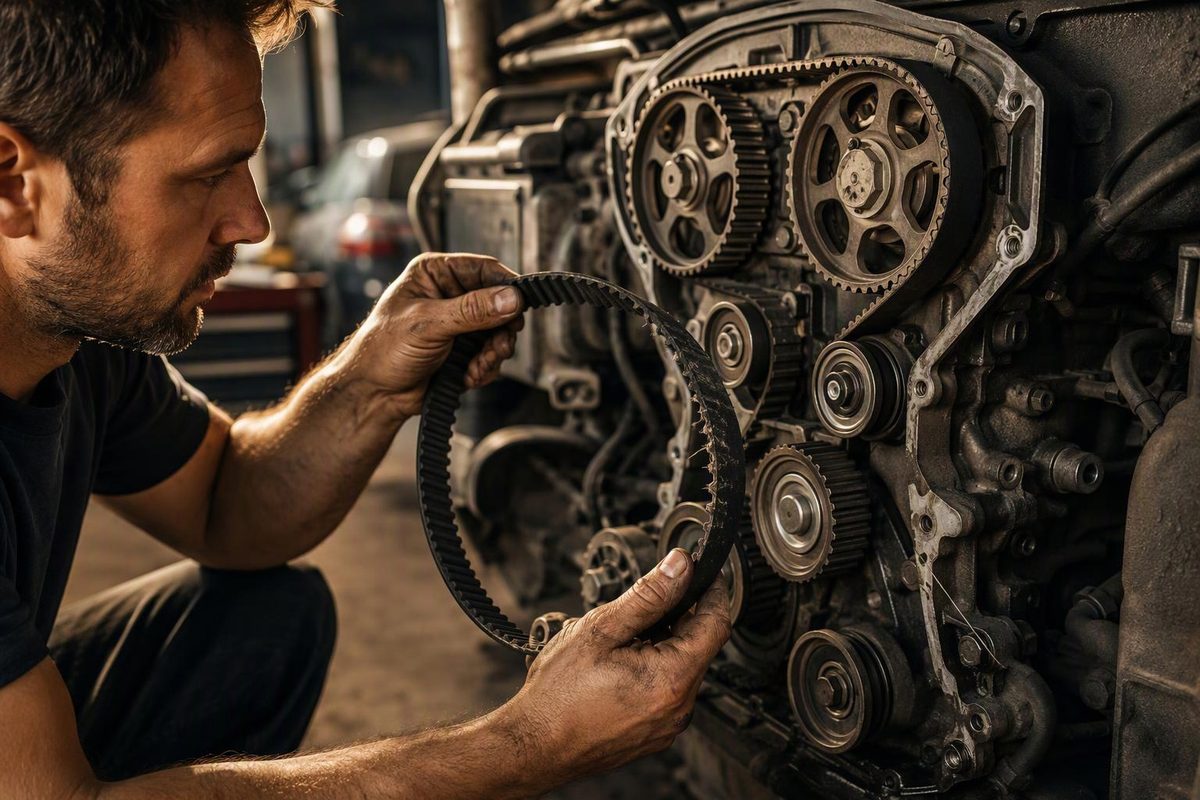
Learn which timing belt symptoms call for a tow, what visible damage means, and how timing, tensioner, and leak checks separate belt trouble from other faults.
A timing belt going bad may cause new timing-drive noise, rough running, hard starting, sudden stalling, or visible belt damage—but it can also break without warning. Running symptoms alone do not prove a belt fault. Stop safely, switch off, and arrange a tow for suspected timing-drive failure after a sudden stall, severe new mechanical noise, or a belt with missing teeth, major fraying, looseness, or breakage. Do not keep trying to restart it.
Choose the symptom and your belt-service history to see the next useful action.
Timing Belt Next-Step Check
Next Action
Arrange Replacement: History Unknown
Establish the exact engine and its service requirements. Gates recommends replacement when belt age or mileage cannot be established; a visual inspection cannot determine remaining life.
No symptoms does not prove the belt is serviceable. Internal belt fatigue can be invisible.
What This Check Cannot Establish
Symptoms do not confirm a belt fault, and this tool cannot establish remaining belt life or internal engine damage. Verify that the engine actually uses a timing belt. Apply the exact engine's inspection and timing procedures; oil exposure alone is not a fault on a belt-in-oil system.
Sources: Gates belt inspection and synchronous-drive failure guidance; AA1Car interference-engine guidance, as cited in the article.
A quiet engine and a clean-looking belt are not reasons to extend the replacement interval. Gates explains that internal tensile-member fatigue can be invisible even when a belt is near the end of its service life. Follow the vehicle’s replacement schedule rather than waiting for symptoms. Gates belt inspection guidance
When Timing Belt Trouble Requires A Tow
Sudden stalling with suspected timing-drive trouble, severe new mechanical noise, and major visible belt damage warrant stopping the engine—not another test drive. Continued restart attempts are not a useful way to establish whether the belt is intact.
The belt synchronizes the crankshaft and camshaft. On an interference engine, loss of that synchronization can allow pistons to strike valves. Damage is possible, not inevitable on every engine. Confirm the exact engine’s design rather than assuming from the vehicle badge. Timing belt failure and interference engines
Symptoms Point To Checks, Not Automatic Belt Replacement
| What You Notice | What It Could Mean | Next Useful Check |
|---|---|---|
| New whining, rubbing, or rattling near the timing cover | Incorrect tension, misalignment, or a drive-component fault | Locate the source; inspect tracking, tensioner, idlers, and driven components with the engine off |
| Rough idle, misfiring, weak power, or hard starting | Incorrect timing, ignition trouble, fuel trouble, or another fault | Save scan data; verify mechanical timing if history or codes point there |
| Sudden stall, then cranking without starting | Broken belt or stripped teeth interrupting camshaft drive | Stop restart attempts; inspect belt integrity and timing before further cranking tests |
| Oil or coolant around the timing cover | A leak that may threaten a dry belt | Trace the leak; inspect inside the cover using the engine-specific procedure |
| Cracks, edge wear, abrasion, or damaged teeth | Belt deterioration or an underlying drive fault | Replace the damaged belt and identify the cause |
Gates lists incorrect tension and misalignment among causes of belt noise, and low tension or seizure of a driven component among causes of tooth shear. Diagnosis must therefore cover the whole timing drive, not just the belt rubber. Gates failure guide
Tooth loss can leave the belt physically present but unable to maintain timing. In a specific 2019 Honda V6 recall, Honda documented teeth breaking away, belt slippage, incorrect timing, stalling, and possible engine damage. That illustrates the failure mechanism; it does not establish that your vehicle is recalled. Honda recall statement
Establish The Engine And Replacement History First
Record the model year, engine code or displacement, mileage, and the date and mileage of the last documented belt replacement. Confirm whether the engine uses a timing belt, timing chain, or a combination. The visible accessory or serpentine belt is not the timing belt.
Check the manufacturer’s maintenance schedule for that engine, including any time limit, severe-use provisions, or applicable updates. There is no universal replacement mileage. If replacement history is unknown, a visual inspection cannot establish remaining life. Gates recommends replacement when belt age or mileage cannot be established. Gates inspection guidance
If the engine uses a chain instead, follow the separate guide to timing-chain replacement decisions.
Save Codes Before Testing The Suspect Drive
Note whether the symptom occurs cold, hot, at idle, under load, or immediately after belt service. Save diagnostic codes and freeze-frame data before clearing anything. Reading stored codes does not require repeatedly starting a suspect engine.
A camshaft/crankshaft correlation code such as P0016 is a reason to investigate synchronization—not an automatic belt diagnosis. Ross-Tech’s VW/Audi guidance lists both timing and camshaft-adjuster issues and calls for checking belt setting, cam timing, and adjusters. Apply the diagnostic procedure for your engine. Ross-Tech P0016 guidance
An isolated misfire without timing-drive evidence should not send you straight to belt replacement. On gasoline engines, ignition-coil testing is one relevant alternative path.
Inspect Belt Damage With The Engine Off
Only remove covers if you have the correct access procedure and can work safely. Keep hands and tools away from moving belts. Do not run the engine with exposed timing components as a casual listening test.
Look for back abrasion, transverse cracks, damaged edges, tooth-root cracks, and tooth-flank damage. Gates identifies these as replacement conditions. A short visible section without damage does not pass the entire belt. Gates inspection criteria
An external wet spot does not prove the belt is contaminated. Trace oil or coolant around the timing-cover area and inspect inside using the specified procedure. For a conventional dry timing belt, investigate oil contamination and repair its source. Gates contamination guidance
For a belt-in-oil system, use its engine-specific inspection and maintenance procedure rather than treating oil exposure alone as a fault.
Verify Mechanical Timing And Tension Before Buying Parts
Mechanical timing is a key check when a belt has allegedly jumped timing or symptoms began after replacement. Use the specified crankshaft/camshaft references, locking tools, and tension-check method. Record whether the references align and whether tension meets the engine’s specification.
Do not substitute a generic belt-twist test or force an engine through resistance. Gates emphasizes that installation procedures, tools, and tension specifications vary by engine. If the belt is broken or teeth are missing, have the damage-assessment procedure established before attempting to rotate or retime the engine. Gates replacement guidance
A Confirmed Fault Requires More Than A New Belt
A worn or damaged belt needs replacement, but a seized pulley, faulty tensioner, misalignment, or leak also needs correction. Otherwise, the new belt remains exposed to the original failure cause.
If timing was lost, assess possible internal engine damage before treating the repair as routine belt maintenance. Gates specifically warns that damage from a broken belt may need repair before a new belt is installed. Ask for findings on mechanical timing, drive-component condition, and any required cylinder-sealing tests—not just a quote for another belt. Gates repair guidance