
Do Not Condemn the Converter on Symptoms Alone
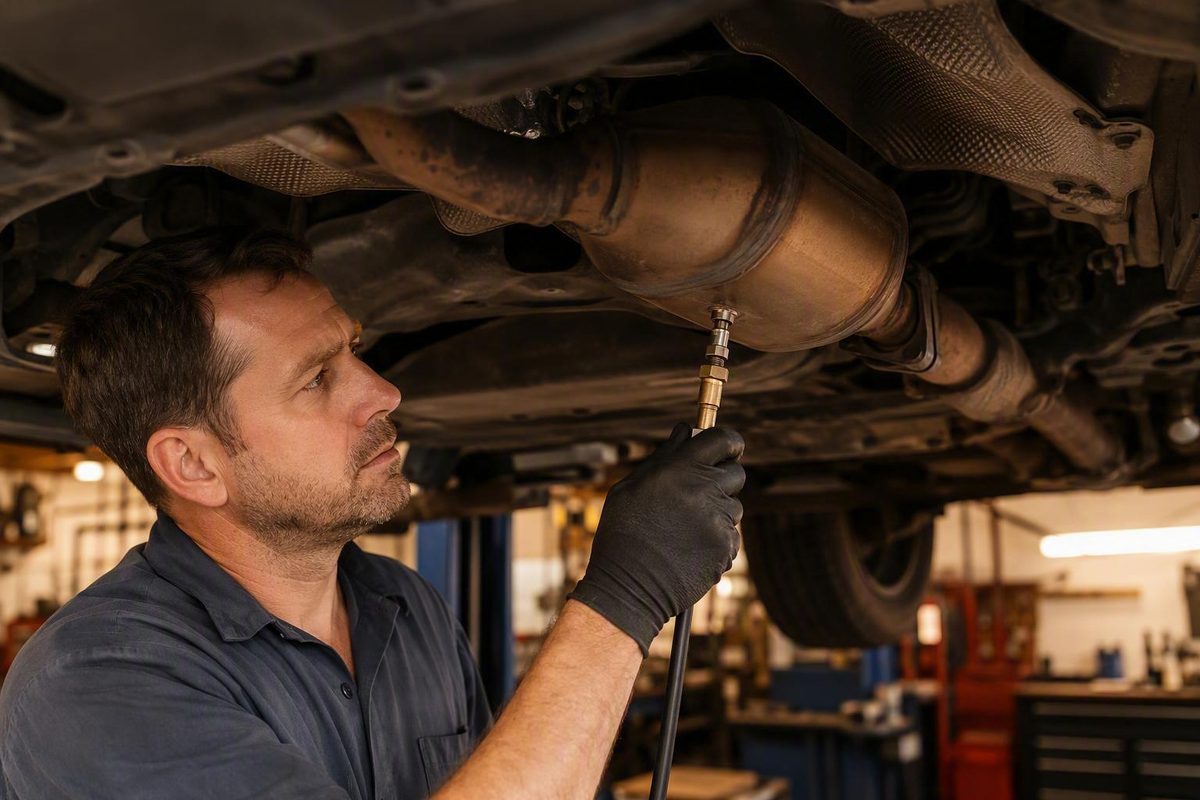
Symptoms alone cannot confirm a blockage; measure exhaust back pressure, then locate the restriction before replacing any component.
Symptoms alone cannot confirm a clogged catalytic converter. The supported diagnostic path is to treat the complaint as a reason to investigate, measure exhaust back pressure to determine whether the exhaust is restricted, and then locate the restriction before replacing any component. Even excessive back pressure establishes a restricted exhaust, not automatically a blocked converter.
The strongest sign is measured back pressure, not a symptom
Separate the diagnosis into three levels:
- Suspected problem: The vehicle’s behavior gives you a reason to investigate.
- Measured exhaust restriction: A back-pressure test produces an excessive reading.
- Localized restriction: Further diagnosis identifies the catalytic converter or another exhaust component as the blockage.
These findings are not interchangeable. The cited back-pressure instructions do not document those complaints as converter-specific signs.
If the reading exceeds the applicable limit, it indicates a restricted exhaust under the cited procedure. Pressure alone, however, cannot identify which component is restricted.
That distinction prevents an expensive diagnostic shortcut. Do not move directly from a symptom—or even from one excessive pressure reading—to converter replacement. First establish whether a restriction exists, then use the exact vehicle’s service information or professional testing to determine its location.
Tools, access points, and safety precautions
It describes two connection methods:
- Remove the check valve from an exhaust-manifold A.I.R. pipe, attach the universal adapter to the gauge hose, and insert the adapter into the pipe.
- Remove an oxygen sensor, attach the appropriate O2-sensor adapter to the gauge hose, and install the gauge assembly in the sensor port.
The instructions also recommend eye protection meeting ANSI Z87.1 and OSHA standards.1
These instructions are not a complete vehicle-specific service procedure. Do not improvise a gauge connection or attempt component removal without the correct tools and experience. If the approved access point is unclear, the required adapter is unavailable, or removing the oxygen sensor or A.I.R. check valve is beyond your experience, have a qualified technician conduct the test.
Before testing, consult current service information for the exact vehicle. Confirm the approved access point, component-removal procedure, reinstallation requirements, and pressure specifications for that engine and exhaust configuration.
Back-pressure test procedure and decision table
The following sequence summarizes the cited Bosch instructions. Its pressure limits are reference values from a document issued by Bosch Automotive Service Solutions on September 26, 2014, and reproduced through a third-party upload. 1
- Identify the appropriate A.I.R.-pipe or O2-sensor access point.
- Install the compatible adapter and back-pressure gauge.
- Bring the engine to normal operating temperature as required by the applicable service procedure.
- Observe the gauge with the engine idling.
- If pressure at idle exceeds 1.25 PSI, stop the test without increasing engine speed.
- If idle pressure is no more than 1.25 PSI, continue by holding the engine at 2,500 RPM and observing the gauge.
- Shut off the engine and restore the removed sensor or valve according to current vehicle-specific instructions.
| Test stage | Cited maximum pressure | Interpretation | Next action |
|---|---|---|---|
| Idle at normal operating temperature | 1.25 PSI | At or below the limit | Continue to 2,500 RPM |
| Idle at normal operating temperature | 1.25 PSI | Above the limit: restricted exhaust | Stop; do not accelerate |
| Engine held at 2,500 RPM | 3 PSI | At or below the limit | Compare with the vehicle specification |
| Engine held at 2,500 RPM | 3 PSI | Above the limit: restricted exhaust | Stop and arrange localization |
The idle stop condition protects the gauge. According to the instructions, increasing engine speed after pressure has already exceeded 1.25 PSI at idle could damage the instrument. Do not continue simply to obtain a higher reading.
Worked examples: interpreting the gauge without overdiagnosing
The following examples apply the cited Bosch maxima of 1.25 PSI at idle and 3 PSI at 2,500 RPM; actual results must still be judged against current specifications for the vehicle being tested.1
Example 1: 0.8 PSI at idle
This reading is within the cited idle limit, so the staged test may continue at 2,500 RPM. It does not establish how the exhaust will perform at the next test stage or under every operating condition.
Example 2: 1.6 PSI at idle
This reading exceeds the cited idle limit. Record the finding as restricted exhaust and stop without increasing engine speed.
Example 3: 2.5 PSI at 2,500 RPM
Assuming the idle result was acceptable and the procedure was followed correctly, this reading is within the cited 3-PSI maximum. Compare it with the vehicle manufacturer’s current specification before drawing a final conclusion.
Example 4: 3.4 PSI at 2,500 RPM
This reading exceeds the cited maximum and indicates restricted exhaust under the Bosch instructions. It does not identify the catalytic converter as the restricted component.
What a positive result proves—and what it does not
An excessive reading confirms a restriction somewhere in the exhaust system under the cited procedure.1 It does not distinguish a restricted catalytic converter from another blocked, collapsed, or damaged exhaust component.
For that reason, pressure alone does not justify replacing, cleaning, drilling, or otherwise modifying the converter. Those actions assume a component-level diagnosis when the gauge has produced only a system-level finding.
Localization requires the diagnostic procedure and specifications for the exact vehicle or appropriate professional testing. Look for service information that identifies the approved test access points, applicable pressure limits, and manufacturer procedure for isolating an exhaust restriction. A supported localization workflow is outside the scope of the cited gauge instructions.
The repair decision should therefore follow this order:
- Confirm the restriction with an appropriate pressure test.
- Identify its location using current vehicle-specific information or professional diagnosis.
- Choose the repair only after the affected component has been established.
Treat symptoms as a reason to investigate, not as a parts verdict. A staged back-pressure test can show that the exhaust is restricted, but only localization can establish whether the catalytic converter is actually the blockage.
-
Bosch Automotive Service Solutions LLC, Exhaust Back Pressure Gauge, Rev. B, September 26, 2014, reproduced in a third-party Scribd upload. ↩↩↩↩