
How to Tell Whether Engine Oil Is Leaking Past the Valves
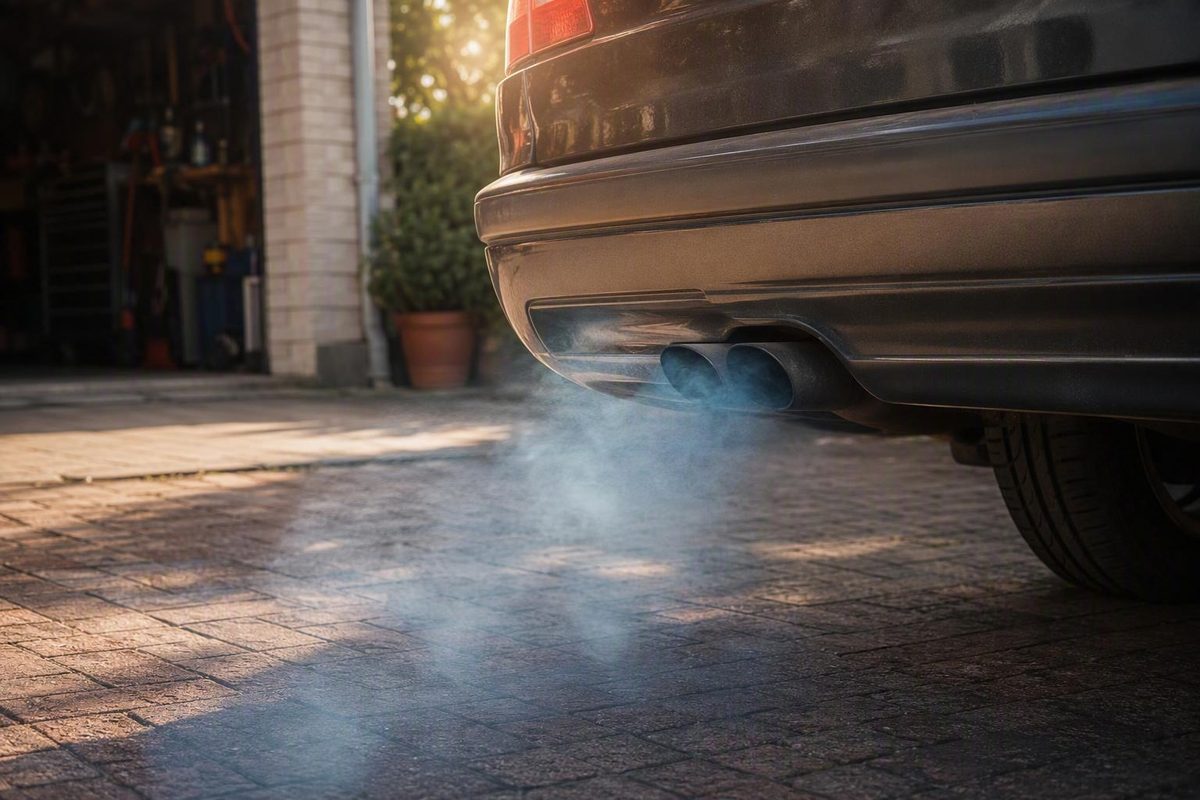
The most characteristic sign of bad valve seals is a brief blue or blue-gray exhaust puff after the engine has been sitting, especially on the first start of the day. Oil may seep through the valve-stem seal and guide area while the engine is off, then burn immediately after startup.
That pattern is a clue, not proof. Worn valve guides can create nearly identical symptoms. PCV-system faults, piston or cylinder wear, excessive oil level, and turbocharger leakage can also produce overlapping oil-smoke patterns. A defensible preliminary diagnosis combines smoke timing, measured oil consumption, spark-plug condition, checks of alternative oil-entry paths, compression and leak-down results, and engine-specific inspection.
The available evidence for these patterns consists mainly of third-party automotive guidance, commercial technical descriptions, and owner-forum observations rather than vehicle-manufacturer service information. Use this article to organize preliminary troubleshooting; the manufacturer’s procedures and specifications for the particular engine should control testing and repair decisions. The smoke patterns discussed are most directly applicable to conventional throttled gasoline engines and may differ with diesel, turbocharged, or variable-valve-control designs.
The Most Telling Signs of Bad Valve Seals
A small cloud at the first start after an overnight sit should place the valve-stem seal and guide area on the preliminary suspect list. A warm restart after the vehicle has been parked briefly can produce a similar, smaller puff. Informal troubleshooting accounts commonly explain this as oil collecting near a valve during shutdown, but they do not establish whether the seal, guide, or another oil-entry path is responsible (startup smoke comparison).
Other patterns consistent with leakage around the valve stems or guides include:
- Blue-gray smoke after several minutes of idling
- A puff when the throttle is opened after prolonged idling
- Smoke following a long closed-throttle descent or engine braking
- A puff when the throttle is reapplied after that descent
- Increasing oil consumption without an obvious external leak
- One or more oil-fouled spark plugs
- Intermittent rough idle or an oil-related misfire
Early or intermittent seal leakage may occur while power and compression remain relatively normal. A valve-stem seal controls oil around the stem; it does not serve as the primary combustion-pressure seal. An engine therefore does not have to feel mechanically worn out before oil can enter through this area.
Continuous smoke, smoke that increases under sustained load, pronounced power loss, or substantial crankcase blow-by calls for a wider investigation. Those findings can move piston, cylinder, PCV, or turbocharger faults higher on the list without conclusively excluding a cylinder-head problem.
A useful symptom hierarchy is:
| Evidence level | Findings | How to interpret them |
|---|---|---|
| Characteristic clues | Brief blue or blue-gray startup puff; puff after extended idle; smoke after overrun when the throttle is reapplied | Makes oil entry through the valve-seal or guide area more plausible |
| Supporting clues | Documented oil use; a repeatedly oil-fouled plug; oil trails near a valve; intermittent misfire | Supports oil entry but does not identify its route |
| Nonspecific symptoms | Rough idle, poor acceleration, oil smell, or continuous smoke | Can arise from seals, guides, rings, PCV faults, turbo leakage, fueling faults, or other problems |
| Urgent warnings | Rapid oil loss, heavy continuous smoke, an oil-pressure warning, persistent misfire, knocking, overheating, or marked power loss | Follow the shutdown and restricted-driving guidance below; these conditions warrant prompt assessment (blue-smoke risk guidance) |
Do not use black smoke as the primary evidence of leaking valve seals. Oil smoke is more commonly described as blue or blue-gray in the supplied troubleshooting sources. Lighting, condensation, exhaust temperature, and exhaust after-treatment can make color difficult to judge, so combine color with timing, duration, oil loss, and inspection findings.
Why the Timing of Blue Smoke Matters
Valve-stem seals fit around the valve stems in the cylinder head. Their purpose is to regulate oil at the stem-and-guide interface while restricting oil from traveling into the intake or exhaust port and combustion chamber. A commercial seal manufacturer describes this oil-metering function and also notes that seal replacement should account for guide and stem condition (valve-stem seal function).
When the engine is switched off, oil remains in the cylinder-head area. If a seal is hardened, torn, displaced, or no longer controlling oil adequately—or if guide clearance is excessive—some oil may travel along the valve stem. It can collect near the valve, in a port, or in a cylinder. That limited quantity then burns at the next start, producing a brief puff that clears.
During an extended idle, the quantity entering at any moment may be small; the smoke may become more noticeable only after the throttle opens and the accumulated oil is burned and expelled.
The same proposed mechanism explains a puff after engine braking. Oil may enter during a long closed-throttle descent and become visible when the driver accelerates again. Owner discussions associate this pattern with seals or guides, but the supplied sources do not agree that it is exclusive to them. Treat post-deceleration smoke as a directional clue, not a conclusive road test (deceleration-smoke and seal-inspection discussion).
These mechanisms implicate the valve stem and guide area, not necessarily the seal alone. Excessive guide clearance can allow lateral valve movement or leave more space than the seal can control. A new seal installed over a badly worn guide may therefore provide little improvement or only a temporary one.
It is also inaccurate to claim that valve seals can cause smoke only at startup. Severe leakage may produce smoke at idle or across several operating conditions. Once smoke becomes persistent, its pattern overlaps substantially with worn guides, piston oil-control problems, PCV faults, and turbocharger leakage.
Smoke-Timing Guide: Startup, Idle, Deceleration, and Load
Use this table to rank possibilities rather than diagnose a failed component:
| Operating condition | Observed pattern | Faults made more plausible | What the pattern does not prove |
|---|---|---|---|
| Cold start after an overnight sit | Brief blue or blue-gray puff that clears | Valve-stem seals or worn valve guides; oil collecting during shutdown | That the seals alone are defective or that the piston rings are healthy |
| Warm restart after a shorter sit | Small, repeatable puff after the engine has been parked | Pooled oil from a seal or guide area; another intake-side oil path | That any one component has failed |
| Extended idle followed by a throttle opening | Smoke appears after idling or as engine speed rises | Valve seals, valve guides, or PCV-related oil entry | That the cylinder head requires repair |
| Long closed-throttle descent followed by acceleration | Puff appears when the throttle is reapplied | Seal or guide leakage is commonly suspected | That the pattern is exclusive to the cylinder head |
| Hard acceleration, uphill load, or sustained throttle | Smoke increases with load | Piston oil-control or cylinder wear; turbocharger leakage where applicable | That rings are certainly defective or that seals cannot also be leaking |
| Continuous blue smoke | Smoke persists across several operating conditions | Severe seal leakage, worn guides, rings, PCV fault, or turbocharger fault | That constant smoke always means worn rings |
| Oil loss with little visible smoke | Dipstick level falls without an obvious plume | Any internal oil-entry path; external leakage must also be checked | That the engine is not consuming oil |
Third-party commentary suggests that a catalytic converter may make oil smoke less visible. Because that observation is not established here by manufacturer information, do not use plume visibility as a substitute for an oil-consumption log or plug inspection. On turbocharged vehicles, oil in relevant charge or exhaust plumbing—or smoke associated with boost—also puts turbocharger leakage into the differential (valve-seal, turbo, and ring discussion).
If another person observes the exhaust, keep the vehicle stationary outdoors, keep the observer clear of the vehicle and exhaust outlet, and do not attempt to turn around or watch the tailpipe while driving. Do not conduct an unnecessary road maneuver solely to provoke smoke; record patterns that occur during normal, lawful operation.
Supporting Symptoms Beyond the Exhaust
Documented oil consumption
Start with a known oil level. Park on comparable ground and use the manufacturer’s specified checking conditions, including any required engine temperature or wait time. Record:
- Date and odometer reading
- Oil level before adding oil
- Exact quantity added
- Whether checking conditions were comparable
- Any smoke event, external leak, misfire, or warning light
Do not apply a universal “acceptable” oil-consumption threshold. Engine design, oil capacity, mileage, operating conditions, oil specification, and manufacturer guidance differ. What matters during preliminary troubleshooting is whether the level falls consistently and whether the rate changes with operating conditions.
Inspect for external leakage as well. An external leak and an internal oil-burning fault can exist at the same time. Starting from an unknown level—or from an overfilled crankcase—makes later conclusions unreliable.
Oil-fouled spark plugs
A wet, oily, or heavily oil-ash-fouled spark plug supports the conclusion that oil is reaching that cylinder. It does not establish whether the oil arrived through a valve seal, worn guide, oil-control ring, PCV-fed intake path, or turbocharger.
Forum contributors discussing a repeatedly fouled plug also noted that good compression can coexist with the problem and that a damaged seal may be difficult to identify visually (plug fouling and visual-inspection limitations).
Record plug locations before cleaning or replacement. Photograph the full set under similar lighting and arrange the plugs by cylinder number. Do not infer the failed component solely from the position of deposits on an insulator or electrode.
Rough idle and misfires
Both symptoms are nonspecific.
If a misfire repeatedly follows the same cylinder and that cylinder’s plug is oil-fouled, the combination is more useful than either clue alone. It still identifies an affected cylinder rather than proving a defective valve-stem seal.
Normal power or compression
Valve-seal leakage can coexist with normal-feeling performance, especially when only a small amount of oil enters after shutdown or closed-throttle operation. The engine may start, idle, and accelerate normally once the initial oil has burned.
This distinction matters because the valve-stem seal does not retain cylinder compression. Normal compression therefore does not clear the seal or guide area. It also does not completely clear the pistons: an oil-control ring can be stuck, worn, or damaged while the compression rings continue to seal adequately.
Targeted visual evidence
A borescope or valvetrain inspection may reveal:
- Oil trails on a valve stem or the back of a valve
- Oil pooling after the engine sits
- One cylinder that appears wetter than the others
- A seal sitting at a different height
- An obviously displaced seal
These findings can corroborate a broader diagnosis but rarely complete it. Oil can spread after entering a cylinder, so a wet piston does not independently identify the route. Conversely, a torn sealing lip or worn guide may look normal during a limited visual inspection. Valve-stem and guide wear generally require measurement by the method and limits specified for the engine.
Bad Valve Seals vs. Rings, Guides, PCV, and Turbo Seals
The best comparison uses clusters of evidence rather than a single symptom:
| Possible fault | Pattern that favors it | Supporting findings | Important limitation |
|---|---|---|---|
| Valve-stem seals | Brief smoke after startup, extended idle, or closed-throttle deceleration; puff as the throttle reopens | Oil use, cylinder-specific plug fouling, and relatively normal compression or power early on | Worn guides can create the same pattern |
| Worn valve guides | Often nearly identical to valve-seal leakage | Measured excessive guide clearance, valve movement, or oil trails around affected valves | New seals may not control oil if guide clearance is excessive |
| Piston rings or cylinder wear | Persistent smoke or smoke that increases under hard acceleration, uphill load, or sustained throttle | Blow-by, reduced power, abnormal compression or leak-down findings, and continuing oil use | Good compression does not eliminate stuck or failed oil-control rings |
| PCV-system fault | Oil in the intake path; smoke or consumption varying with manifold vacuum or crankcase conditions | Abnormal liquid-oil accumulation in relevant PCV hoses, separators, or intake passages | A valve-rattle check alone is not a definitive diagnosis |
| Turbocharger oil leakage | Smoke associated with boost or particular idle/load transitions on a turbocharged engine | Abnormal oil in relevant charge or exhaust plumbing and supporting model-specific inspection findings | Not applicable to a naturally aspirated engine |
| Excessive oil level | Smoke begins after an overfill or service event | Dipstick confirms a level above the specified range; oil may be present in the intake path | Correcting the level does not exclude a second fault |
Valve seals versus valve guides
This is usually the hardest distinction to make without targeted mechanical inspection. Both faults affect oil movement along the valve stem, and both can produce startup, post-idle, or post-deceleration smoke. A seal may be hardened, torn, incorrectly installed, or displaced. A guide may be worn beyond its service limit even when the visible seal appears intact.
If guide clearance is excessive, replacing only the seal may produce limited or temporary improvement. The repair decision should therefore include guide and stem inspection or measurement whenever the engine-specific procedure requires it.
Valve seals versus piston or cylinder wear
Piston-ring or cylinder wear moves higher on the list when several findings occur together: smoke under sustained load, persistent oil burning, pronounced crankcase blow-by, reduced power, and abnormal cylinder-sealing results. None of these findings is mandatory in every failure, and no single one proves worn rings.
Compression-ring condition and oil-ring condition are not identical. Compression rings may retain enough pressure for acceptable test results while a stuck, worn, or damaged oil-control ring allows oil into the chamber. Informal ring-versus-seal discussions repeatedly note this limitation, which is why good compression cannot close the diagnosis (ring and seal troubleshooting discussion).
Valve seals versus PCV faults
A fault can provide another path for liquid oil to reach the intake or disrupt crankcase pressure control, allowing the symptoms to imitate internal wear.
Inspect the applicable valves, hoses, separators, covers, ports, and intake passages according to the vehicle manufacturer’s procedure. Some informal advice recommends shaking a removable PCV valve and listening for a rattle, but that observation does not verify correct flow under operating pressure and vacuum. Forum discussions themselves identify PCV faults as alternatives while acknowledging that no simple observation conclusively isolates valve seals (valve-seal and PCV troubleshooting discussion).
Valve seals versus turbocharger leakage
On a turbocharged engine, a turbo-related fault may allow oil into the intake/charge side or exhaust side. Relevant clues include smoke following boost and abnormal oil accumulation in the associated plumbing, interpreted through model-specific service information. A light oil film alone does not establish turbocharger failure.
Do not apply this differential to a naturally aspirated engine. If no turbocharger is installed, turbo oil leakage is not a candidate.
Excess oil and mixed failures
Check the dipstick before assigning the problem to internal wear.
Do not force an older or high-mileage engine into a seals-versus-rings choice. Valve seals may have hardened while guides, cylinders, and rings have also accumulated wear. Mixed faults can explain why one repair improves a smoke pattern without eliminating oil consumption.
A Diagnostic Sequence Before Replacing Valve Seals
1. Verify the oil level and start a consumption log
Check the oil by the manufacturer’s method. Correct an overfill before drawing conclusions, and do not run the engine below the safe range. Record the odometer, oil level, and exact amount added at each check. Note external leakage rather than assuming every missing quantity was burned.
2. Document exactly when the exhaust smokes
Record whether smoke appears:
- At the first cold start
- At a warm restart
- After several minutes of idling
- When the throttle opens after idling
- During or immediately after closed-throttle deceleration
- Under hard acceleration or sustained load
- Continuously across several operating conditions
Repeatability is more informative than a single observation. Record what happened without treating one smoke event as a component diagnosis.
3. Classify the exhaust observation cautiously
Blue or blue-gray smoke is consistent with burning oil, but color alone cannot identify the route. Black smoke generally points away from the characteristic valve-seal pattern described here, while white vapor requires separate consideration based on duration and accompanying evidence. Lighting and video processing can distort color.
A video can preserve timing and duration, but it cannot verify oil level, smell, plug condition, crankcase behavior, or internal engine condition. Use it as documentation, not as a diagnosis.
4. Inspect the PCV system and intake path
Follow the manufacturer’s flow checks, routing, restriction checks, and component-inspection procedure. Look for abnormal liquid-oil accumulation in the relevant hoses, separator, manifold, or intake tract. Confirm that replacement components and hose routing match the engine application.
Do not condemn or clear a PCV valve solely because it does or does not rattle when shaken. The complete system must operate correctly under actual engine conditions.
5. Inspect turbo-related paths where applicable
On a turbocharged engine, inspect the relevant intake, charge, and exhaust paths using model-specific service information before blaming the valve seals. Interpret oil accumulation and any turbocharger inspection findings by the manufacturer’s criteria rather than a generic rule.
This step can prevent unnecessary cylinder-head work when the oil is entering through a turbo-related path.
6. Remove, label, and compare the spark plugs
Keep each plug associated with its cylinder. Compare wet oil, ash, and fouling across the full set, then correlate the findings with recurring symptoms and cylinder-specific misfire information.
A uniformly contaminated set may suggest a shared oil-entry path but does not prove one. A single contaminated plug narrows the affected area without showing whether the oil source is above or below the piston.
7. Perform compression and leak-down tests correctly
Use the engine-specific preparation and specifications.
Compression testing compares the pressure developed by the cylinders. Leak-down testing helps locate combustion leakage toward the crankcase, intake valve seat, exhaust valve seat, or another chamber-sealing path. A wet-compression comparison may add context when compression-ring wear is suspected, but it is not a valve-seal test and does not directly evaluate oil-control rings.
Avoid universal pressure values, cylinder-to-cylinder percentages, or leak-down limits detached from the manufacturer’s service information.
8. Use targeted borescope or valvetrain inspection
If pooling during shutdown is suspected, inspect after a controlled sitting period and compare cylinders rather than judging one image in isolation. Look for oil trails, unusual wetness, a displaced seal, or deposits that correspond with a repeatedly fouled plug.
Keep the limitations in view: the source may be outside the camera’s field, oil may spread, and a damaged sealing lip can remain hidden. A clean-looking seal does not prove that it meters oil correctly.
9. Evaluate the guides and stems before choosing a seal-only repair
If the smoke timing, oil-use records, plug findings, alternative-path checks, and cylinder tests continue to implicate the cylinder head, follow the engine-specific procedure for checking the seals, stems, and guides. Measurement may require valvetrain disassembly or cylinder-head removal, depending on the design.
Authorize repair only when four parts of the diagnosis agree:
- The observed smoke and oil-use pattern is repeatable.
- Reasonable alternative oil-entry paths have been checked.
- Cylinder tests have ranked competing combustion-sealing faults.
- Physical inspection supports a repair of the seal-and-guide area.
Replacing seals solely because an engine smokes at startup skips the critical question: whether the seal is defective or can no longer control oil because the guide is worn.
What Compression and Leak-Down Tests Can—and Cannot—Tell You
Neither a compression test nor a leak-down test directly confirms a leaking valve-stem seal.
The terminology matters:
- A valve-stem seal meters oil around the valve stem and guide.
- A valve guide locates and supports the moving valve stem.
- A valve seat helps seal the combustion chamber when the valve closes.
Oil moving along a valve stem is outside what the test directly measures. An enthusiast discussion specifically corrects the misconception that cylinder pressurization exposes a stem-seal leak: it assesses sealing at the valve seat, not oil control at the stem (stem seals versus valve seats).
Weak or uneven results can reveal a sealing problem that requires localization. In some cases, a dry-versus-wet comparison may support suspicion of compression-ring or cylinder wear if adding a small amount of oil changes the result. The comparison still requires engine-specific interpretation.
Acceptable compression leaves valve-seal leakage possible because the stem seal does not retain combustion pressure. It also leaves two other possibilities open:
- A worn guide that permits oil passage without significant valve-seat leakage
- A failed or stuck oil-control ring while the compression rings continue to seal
A satisfactory leak-down result may make major leakage through compression rings or valve seats less likely under the test conditions. It does not prove that valve-stem seals are the remaining cause.
Use both tests to exclude or rank competing faults—not as pass-or-fail valve-seal tests. Follow the manufacturer’s preparation, specifications, and interpretation rather than applying a universal compression number or leak-down percentage.
When to Limit Driving and What a Repair Decision Must Address
A small, intermittent puff after startup does not by itself establish immediate engine failure. It does justify frequent oil-level checks, a consumption log, and diagnosis before the condition becomes more severe or obscures another fault.
Some symptoms call for different responses:
- Pull over safely and shut the engine off if an oil-pressure warning appears, the engine is severely overheating, or a pronounced mechanical knocking noise develops. Continuing to run the engine may expose it to an immediate lubrication or mechanical risk.
- Avoid further routine driving and arrange prompt assessment when oil is disappearing rapidly, smoke is heavy and continuous, a misfire persists, or power falls markedly.
- Do not restart until the oil level is checked if substantial oil loss is suspected.
These precautions apply regardless of whether the oil escaped through seals, guides, rings, a turbocharger, or an external leak. Third-party driving guidance likewise identifies rapid oil loss, an oil-pressure warning, heavy smoke, persistent misfire, knocking, overheating, and major power loss as reasons to stop or sharply restrict operation (driving-risk guidance).
The severity and timeframe depend on the engine, oil-consumption rate, catalyst design, and operating conditions; a specific failure or deadline cannot be predicted from smoke timing alone.
Valve-seal replacement is labor-intensive and engine-specific. It commonly requires partial engine disassembly, and the repair plan must account for valve-guide and stem condition. A commercial seal manufacturer similarly advises checking the guides and stems when addressing failed seals (seal replacement and guide considerations).
Some engines may allow seal replacement while the cylinder head remains installed, using an engine-appropriate method to retain the valves. Others require head removal or additional disassembly. Access, valve-spring arrangement, timing layout, camshaft design, and variable-valve hardware determine what is appropriate. There is no universal in-place procedure or universal labor estimate.
The principle is diagnosis before parts: verify the oil level, establish the smoke pattern, inspect PCV and turbo paths where applicable, compare the plugs, evaluate cylinder sealing, and assess the guides before paying for valve-seal replacement.
Frequently Asked Questions
Can bad valve seals cause smoke only when the engine starts?
Yes. A brief blue or blue-gray puff at startup that clears quickly is the characteristic pattern most often associated with oil seeping through the seal-and-guide area while the engine sits. It may appear mainly on the first start of the day or after a shorter warm soak.
It is not conclusive. Worn valve guides and other oil-entry paths can produce similar smoke, while severely leaking seals may also smoke after idling or during other operating conditions. Compare the repeatable startup pattern with oil consumption, plug condition, PCV and intake findings, and engine-specific inspection.
Can valve seals be bad even if compression is normal?
Yes. Valve-stem seals control oil around the valve stems; they do not retain combustion pressure. An engine can therefore have acceptable, even compression while oil leaks through a damaged seal or excessive guide clearance.
Normal compression also does not eliminate a piston-related oil-control fault. Compression rings may seal adequately while oil-control rings are stuck, worn, or damaged.
Does a leak-down test show whether valve-stem seals are leaking?
No. A leak-down test evaluates combustion-chamber sealing. It may reveal air escaping past compression rings, intake or exhaust valve seats, a head gasket, or another chamber-sealing path. It does not directly test oil movement along a valve stem.
A satisfactory result can make major combustion leakage less likely and help rank the alternatives. It cannot prove that the valve-stem seals are faulty.
How do bad valve-seal symptoms differ from worn piston-ring symptoms?
Valve-seal or guide leakage is more strongly suggested by a brief puff after startup, extended idle, or closed-throttle deceleration, particularly when power and compression remain relatively normal. Ring or cylinder wear moves higher on the list when smoke persists or increases under sustained load and occurs with blow-by, reduced power, continuing oil use, or abnormal cylinder-sealing results.
These are patterns rather than rules. Severe seal leakage can smoke continuously, defective oil-control rings can coexist with normal compression, and older engines may have seal, guide, and ring wear at the same time.
Is it safe to drive with suspected bad valve seals?
A small intermittent startup puff, with the oil maintained at the correct level and no warning symptoms, does not by itself establish an immediate failure. It still calls for monitoring and diagnosis.
Safety depends on severity rather than the suspected component. Apply the shutdown and restricted-driving criteria above: an oil-pressure warning, severe overheating, pronounced knocking, rapid oil loss, heavy continuous smoke, persistent misfire, or marked power loss should not be treated as a routine valve-seal symptom that can simply be watched.
The strongest reason to suspect valve seals is not blue smoke alone but a repeatable pattern: a brief puff after sitting, idling, or engine braking, supported by measurable oil use or cylinder-specific fouling and without clear evidence of major combustion leakage. Even then, worn guides, PCV faults, turbocharger leakage, excess oil, and piston-related problems remain possible. Document the pattern, test the alternatives, and inspect the seal-and-guide area before replacing parts or dismantling the cylinder head.