
How a Failing Ignition Coil Feels—and How to Confirm It
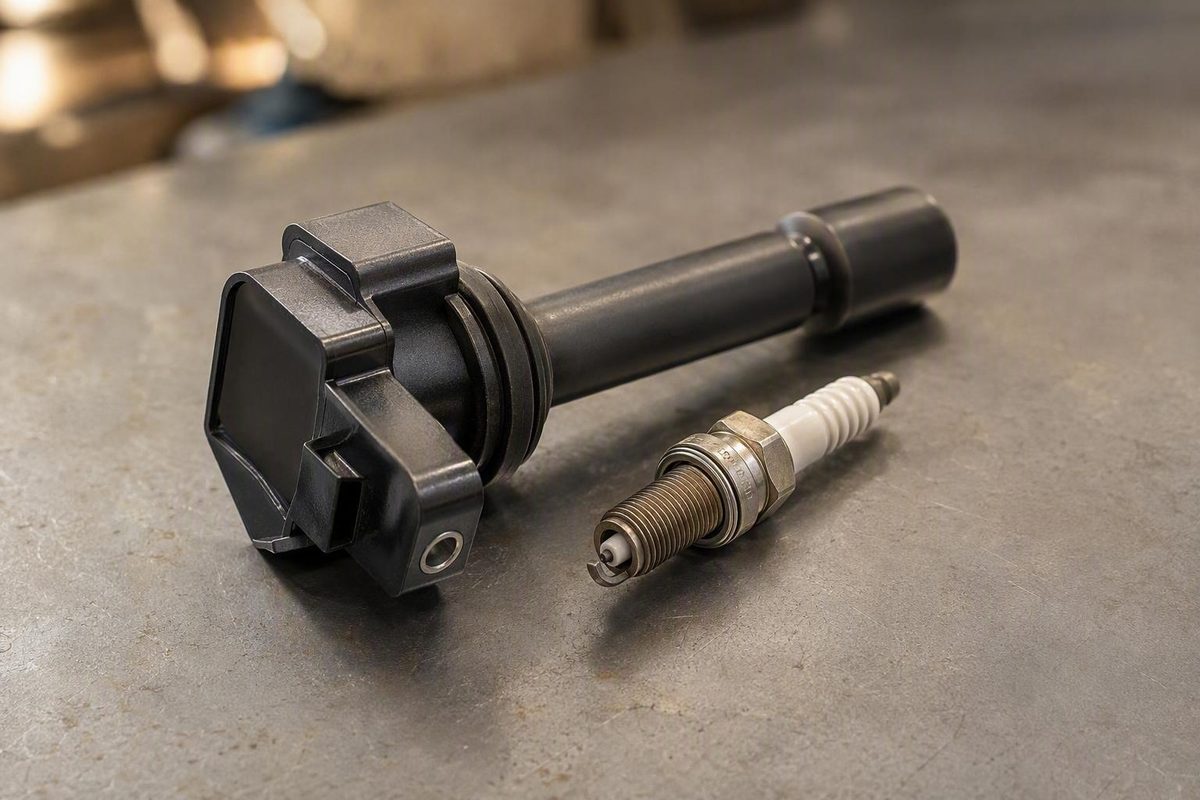
Misfires can feel like rough idle, sputtering, hesitation, weak acceleration, hard starting or stalling; see how scan data and testing confirm the cause.
The central symptom of a bad ignition coil is an engine misfire caused by weak, absent, or intermittent spark. It may feel like shaking at idle, sputtering, hesitation, jerking, weak acceleration, hard starting, or stalling. However, symptoms—and even a cylinder-specific misfire code—do not prove the coil is faulty. Confirm the cause by noting when the problem occurs, scanning for misfires, inspecting the complete ignition path, and performing vehicle-appropriate tests before buying parts.
The most common signs of a bad ignition coil
A repeatable misfire affecting one cylinder is the most useful initial clue. Broad signs such as reduced fuel economy or a generic Check Engine light are much less diagnostic because many unrelated faults can cause them.
| Sign and driving situation | What the driver may notice | Why a coil could cause it |
|---|---|---|
| 1. Rough idle while stopped | Shaking, vibration, surging, or an uneven exhaust note | One cylinder may miss power strokes because its spark is weak or absent |
| 2. Sputtering or hesitation during acceleration | Coughing, stumbling, hesitation, or jerking | A marginal coil may fail as spark demand rises |
| 3. Weak acceleration or power loss under load | Sluggish response or sudden loss of pulling power, especially on hills | A misfiring cylinder contributes less power, and demanding cylinder conditions can expose a weak coil |
| 4. Hard starting | Longer cranking, several attempts, or rough running immediately after startup | Weak or inconsistent spark may prevent reliable ignition of the mixture |
| 5. Stalling when stopping or returning to idle | Engine speed drops too far, or the engine shuts off | A severe or intermittent misfire can destabilize idle speed |
| 6. Popping or backfiring | Popping or banging from the exhaust | Fuel associated with a misfire may enter the exhaust and ignite |
| 7. Reduced fuel economy during normal use | More frequent refueling without an obvious change in driving | Repeated incomplete combustion can waste fuel |
| 8. A steady or flashing Check Engine light | The warning light remains on or flashes while the engine runs poorly | The engine computer may detect misfire activity or another fault |
| 9. A repeatable cylinder-specific misfire | Roughness consistently corresponds to one cylinder in scan data | A failed coil can prevent the plug on that cylinder from firing correctly |
Ignition-coil problems can be intermittent. An engine may idle acceptably when cold but misfire after warming up, or run smoothly at light throttle yet hesitate during hard acceleration. Heat, vibration, and engine load can expose a marginal coil that appears normal during a short driveway check. Innova describes both intermittent and load-related ignition-coil failures.
Treat each sign as a reason to test, not as a parts verdict. Similar roughness can result from a spark plug, injector, vacuum leak, compression problem, wiring fault, or another cause.
Why one weak spark causes several different symptoms
An ignition coil converts low battery voltage into the much higher voltage needed for a spark plug to fire. If coil output becomes weak or intermittent, the spark may fail to ignite the air-fuel mixture reliably.
That creates a straightforward chain of effects:
- The affected cylinder misfires.
- Its expected power stroke becomes weak or disappears.
- Uneven power strokes make the engine shake or run roughly.
- Losing contribution from that cylinder reduces acceleration and overall power.
- Fuel associated with the missed combustion event may enter the exhaust.
High-load operation often reveals the problem first. During hard acceleration, towing, or hill climbing, the ignition system must produce a reliable spark under more demanding cylinder conditions. A marginal coil may satisfy the lower demand at idle but break down under load, causing repeatable hesitation, jerking, or power loss.
Fuel entering the exhaust during an active misfire can contribute to popping or backfiring. More importantly, continued misfiring can overheat and damage the catalytic converter. Identifix discusses coil-related misfires, diagnostic steps, and the risk of catalytic-converter damage.
Hard start versus no-start: ignition-system design matters
Whether a faulty coil causes rough running or prevents starting depends on the ignition-system design.
Many modern gasoline engines use coil-on-plug ignition, with one coil for each cylinder. If one coil fails, the remaining cylinders can often still fire. The engine may start but shake, idle poorly, and lack power.
Other systems use one coil for the entire engine or a coil pack shared by multiple cylinders. Complete failure of a single coil serving every cylinder can leave the engine cranking without starting. Failure within a shared pack may disable more than one cylinder. AutoZone’s ignition-coil overview distinguishes coil-on-plug, shared-coil, and single-coil systems.
Even a crank-no-start condition accompanied by no spark does not prove the coil itself has failed. Depending on the vehicle, possible causes include:
- Loss of coil power or ground
- Damaged wiring or connectors
- A failed ignition module
- Distributor cap, rotor, pickup, or related distributor faults
- A control-circuit problem
- Battery or charging-system weakness
- Another fault preventing the ignition system from being commanded
Identify the ignition design and follow model-specific service information rather than applying a universal no-start rule.
When to stop driving and when to arrange prompt diagnosis
Do not use a fixed mileage or time allowance to decide whether an active misfire is safe. Warning-light behavior, drivability, severity, and your ability to control the vehicle matter more.
| Condition | Recommended response | Why |
|---|---|---|
| Flashing Check Engine light accompanied by severe shaking, major power loss, repeated stalling, backfiring, or fuel odor | Pull over safely, shut the engine off, and arrange diagnosis or towing. A flashing light can accompany a serious active misfire and should be addressed quickly. This warning behavior is described in guidance on coil-related misfires. | Continued misfiring may damage the catalytic converter, while stalling or major power loss can make the vehicle difficult to control |
| Obvious but stable misfire or rough running | Arrange prompt diagnosis and avoid unnecessary driving | Continued misfiring may worsen or damage the catalytic converter |
| Mild intermittent hesitation or a steady warning light while the vehicle remains controllable | Scan and investigate soon | The fault may be less severe at that moment, but it can progress |
| Warning light without noticeable symptoms | Retrieve the codes and diagnose the cause | A steady light does not identify a bad coil and should not be ignored |
Warning-light behavior is not identical across every make and model. Consult the owner’s manual for the vehicle’s specific warning guidance. Regardless of the display strategy, severe shaking, repeated stalling, backfiring, fuel odor, or substantial power loss calls for a conservative response.
A steady light or mild symptom is not proof that the problem is harmless—or that an ignition coil is responsible. It simply provides an opportunity to investigate before the condition becomes more severe.
How to distinguish a bad coil from other misfire causes
A symptom tells you what the engine is doing. A trouble code may indicate which cylinder is affected. Neither necessarily identifies the component that failed.
| Possible cause | How it can resemble coil failure | Relevant next check |
|---|---|---|
| Ignition coil | Cylinder misfire, rough idle, hesitation, or weak power | Inspect the coil and determine whether a compatible swap moves the misfire |
| Spark plug | The same cylinder may misfire under load, at idle, or during starting | Remove and inspect the plug; compare its condition and gap with vehicle specifications |
| Connector or wiring | Intermittent loss of power, ground, or control can mimic an internal coil failure | Check terminal fit, corrosion, broken locks, chafing, heat damage, and circuit integrity |
| Injector or fuel delivery | A lean, rich, restricted, or electrically inactive cylinder can misfire | Check injector operation and applicable fuel-delivery data or tests |
| Compression problem | A valve, ring, or sealing fault can cause a persistent cylinder misfire | Perform vehicle-appropriate compression or leak-down testing |
| Ignition module | Interrupted coil control may affect one or several cylinders | Test module inputs and outputs according to the service procedure |
| Battery or charging problem | Low or unstable supply voltage can contribute to hard starting and ignition faults | Test battery condition, charging output, connections, grounds, and relevant power feeds |
Inspect the coil and everything around it. Look for cracks, burn tracks, melted plastic, corrosion, loose or damaged terminals, and chafed wiring. Where appropriate, remove the spark plug and inspect both the plug and its well for oil, coolant, or water contamination. Visible damage strengthens the diagnosis, but a coil can fail internally without displaying external damage.
A worn or incorrectly gapped spark plug can mimic a weak coil because either problem can produce an ignition misfire. A worn plug can also increase demand on the coil. Electrical faults, poor connections, and contamination should be corrected instead of being overlooked while a new coil is installed. Firestone identifies worn plugs, wiring faults, poor grounds, leaks, battery weakness, and charging problems as possible contributors to coil trouble.
If a valid coil swap does not move the misfire, investigate other causes; one inconclusive test does not rule out an intermittent coil fault. Turn to the plug, connector, wiring, injector, compression, plug-well contamination, or another cylinder-specific fault.
A diagnosis-first workflow for confirming the faulty coil
-
Record the operating conditions. Note whether the engine is cold or fully warm, idling or accelerating, and whether the problem appears during rain, heavy load, or hill climbing. Record whether the Check Engine light is steady or flashing.
-
Scan for trouble codes and misfire data. Codes in the P030# family indicate detected misfire activity; a cylinder-specific code can identify the affected cylinder. It does not prove that the cylinder’s ignition coil failed. Identifix includes P030# codes as part of a broader coil-diagnostic process.
-
Identify the affected cylinder correctly. Verify the engine’s cylinder numbering through applicable service information rather than assuming cylinder 1 starts at a particular end.
-
Inspect the complete ignition path. Check the coil body, boot, connector, wiring, spark plug, and plug well. Look for cracking, melting, burn marks, corrosion, damaged terminals, moisture, and oil contamination.
-
Check relevant electrical-supply concerns. If symptoms affect several cylinders or starting is poor, inspect the battery, charging system, grounds, fuses, shared power feeds, and ignition-control components as applicable.
-
Perform a compatible coil-swap test where appropriate. Shut the engine and ignition off, let the engine cool, and follow the service procedure for electrical isolation before touching coils. DENSO’s installation guidance emphasizes a cool engine and correct precautions. Do this only if the coils are interchangeable and the vehicle’s ignition design and service procedure permit it. Do not force connectors, move coils with different part numbers, or apply the method to an incompatible shared-coil system.
For example, suppose the scanner records a cylinder 2 misfire. After inspection, move the cylinder 2 coil to cylinder 4 and the cylinder 4 coil to cylinder 2. Preserve or clear the original diagnostic information as appropriate, then reproduce the operating condition only if it can be done safely:
- If the misfire changes from cylinder 2 to cylinder 4, the moved coil becomes a strong suspect.
- If the misfire remains on cylinder 2, continue diagnosing that cylinder’s plug, connector, wiring, injector, compression, and plug well rather than replacing the coil.
Do not deliberately reproduce severe shaking, major power loss, repeated stalling, backfiring, or a flashing-light condition on the road. If confirming the fault would conflict with the stop-driving guidance above, arrange professional diagnosis or towing instead.
Coil swapping is not suitable for every ignition system. Shared packs, inaccessible assemblies, different coil part numbers, and some control strategies require another vehicle-specific procedure.
Resistance measurements can supplement the diagnosis when the manufacturer provides specifications and a test procedure. Compare readings only with the correct specifications for that vehicle and coil design. A normal static resistance result cannot rule out a coil that fails only when hot, vibrating, or under load. Generic resistance ranges should not replace vehicle-specific service information. AutoZone likewise notes that resistance specifications vary by vehicle.
Avoid universal voltage thresholds and improvised exposed-spark tests. The correct procedure, equipment, and safety precautions depend on the vehicle.
Replace one coil or all of them?
Replacing every coil is not automatically necessary when testing confirms that one has failed. Replace the verified faulty component, inspect its spark plug, and examine the remaining coils, boots, connectors, and plug wells for similar damage or contamination.
Broader replacement may make sense in some cases, but it should be a vehicle-specific decision based on:
- The confirmed condition of the other coils
- Spark-plug condition and service history
- Vehicle age and operating history
- Whether access labor is unusually high
- Repeated failures among the same set of coils
- Manufacturer guidance
- The owner’s preference regarding preventive cost and future repair risk
Do not convert general lifespan estimates into a maintenance interval. Heat, vibration, contamination, electrical faults, and excessive spark-plug demand can contribute to early failure, while other coils may remain serviceable much longer.
Before speaking with a technician or ordering a part, collect:
- Vehicle, model year, and engine
- Symptoms when cold versus fully warm
- Whether the fault occurs at idle, during acceleration, or under load
- Whether the Check Engine light is steady or flashing
- All stored and pending trouble codes
- The affected cylinder, if identified
- Visible coil, connector, plug, or wiring damage
- Oil, water, or other contamination in the plug well
- Whether a valid coil swap moved the misfire
Do ignition coils have a fixed replacement mileage?
No. Ignition coils do not have one universal replacement mileage. Service life varies with ignition design, heat exposure, vibration, contamination, electrical condition, spark-plug condition, and vehicle use. Replace a coil when diagnosis confirms failure, or follow a vehicle-specific manufacturer schedule if one is provided. General lifespan estimates should not be treated as mandatory maintenance intervals.
The key pattern is a misfire, not a final diagnosis. Treat severe symptoms or a flashing warning light urgently, identify the affected cylinder, and inspect and test the complete ignition path before replacing a coil. Flashing-light misfire symptoms warrant prompt attention.