
Find Which 2.3 EcoBoost Recall Matches Your Ford
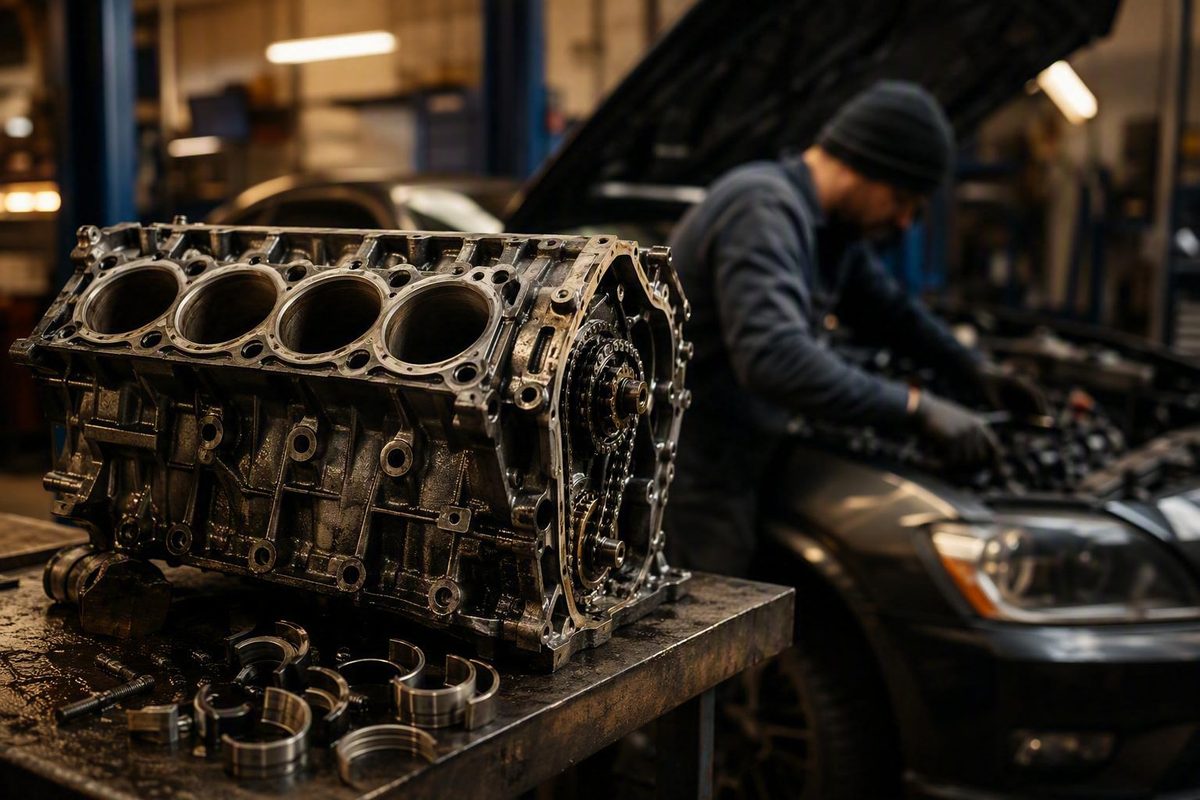
Separate Ford’s follower defect from its bearing recall, check VIN eligibility, recognize warning signs, and prepare for a long-block replacement.
Two Ford 2.3L EcoBoost recalls can cause engine failure in 2026: 26S35 / NHTSA 26V343000 covers select 2025–2026 Bronco, Explorer, and Ranger vehicles with a roller finger follower defect, while 26S58 / 26V532000 covers certain 2026 Explorers whose connecting-rod bearings may seize. Ticking or tapping with a check-engine light has been reported with 26S35; knocking is the reported possible warning for 26S58. Neither sound confirms a recall defect, and only a VIN search establishes eligibility.
Choose the vehicle and build month, then mark any symptoms to see the applicable campaigns and next diagnostic step.
This screens for possible campaign overlap. Ford and NHTSA VIN results make the final recall determination.
Possible overlap: check 26S35 and 26S58 by VIN.
- 26S35 / 26V343: 2026 Explorer and March 2026 fall within the reported February 5, 2024–May 1, 2026 production range. Interim letters: June 5, 2026. Long-block remedy anticipated November/Q4 2026.
- 26S58 / 26V532: certain 2026 2.3L Explorers. A build-date range was not provided here. VINs became searchable August 18; owner letters were expected August 24, 2026. Free long-block remedy listed.
A matching month identifies only a possible campaign. Boundary months may require the exact production day.
Mark everything currently observed. Codes and oil findings direct testing but are not official proof of either defect.
With no symptoms selected, search Ford and NHTSA for both campaign numbers if this is a 2026 Explorer.
Testing order: preserve codes and freeze-frame data, document any noise without revving the engine, and obtain a dealer inspection.
| Finding | Recall Link | What It Means | Next Check |
|---|---|---|---|
| Tick/tap | Reported with 26S35 | Possible valvetrain warning; not conclusive | VIN, codes, mechanical inspection |
| Knock | Reported with 26S58 | Possible bearing warning; not conclusive | Stop if severe; assess mechanically |
| Check-engine light | Reported with 26S35 | Lamp cannot identify a follower | Stored, pending, permanent codes |
| P0016 | Not specified by recall | Crank/cam correlation direction | Freeze-frame and correlation diagnosis |
| P0300 | Not specified by recall | Random/multiple-cylinder misfire | Misfire data and mechanical condition |
| Metal in oil/filter | Not campaign-specific | Supports concern about internal wear | Document source and dealer findings |
| Oil-pressure warning | Not campaign-specific | Running may increase damage | Shut down and verify pressure safely |
| Power loss, smoke, oil release | Possible progressed failure | Crash or fire hazard | Stop safely; do not restart |
Sources: NHTSA campaigns 26V343000 and 26V532000; Ford campaigns 26S35 and 26S58. Production ranges and campaign figures are those reported in the accompanying article; unknown ranges are shown as —.
The Two Recalls Cover Different Engine Defects
The campaigns overlap only in part. Both can include a 2026 Explorer with a 2.3L engine, but they concern different components and very small, VIN-specific populations.
| Detail | 26S35 / 26V343 | 26S58 / 26V532 |
|---|---|---|
| Vehicles | Select 2025–2026 Bronco, Explorer, Ranger | Certain 2026 Explorers |
| Defect | Dislodged roller finger follower | Seizing connecting-rod bearing |
| Reported warning | Ticking/tapping, check-engine light | Knocking |
| Remedy | Free long-block replacement | Free long-block replacement |
Campaign 26S35 reportedly covers 1,536 vehicles: 408 Broncos, 895 Explorers, and 233 Rangers. Campaign 26S58 reportedly covers six Explorers. Those limited populations are why model, engine size, build date, or a familiar noise cannot establish coverage.
Both defects can progress to engine failure and loss of drive power. The bearing defect presents an additional hazard: internal damage may breach the engine block and release oil, increasing fire risk if that oil reaches an ignition source. The official NHTSA 2026 Explorer recall data lists the bearing defect, loss-of-power and fire risks, and free long-block remedy.
The same NHTSA data lists separate 2026 Explorer engine campaigns involving piston circlips and cylinder heads. Those recalls should not be combined with 26S35 or 26S58 merely because they can also cause engine damage, oil loss, or power loss.
Recall 26S35 Involves the Valvetrain
Ford campaign 26S35, filed as NHTSA 26V343000, concerns a camshaft roller finger follower that may have been installed incorrectly. The follower can move out of its intended position on the valve stem, disrupting valve operation and potentially causing internal damage, a no-start condition, engine failure, or loss of drive power.
Secondary reporting associates two possible advance signs with this campaign:
- Ticking or tapping from the engine
- An illuminated check-engine light
These are associations, not diagnostic criteria. The NHTSA Explorer API summary does not independently identify those driver-observable symptoms. Coverage of the 26V343000 filing reported the sounds, check-engine light, defect, affected-model breakdown, and expected repair timing.
A new valvetrain-like tick deserves code retrieval and inspection, particularly if the VIN is included. It does not justify ordering a follower or declaring that one has become dislodged. Injector operation, accessories, exhaust leaks, oil-pressure problems, and other mechanical faults can produce noises that owners describe with the same words.
Some reports use the phrase “low-volume engine leak while running.” Its technical meaning is unclear. It should not be converted into a diagnosis of an oil, coolant, combustion, or component-specific leak. If fluid is visible, record its color, location, amount, warning lights, and any smoke without touching hot parts or crawling beneath a running vehicle.
The Build Ranges Narrow the Search but Do Not Decide It
Reported 26S35 production ranges are:
- Bronco: July 24, 2024 through April 26, 2026
- Explorer: February 5, 2024 through May 1, 2026
- Ranger: February 2, 2025 through April 9, 2026
These dates provide production context but do not replace a VIN lookup. They also make the first and last month ambiguous when only the month—not the exact production day—is known.
Coverage of Ford recall 26S35 reported the 1,536-vehicle population, production ranges, safety risk, free remedy, and anticipated November availability. A forum-hosted reproduction of an advance dealer notice listed 1,704 U.S. vehicles, but that preliminary figure should not displace the better-supported 1,536 total. The discrepancy reinforces the need to use Ford’s VIN system rather than a population estimate.
Ford mailed interim letters on June 5, 2026. The long-block remedy was anticipated for November or the fourth quarter of 2026. That was a projection, not a guarantee that an assembly would be available at every dealer or that repairs would be completed by then.
Recall 26S58 Involves Connecting-Rod Bearings
Ford campaign 26S58, filed as NHTSA 26V532000, applies to certain 2026 Explorers with a 2.3L engine. Connecting-rod bearings may seize, preventing normal movement and potentially stopping the engine.
Knocking is the specifically reported possible warning. A seized bearing can cause engine failure and loss of drive power. If internal damage breaches the block, escaping oil can contact a hot engine, exhaust component, or another ignition source and create a fire hazard.
A knock alone does not prove bearing seizure. Sound recordings cannot reliably distinguish a rod-bearing problem from combustion knock, valvetrain noise, accessory noise, or another internal fault. Severe, rapidly worsening, or load-related knocking nevertheless warrants a conservative response because continued operation can increase internal damage.
The Investigation Identified a Narrow Production Event
As of August 11, 2026, Ford was reportedly aware of 11 warranty claims and 10 engine replacements. The replaced engines reportedly showed evidence of a seized number-two connecting-rod bearing.
Ford traced suspect crankshafts to an approximately 30-minute production interval after a polishing shoe was replaced. Plant data reportedly showed a shift in certain number-two crank-pin measurements during that interval, although Ford had not determined the final root cause of the shift.
Those investigation figures, the six-vehicle recall population, and the production findings come from Autoblog’s coverage of 26V532, which attributes them to the NHTSA recall report.
Affected VINs became searchable through NHTSA on August 18, 2026. The official data listed an expected owner-letter mailing date of August 24, 2026, while secondary coverage reported an expected date by August 26. A mailing projection does not prove that every letter arrived or that every dealer had a replacement engine ready.
Noise, Codes, and Oil Findings Require Different Tests
Ticking or tapping is associated in reporting with 26S35, while knocking is associated with 26S58. No-start and sudden power loss are possible progressed outcomes under either campaign, not dependable early warnings.
Cold-Start Knock Needs Reproduction, Not Assumption
A knock heard only during a cold start is not an official identifying symptom for either recall. Record how long it lasts, whether it returns when warm, whether engine speed changes it, and whether an oil-pressure warning appears. Avoid repeatedly starting or revving the engine merely to capture the sound.
A persistent, deep, or rapidly worsening knock—especially with an oil-pressure warning, power loss, or visible oil—requires more urgent assessment than a brief sound that has not recurred. The distinction sets urgency; it does not identify the failed part.
P0016 and P0300 Do Not Confirm Either Recall
A check-engine light has been reported with 26S35, but the lamp cannot identify a displaced follower. Retrieve stored, pending, and permanent diagnostic trouble codes and preserve freeze-frame data before codes are cleared.
P0016 indicates a crankshaft/camshaft position correlation problem. P0300 indicates random or multiple-cylinder misfire. Either code may help direct testing, but the available recall evidence does not designate either as a required 26S35 or 26S58 code. Diagnosis still requires VIN verification and mechanical inspection.
A flashing warning light with rough running, severe noise, or substantial power loss raises the urgency. Avoid loading or revving the engine to see whether the light stops.
Metal in Oil Is a Finding, Not a Campaign Number
Visible metallic material in drained oil or an opened filter can support concern about internal wear, but it does not identify which component produced it. Ask the dealer to document the oil condition and any filter inspection before approving disassembly. Do not drain the oil solely to investigate a recall if doing so could complicate safe transport, evidence preservation, or dealer assessment.
An oil-pressure warning, active leak, or low level also does not prove a seized rod bearing. Those findings affect whether the engine should continue running and what must be inspected first.
Severe Noise, Oil Release, or Power Loss Calls for a Stop
If the vehicle develops sudden power loss, severe or rapidly worsening engine noise, active oil leakage, smoke, or signs of fire, move out of traffic if possible, stop in a safe place, and shut the engine off. Avoid restarting it while arranging assistance. Move away and contact emergency services if smoke, fire, or leaking fluid creates an immediate hazard.
This is a conservative response to the documented power-loss, oil-release, and fire hazards. It is not a quotation of a blanket Ford do-not-drive order for every VIN in either campaign.
After a no-start or stall, repeated restart attempts may circulate contaminated oil or worsen internal contact. Record dashboard messages and the conditions surrounding the event instead.
For any suspected failure, preserve:
- Date, mileage, engine temperature, speed, and load
- Warning lights, messages, and retrieved codes
- Whether the engine stalled or restarted
- Photos or video obtained from a safe position
- Tow records, repair orders, and written dealer findings
- Maintenance records and prior oil-level observations
The available evidence does not establish automatic coverage for towing, rental transportation, or a loaner. Ask Ford and the dealer about each benefit before assuming reimbursement.
A VIN Search Is the Only Coverage Check
Use both NHTSA and Ford, then ask a Ford dealer to verify both campaign numbers. A year-and-model result only identifies recalls that might apply to similar vehicles.
- Find the 17-character VIN at the lower driver-side windshield, driver-side doorframe, registration, insurance card, or purchase paperwork.
- Search the NHTSA page for 26V343 and the NHTSA page for 26V532.
- Check Ford’s official recall system and save a dated screenshot or PDF of the result.
- Give the VIN to a Ford service department and ask it to check 26S35, 26S58, and any other engine campaign.
- Confirm whether each campaign is open, completed, awaiting a remedy, or absent from that VIN.
A result of “0 unrepaired recalls” can mean no open recall is assigned, a recall was completed, or a newly announced campaign has not yet been populated for that VIN. NHTSA says recently announced recalls may not appear until affected VINs have been identified and added. Repeat the search when a campaign is new, particularly because 26S58 VINs became searchable on August 18.
Ford’s 2026 Explorer recall page lists several possible engine campaigns but requires a VIN search to validate coverage.
Both Campaigns List a Free Long-Block Replacement
The listed remedy under 26S35 and 26S58 is engine-long-block replacement at no charge through a Ford dealer. Ask what the replacement includes rather than assuming every external engine component will be renewed.
For 26S35, November or the fourth quarter was the anticipated remedy period. For 26S58, the owner-letter date should not be confused with parts availability. Dealer scheduling, final instructions, assembly supply, inspection requirements, and VIN-specific authorization may affect timing.
Ask the service department:
- Which campaign applies to this VIN?
- Is the campaign open or already recorded as completed?
- Is the long-block remedy available now?
- Does Ford require inspection or prior authorization?
- Should the vehicle be driven with its current symptoms?
- Who arranges and pays for towing if it should not be driven?
- Are a loaner, rental, or alternate transportation available?
- What warranty covers the replacement and installation?
- What documents are needed for a previously paid repair?
Ford says safety, compliance, and emissions recalls do not expire and that recall parts and service are free. It also says an owner who previously paid for a repair later associated with a recall may be eligible for reimbursement, subject to review. Confirm covered expenses, documentation, and deadlines through Ford’s official recall portal.
An Unlisted VIN Still Needs a Mechanical Diagnosis
A vehicle is not recalled merely because it has the same engine, date range, noise, code, or failure. If the VIN is not listed, ask the dealer to identify the failed component and mechanical cause in writing and to check for other recalls, manufacturer communications, or applicable programs.
Preserve invoices, tow bills, code reports, inspection findings, photos, maintenance records, mileage, and written communication. If parts are replaced, ask whether they can be retained or photographed. Owners may also submit a safety complaint to NHTSA using factual observations such as noise, warnings, speed, power loss, oil release, smoke, towing, and repair findings.
Recall eligibility and diagnosis answer different questions. The VIN determines whether Ford assigns the vehicle to a campaign. Inspection determines what is happening mechanically. Ticking, knocking, P0016, P0300, or metal in oil may direct testing, but none substitutes for either step.