
6.7 Cummins CCV Filter: When to Replace It—and When to Diagnose
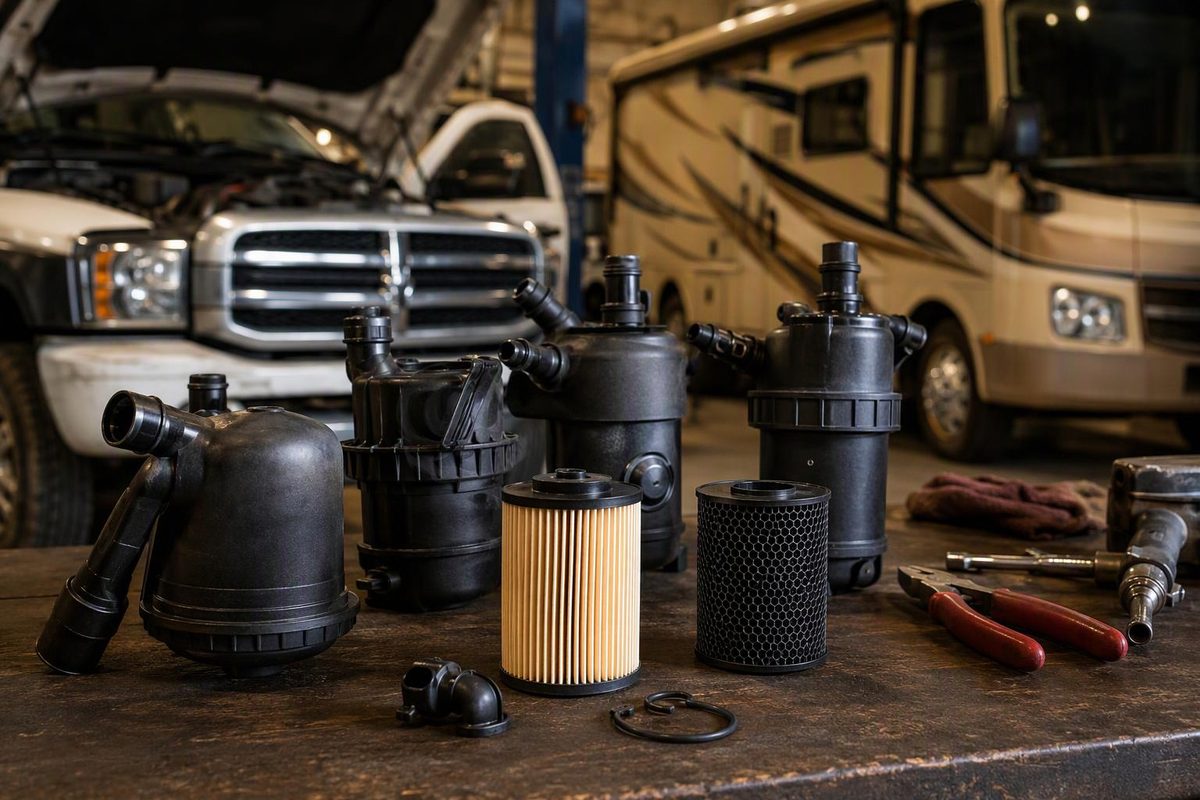
Check Ram and motorhome CCV intervals, confirm application-specific fitment, and separate scheduled maintenance from leak, restriction and software faults.
A 6.7 Cummins CCV filter does not have one replacement interval across every application. Ram’s schedule changed for 2019, while some commercial B6.7 engines use maintenance-free crankcase ventilation. Identify the vehicle model year and engine application before ordering parts.
Scheduled replacement does not require a fault code. Conversely, an oil leak or crankcase-pressure warning is not proof that the filter needs replacing.
When is replacement due?
Use these schedule references, then check the exact vehicle or engine manual—including its time limit.
| Application | CCV maintenance requirement |
|---|---|
| 2007.5–2018 Dodge/Ram 6.7L diesel trucks | Geno’s Garage documents a 67,500-mile interval for this range. The 2018 OEM chart specifies 67,500 miles/108,000 km or 54 months, whichever comes first, and another replacement at 135,000 miles/108 months. |
| 2019 Ram 6.7L diesel trucks and 2024 Ram 2500/3500 pickups | Both OEM charts specify 75,000 miles/120,000 km or 60 months, whichever comes first, with another replacement at 150,000 miles/120 months. Check the individual manual for intervening model years. |
| 2025 Ram 2500/3500 pickups | The owner handbook specifies replacement every 75,000 miles/120,000 km. Check the full manual for applicable time requirements. |
| Motorhome ISB6.7/B6.7 engines built 2007–2020 | Cummins’ motorhome guide lists a 75,000-mile breather-filter interval. Use the engine-specific manual for any applicable hour limit. |
| Motorhome engines built 2021 onward; EPA 2021 truck B6.7 | The motorhome guide lists no scheduled breather-filter replacement for its 2021+ group. Cummins’ EPA 2021 truck guide explicitly lists crankcase ventilation as maintenance-free. |
The early Ram mileage range is documented in Geno’s Garage’s service guide, with the mileage/time columns confirmed in the 2018 Ram diesel supplement. The later schedule appears in the 2019 diesel supplement and 2024 pickup manual. The 2025 pickup mileage interval comes from its owner handbook.
For motorhomes, use the engine build year, not automatically the coach’s model year. See Cummins’ motorhome guide and its separate EPA 2021 truck maintenance guide.
Do not apply “maintenance-free B6.7” advice to a Ram pickup simply because both engines displace 6.7 liters. For a chassis cab or a newer model year, use its own manual rather than extending a pickup schedule.
What “Perform Service” means
Ram describes “Perform Service” as a reminder for emissions maintenance at a set interval; that maintenance may include the CCV element. It is not, by itself, a measured filter-restriction diagnosis. The 2024 manual treats DPF regeneration and DEF warnings separately.
Check the service history against the schedule. If replacement is due, install a replacement element rather than treating washing as scheduled service. Complete the applicable maintenance before resetting the reminder. Obtain the year-specific Perform Service reset procedure; do not substitute an oil-life or fuel-filter-life reset.
Confirm fitment and prepare for replacement
A listing that says only “6.7 Cummins” is insufficient. Record the VIN, model year, pickup versus chassis-cab configuration, and installed housing. For non-Ram applications, use the engine serial number. Cummins’ motorhome guide lists different top- and rear-mounted breather parts and directs owners to QuickServe for complete engine-specific information.
On the older Ram top-mounted arrangement illustrated by Geno’s Garage, access involves removing the decorative cover, disconnecting the oil-drain hose, and opening the CCV housing. That procedure shows four decorative-cover fasteners and eight CCV-cover fasteners with 8 mm heads. Do not assume those counts apply to a 2025 truck or a motorhome installation.
The following is a preparation and verification sequence, not a substitute for the exact service procedure:
- Prepare first. Let the engine cool, switch the ignition off, prevent remote starting, and clean loose debris from around the housing. Have the correct element, required seals and application-specific instructions ready.
- Expose the housing carefully. Note hose routing and release connections without pulling on brittle fittings. Protect exposed oil-fill openings from debris.
- Remove and inspect. Inspect the housing, sealing surfaces, hoses and drain connections. Stop if a fitting is cracked, a passage is blocked, or the housing is damaged; a fresh filter will not repair those defects.
- Install and seal. Follow the specified seal-reuse or replacement instructions. Seat the element fully and tighten fasteners to the specified torque and sequence. Obtain those specifications before starting—an 8 mm socket size is not a torque specification. Do not use an impact tool for reassembly.
- Verify. Remove any temporary opening protection and restore every hose, cap and cover. Run the engine in a ventilated area, check disturbed connections for leakage, and record mileage, date and engine hours where applicable. Reset only the completed maintenance reminder.
When a different fault needs diagnosis
Recurring P1507 on a 2019 Ram pickup: Check restriction and service history, but also have a technician verify PCM calibration and bulletin applicability. Ram TSB 18-066-23 includes P1507, “Crankcase Filter Restriction,” among concerns addressed by software updates for 2019 2500/3500 diesels with the specified ETL or ETM engine sales codes. That update requires the Y78 fuel-pump recall work first. It is not a blanket instruction to flash every truck or ignore an actual restriction.
Oil leaking around a breather tube: Locate the leak before buying a filter. Cummins TSB220072, specifically for B6.7 CM2450 B155B engines, identifies a broken tube near the cylinder-block connection and calls for tube replacement—not filter replacement. It also warns against bending or twisting the tube during installation.
Suspected pressure remains after correct service: Inspect the complete ventilation path and measure crankcase pressure using the engine-specific procedure. Record test temperature, RPM/load and units, then compare with that engine’s specified limit. An oil-cap observation is not a substitute for this measurement. Separate ventilation restriction from excessive blow-by before considering engine teardown.
Heavy smoke or rapid oil loss needs prompt diagnosis, not a routine CCV change followed by continued driving. See turbocharger failure symptoms and stop-driving signs for that separate diagnostic path.