
Cam Chain Tensioner: Tests Before Replacement
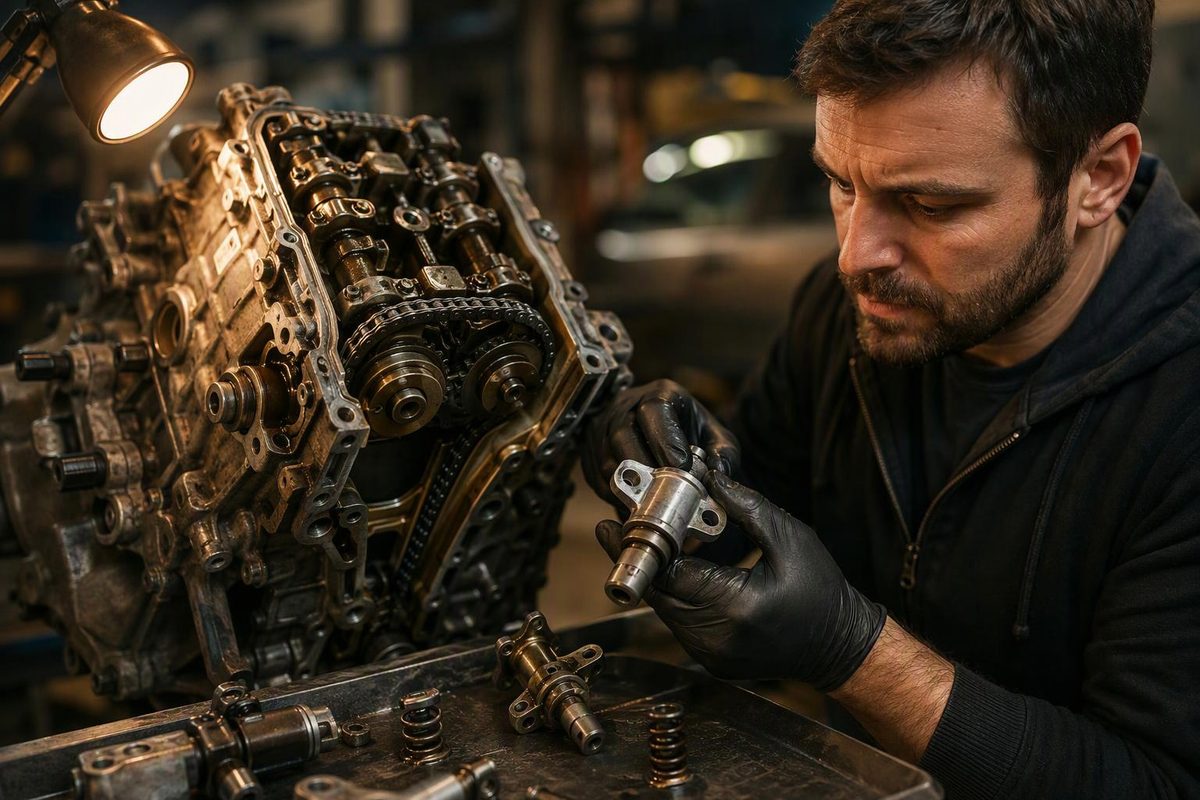
Separate cam chain tensioner failure from oil drain-back and VTC noise, recognize stop points, and use engine-specific tests before replacing parts.
A cam chain tensioner keeps the camshaft timing chain under the tension its design requires. A failed tensioner can cause startup rattling, but a startup rattle alone does not identify the failed part. The useful diagnosis separates tensioner failure from oil drain-back, a camshaft actuator fault, and damage elsewhere in the timing drive.
This guide covers automotive engines. Start with the exact model year, engine code and VIN—not a repair procedure for a similar-looking engine. The bulletins below illustrate diagnostic distinctions; confirm their applicability and use current service information before repair.
When to stop running the engine
Stop driving and arrange inspection if a new timing-area rattle is persistent or comes with rough running, loss of power or stalling. If the engine stops and will not restart after a rattle, do not keep cranking it to reproduce the sound.
The risk is engine-specific. Volkswagen’s bulletin for 2008–2013 vehicles with 2.0-liter CCTA or CBFA engines describes incorrect tension caused by the tensioner, allowing the chain to skip and the pistons to contact the valves. Its listed symptoms include rattling after starting, a no-start condition and stored P0016 or P0328 faults. That warning does not apply automatically to every Volkswagen engine. Volkswagen bulletin 15-12-01
Conversely, do not assume every brief rattle means imminent engine damage. Mercedes-Benz’s May 2014 bulletin describes a specific startup rattle on certain M157, M276 and M278 engine-number ranges while secondary-chain tensioners build oil pressure; it states that consequential damage is not expected from that identified condition. That reassurance is limited to the bulletin’s condition and applicability. Mercedes-Benz bulletin LI05.10-P-056435, version 3
Follow this diagnostic order
1. Record the conditions before disturbing anything
Write down:
- Whether the noise occurs after an overnight cold soak, a warm restart or both.
- How long it lasts and whether it continues at idle.
- Whether the engine starts and runs normally afterward.
- Oil level, the oil specification used and recent oil-service or timing-repair history.
- Stored and pending trouble codes, with freeze-frame data where available.
A recording can help a technician compare the complaint with an applicable bulletin. Do not repeatedly start a suspect engine just to get a better recording.
2. Separate oil supply from oil retention
Check oil level using the vehicle manual’s method, and verify the specified oil and filter before blaming the tensioner. If lubrication is suspect, have oil pressure measured under the temperature and RPM conditions specified for that engine. A generic pressure number is not a tensioner test.
Oil pressure reaching the engine and oil remaining inside a tensioner after shutdown are different questions. Honda bulletin 19-019 lists a worn tensioner check valve as the possible cause of cold-start knocking or clicking: internal leakage allows the chain to lose tension after shutdown. It covers specified 2014 Accord L4 VIN ranges, all 2015–2017 Accord L4 models and all 2015–2017 CR-V models; its corrective action is tensioner replacement. Honda bulletin 19-019
Mercedes-Benz’s bulletin illustrates another distinction: some covered engine-number ranges require check valves and tensioners, while others require check valves only, with the existing optimized tensioners still checked under the workshop procedure. Oil drain-back does not always justify replacing the tensioner. Mercedes-Benz repair distinctions
3. Do not confuse the tensioner with the camshaft actuator
A variable valve timing actuator is another possible source of startup noise. Honda’s January 2018 ServiceNews article documented a one-to-three-second rattle caused by a VTC actuator lock pin on 2013–2016 Accord L4 and 2015–2016 CR-V models. That historical article establishes a competing cause—not current repair instructions. Use current service information to choose the actuator test and remedy. Honda ServiceNews A18010F
Similarly, P0016 is a crankshaft/camshaft correlation fault, not a tensioner verdict. Volkswagen directs technicians to complete guided fault finding before inspecting its tensioner. Volkswagen diagnostic sequence If the codes instead point toward a camshaft signal fault, follow the camshaft position sensor diagnostic path.
4. Use an engine-specific mechanical test
There is no universal “push the plunger” test.
For the CCTA/CBFA application above, Volkswagen’s bulletin specifies removing the lower timing-chain cover and pressing the tensioning rail against the tensioner by hand:
| Result under that procedure | Meaning |
|---|---|
| Tensioner piston can be compressed by hand | The tensioner has failed; further engine diagnosis may be needed. |
| Piston cannot be compressed after several attempts | Continue engine diagnosis; this result does not explain the complaint by itself. |
Volkswagen also recommends inspecting the intake camshaft and camshaft bearing, and checking for piston/valve contact damage if noise or a no-start condition remains. Apply this test only to the specified application and tensioner design, using current repair information. Volkswagen tensioner test
Tensioner only—or more timing-drive work?
A tensioner-only repair needs evidence that the tensioner is the fault and that the remaining timing drive is serviceable. Chain, guide or contact damage requires a broader repair assessment. Mileage or noise alone should not become an automatic full-kit recommendation; see when timing-chain replacement is justified.
Do not remove a tensioner as a casual inspection step. Honda’s 19-019 procedure requires controlled crankshaft rotation and pinning before removal. It also requires inspecting the tensioner filter: clean and reuse it if undamaged, replace it if damaged, then install it on the new tensioner. Honda identifies this as work for skilled technicians with the appropriate equipment. Honda repair procedure
Before authorizing repair, ask for the applicable bulletin or workshop test, its result, and any evidence supporting additional parts. Afterward, verify leaks, codes and the original noise under the same startup conditions—not just a quiet warm idle.