
Vehicle Water Pump Repairs: A Test-First Guide
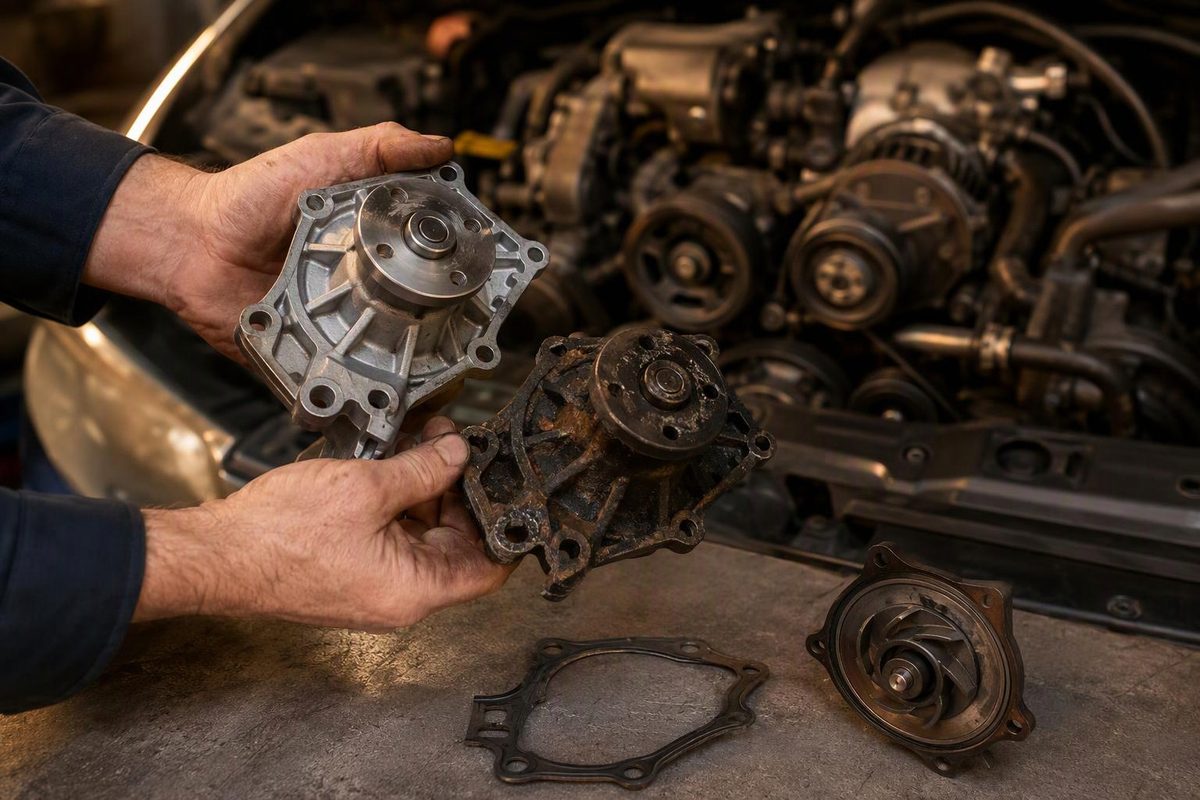
Trace coolant leaks, noise and overheating to the water pump, then plan the correct mechanical or electric pump repair without guessing.
A coolant leak near the front of an engine, pulley noise or overheating can point toward a water pump, but none proves the pump has failed. Coolant can run onto the pump from a hose, thermostat housing or crossover pipe. A noisy idler can sound like a pump bearing. Poor radiator airflow, a stuck thermostat, trapped air and combustion gas can all cause overheating.
Most vehicle water-pump repairs involve replacing the pump assembly or a separately serviced seal—not rebuilding the pump. Before ordering parts, identify the exact year, model and engine, then determine whether it uses an accessory-belt-driven pump, timing-belt-driven pump, electric main pump or electric auxiliary pump.
Stop if the engine is overheating
Pull over safely and switch the engine off if the temperature enters the hot zone, a stop-engine warning appears, coolant is pouring out or steam is visible. Do not open a hot cooling system. Ford’s owner guidance, for example, says to stop an overheating engine and never remove the coolant-reservoir cap while the engine is running or hot (Ford owner’s manual).
After a severe overheat, fixing the leak may not be the end of the repair. Continuing coolant loss, misfires, combustion gas entering the cooling system or oil-and-coolant contamination warrants additional engine testing.
Diagnose the failure mode
Save cooling-system or pump-control trouble codes and freeze-frame data before clearing anything. Then follow the branch matching the symptom.
Coolant loss or visible residue
- Let the engine cool completely. Check the coolant level by the vehicle manufacturer’s procedure.
- Clean and dry the suspected area. Old residue cannot establish whether a leak is active or where it began.
- Inspect above the pump. Check hose joints, coolant outlets, thermostat housings, reservoirs and pipes. Follow fresh residue to its highest point.
- Pressure-test the cold system at the vehicle’s specified pressure. Do not exceed that pressure. Watch the pump mounting joint, housing, hose connections and weep-hole area.
- If the cold test is inconclusive, use the manufacturer’s next test condition. Some leaks appear only as the system warms or the pump turns.
For specified 2018–2024 Audi V6 TFSI applications, Audi directs technicians to clean and dry the area, fill the system, inspect at idle and up to about 2,500 rpm, and then perform the workshop-manual leak test before replacing anything. If no leak reappears, the bulletin says to continue observing without replacing parts (Audi TSB 2070349/2). That procedure and its limits apply only to the listed vehicles.
The exact leak point matters. GM’s 2013 preliminary engineering information for certain U.S.-market Chevrolet Cruze and Sonic models with the 1.4L turbo engine identified possible leakage at the gasket between the pump housing and front cover, including traces from a mounting-bolt hole (GM PIE0275). This is different from coolant escaping through a failed shaft seal.
Do not condemn every damp weep hole. Gates says a new mechanical pump can seep briefly while its seal beds in, but continuing drips or a large coolant track after that break-in are abnormal (Gates water-pump diagnosis). Audi’s bulletin also permits a small, measured trace in the collection area of the specific pumps it covers. Never transfer one pump’s allowance to another design.
Stop points:
- Leak from a hose, pipe or housing above the pump: repair that source and retest.
- Leak from the pump-to-engine joint: inspect the housing and sealing surfaces. The specified repair may be a seal, pump or larger housing assembly.
- Active weep-hole leakage beyond the pump maker’s permitted break-in or trace: replace the pump.
- No active leak after cleaning and testing: do not replace the pump because of old residue alone.
Noise, wobble or belt trouble
With the engine off and cool, remove the accessory belt only if the service procedure permits it. Turn the mechanical pump by hand and compare it with nearby idlers and accessories.
A rough or noisy bearing, pulley runout or shaft play supports pump replacement. Gates specifies that there should be no side-to-side shaft play and advises checking belt alignment, tensioner and pulleys when bearing or shaft damage is found (Gates). Do not run the engine with the belt removed unless the exact service procedure expressly allows it.
If the parts turn smoothly, reinstall or replace the belt as appropriate and continue isolating the noise. A stethoscope can help locate a sound, but one listening point alone does not prove which rotating component has failed.
Overheating without an external leak
Pump failure is only one branch. Check coolant level, trapped air, thermostat operation, radiator airflow, fan operation, hose collapse, radiator restriction and possible combustion-gas intrusion. NAPA’s water-pump failure guide lists these as separate overheating causes and also identifies belt slippage and incorrect belt routing (NAPA water-pump failure guide). The broader cooling-system diagnostic sequence covers these branches.
A damaged or detached impeller can reduce circulation without creating an external leak. Heater output or hose temperature may provide clues, but neither confirms an impeller failure by itself. Use the vehicle-specific flow test, scan-tool pump command or inspection procedure before ordering a pump.
Electric main or auxiliary pump faults
An electric pump adds circuit and control faults to the diagnosis. Record all DTCs, then use the OEM wiring diagram and scan procedure to check:
- commanded pump activation or speed;
- reported speed or status, when available;
- power and ground under load;
- connector condition and coolant intrusion;
- control or communication circuits;
- restrictions or air locks that can make a working pump appear ineffective.
Do not apply battery voltage directly unless the manufacturer authorizes that test; an electronically controlled pump may not accept a simple power-and-ground check.
Check the VIN for open recalls as well. BMW recall 18V-248 covered certain 2008–2012 vehicles with N63, S63 and N74 engines because an auxiliary-pump circuit board could short, overheat and, in rare cases, cause an engine-compartment fire. The campaign procedure calls for replacement of the turbocharger auxiliary pump and proper bleeding—not ordinary symptom-based diagnosis (BMW recall instructions).
Plan the replacement around the pump drive
Use service information for the exact engine. Access, timing setup, one-time-use fasteners, torque values, sealants and bleeding procedures vary substantially.
- Accessory-belt-driven pump: inspect the belt, tensioner, idlers, pulley alignment and fan clutch where fitted. Correct anything that could overload the new bearing.
- Timing-belt-driven pump: treat the job as timing-system work. Lock or index the engine exactly as specified. If the timing belt is due for replacement or must be removed, assess the belt, tensioner and idlers as a system. Continental recommends replacing a timing-belt-driven pump along with the tensioner and deflection pulleys whenever the timing belt is changed, while still deferring to the vehicle manufacturer’s instructions (Continental workshop guide).
- Electric pump: follow the prescribed fill and bleed routine. Some systems can run the pump with the engine off; others require a scan-tool service function.
Before installation, compare the old and new pumps: pulley or sprocket, impeller, ports, electrical connector, mounting depth and seals. Clean the mating surface without gouging it. Use the specified gasket or O-ring, and add sealant only when the procedure calls for it. Excess sealant can enter the cooling circuit or obstruct a pump vent passage (Schaeffler REPXPERT).
Torque fasteners in the specified sequence. Never run a mechanical pump dry; Gates warns that doing so can damage its mechanical seal within seconds.
Refill with the coolant specification and mixture required for the vehicle, bleed the system completely, and confirm stable temperature and cabin heat. Inspect for leaks at operating temperature and again after a full cool-down, then correct the level if the manufacturer’s procedure requires it.
Collect drained coolant in a clean, sealable container. EPA guidance recommends recycling used antifreeze and says it should never enter storm drains or surface water; consult the relevant state or local agency for disposal requirements (EPA antifreeze guidance).