
What Your Hyundai Is Telling You—and What to Check Before Buying Parts
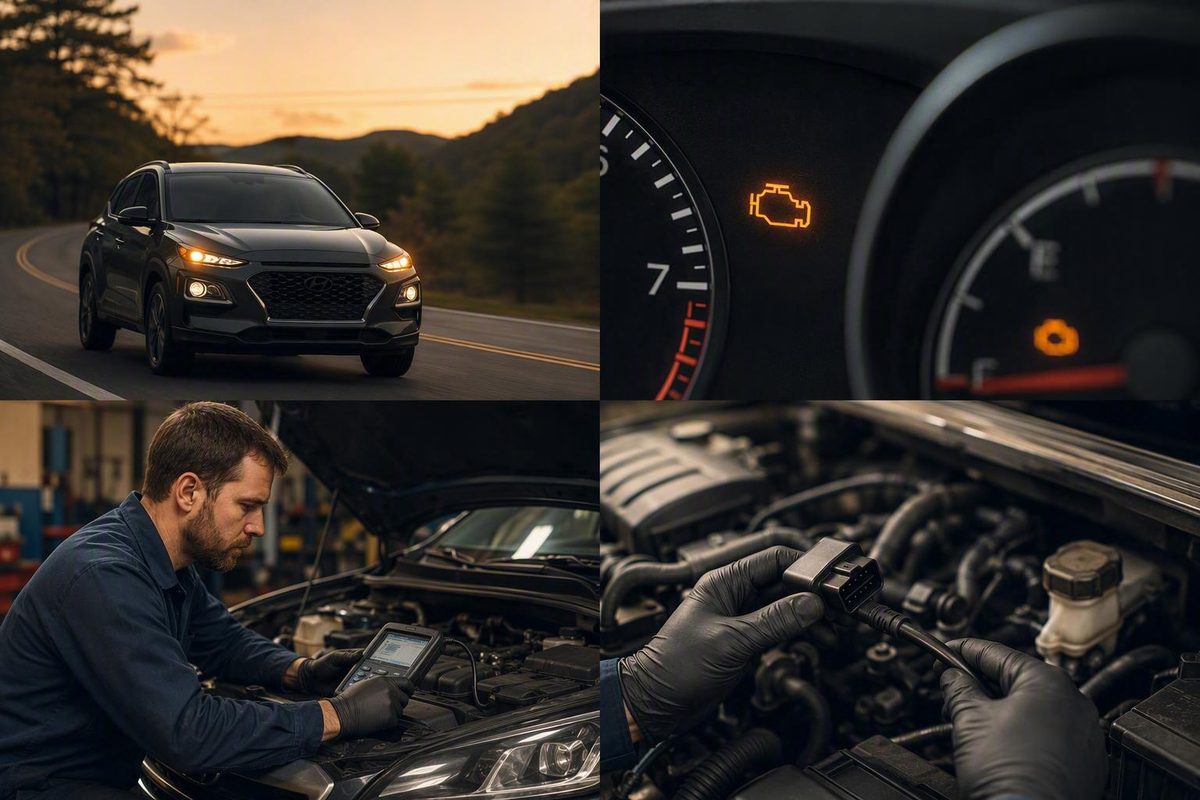
Use steady vs. flashing behavior and symptoms to decide whether to drive or stop, then save codes and freeze-frame data before clearing.
A Hyundai check-engine light means the vehicle’s onboard diagnostic system detected a condition that needs investigation. It does not identify a failed part by itself. The same warning can appear for a fuel-vapor leak, misfire, sensor-circuit problem, air-measurement fault, catalyst-related condition, or another monitored powertrain issue.
The right response is to assess the light’s behavior and the vehicle’s symptoms, preserve the diagnostic evidence, and test the affected system before buying parts.
This is general OBD-II troubleshooting guidance, not a substitute for the instructions for a particular Hyundai. Warning strategies, displays, powertrains, and procedures vary by model and year. If the owner’s manual differs from this framework, follow the manual.
Quick triage: drive cautiously, stop, or arrange a tow?
Start with what the light is doing. Then consider engine temperature, performance, sounds, smells, smoke, and any other warnings.
| Warning behavior and symptoms | Recommended response |
|---|---|
| Steady light; normal temperature and performance; no smoke, odors, unusual noises, or serious additional warnings | Limit unnecessary driving and arrange a prompt scan. Do not assume the vehicle is automatically safe simply because it feels normal. One Hyundai dealership’s general guidance similarly recommends timely service for a constantly illuminated light (AutoNation Hyundai check-engine-light guidance). |
| Steady light with overheating, smoke, steam, burning odor, pronounced shaking, rough running, abnormal noise, stalling, or substantial power loss | Pull over safely, shut the engine off, and arrange assistance rather than trying to continue to your destination. A dealership troubleshooting page likewise advises stopping safely when overheating, smoke, or another serious symptom accompanies the warning (Sid Dillon Hyundai warning guidance). |
| Flashing light with rough running, shaking, hesitation, or power loss | Treat the situation as urgent. Ease off the accelerator, stop somewhere safe, shut down, and arrange professional assistance. Towing is the conservative choice; one dealership page recommends a safe stop and tow for a blinking warning (Suntrup Hyundai warning-light guidance). |
| Flashing light without an obvious drivability change | Reduce load, find a safe place to stop, consult the owner’s manual, and arrange prompt diagnosis. Do not assume that continued driving is safe merely because no symptom is obvious (Dickson City Hyundai check-engine-light guidance). |
| Intermittent light that comes and goes | Note when it appears and scan the vehicle as soon as practical. If performance changes or the light begins flashing, limit driving and reassess the situation immediately. |
| Light recently turned off by itself | Do not assume the problem repaired itself. Scan for available stored or pending information, especially if the event has occurred more than once. |
A steady warning with normal temperature and performance generally calls for timely diagnosis rather than panic or immediate parts replacement. Minimize avoidable trips, monitor the gauges and warning indicators, and arrange a scan.
The decision changes when the light is accompanied by overheating, smoke, steam, a burning odor, pronounced vibration, rough running, abnormal mechanical noise, stalling, or major power loss. In those circumstances, pull over safely and switch off the engine. Do not keep driving merely to reach home or a repair shop.
A flashing light commonly indicates a severe active fault, but it does not prove that a particular spark plug, coil, injector, sensor, catalytic converter, or other component has failed. The light communicates urgency, not a completed diagnosis.
Confirm that you are looking at the check-engine or malfunction-indicator lamp rather than an oil-pressure, temperature, charging-system, or hybrid-system warning. Consult the model- and year-specific owner’s manual for the symbol’s meaning and the manufacturer’s instructions; dealership guidance also recommends starting with the vehicle manual (Sid Dillon Hyundai owner-manual guidance).
Safe checks to make before scanning the vehicle
Before touching anything, record what happened. Details that seem minor may help distinguish a refueling-related evaporative-emissions condition from a cold-start misfire or a fault that appears only under load.
Write down whether the light was steady, flashing, or intermittent and when you first noticed it. Note whether it followed:
- Refueling
- Recent maintenance or repair work
- A cold start
- Extended idling
- Hard acceleration or climbing a grade
- Wet, freezing, or unusually hot weather
- Driving through deep water
- A low battery, jump-start, or starting difficulty
- A particular speed or engine temperature
Record other warning indicators and symptoms. Useful observations include displayed coolant temperature, shaking, rough idle, hesitation, reduced power, smoke, steam, unusual odors, abnormal noises, hard starting, extended cranking, and stalling. Do not continue operating the engine solely to reproduce a severe symptom.
Consult the owner’s manual before checking fluids or inspecting unfamiliar areas. Use its model-specific procedures and observe any access or temperature warnings it provides.
If conditions are safe, inspect the fuel cap:
- Switch off the engine.
- Confirm that the cap is present.
- Remove it and inspect the cap and visible seal for cracks, cuts, distortion, contamination, or other obvious damage.
- Reinstall it squarely.
- Tighten it according to the cap and owner-manual instructions.
- Confirm that the fuel door closes normally.
A loose, missing, incorrectly installed, or visibly damaged cap is one possible cause. It is not automatically the most likely cause. The same general category of evaporative-emissions fault can involve hoses, connections, valves, electrical circuits, or the charcoal canister.
If the warning appeared after refueling and the cap was loose, correcting the seal may resolve the original condition.
Do not repeatedly loosen and tighten the cap, replace it solely because the light remains on, or erase the codes just to see whether the warning returns. If the light persists, retrieve the diagnostic information. The code may identify an entirely different diagnostic path—or show that the evaporative-emissions system needs further inspection and testing.
Use this worksheet before scanning or requesting help:
| Item | What to record |
|---|---|
| Hyundai | Model and trim |
| Model year | Exact year |
| Powertrain | Engine size or code if known; gasoline, hybrid, plug-in hybrid, or other configuration |
| Mileage | Current odometer reading |
| Fuel information | Fuel level, recent refueling, and whether the tank was topped off |
| Environment | Ambient temperature, rain, snow, humidity, or other notable weather |
| Driving condition | Speed, acceleration, idle, cold start, cruise, hill, or stop-and-go traffic |
| Engine condition | Cold, warming up, or fully warm; displayed coolant temperature |
| Symptoms | Shaking, rough idle, hesitation, power loss, odor, smoke, noise, hard start, or stall |
| Warning behavior | Steady, flashing, intermittent, or now off |
| Other indicators | Temperature, oil-pressure, charging, traction-control, or hybrid-system warnings |
| Recent work | Maintenance, battery work, fueling, repairs, or modifications |
This record is especially helpful when the light disappears before the vehicle can be inspected.
Possible causes—and the clues each system may produce
The following categories are possibilities, not frequency rankings or diagnoses. Several systems can produce similar symptoms, and one fault may cause secondary codes or unusual readings elsewhere. Dealership cause lists commonly include the fuel cap, EVAP system, oxygen or air-fuel sensor, ignition components, mass-airflow sensor, and catalyst-related conditions, but a list cannot identify the cause in a specific Hyundai (overview of possible Hyundai check-engine-light causes).
Fuel-cap and EVAP-system faults: A loose, absent, incorrectly installed, or visibly damaged cap can allow the system to detect a vapor-containment problem. Other EVAP possibilities include cracked or disconnected hoses, leaking connections, stuck valves, electrical faults, or a charcoal-canister problem. A warning that appears after refueling is a useful clue, but it does not prove that the cap caused it.
Ignition misfires: Spark plugs and ignition coils are possible causes of misfire conditions, as are their boots, connectors, wiring, power supplies, and control circuits. Possible clues include a rough idle, shaking, stumbling during acceleration, hesitation, reduced power, or difficult starting. Similar symptoms can also arise from fuel-delivery, intake-air, mechanical, or control problems, so they do not justify replacing ignition parts without testing.
Oxygen-sensor or air-fuel-ratio-sensor faults: These sensors provide feedback related to exhaust oxygen and mixture control. Fuel-economy or drivability changes may occur, but some faults produce little that a driver can feel.
Mass-airflow and intake-measurement faults: A mass-airflow sensor or related intake-measurement problem may be associated with sluggish response, hesitation, inconsistent idle, or a change in fuel economy.
Catalytic-converter-related faults: A scanner description containing the word “catalyst” is not a universal replacement instruction.
These categories overlap.
A cause list helps organize an inspection path. It cannot distinguish among the possibilities. That requires exact codes, operating data, inspection, and tests selected for the affected system.
Read the codes before clearing the evidence
The OBD-II diagnostic connector is generally beneath the dashboard near the steering column, although its exact position and orientation vary. Use the owner’s manual or a reliable model-specific reference if it is not readily visible.
A bounded scanning workflow looks like this:
- Park safely, apply the parking brake, and switch off unnecessary electrical loads.
- Locate the diagnostic connector.
- Connect a compatible reader without forcing the plug.
- Follow the scanner’s prompts for ignition-on, engine-off, or engine-running operation.
- Scan the modules available to the tool.
- Record stored or confirmed codes.
- Record pending codes separately.
- Save any available freeze-frame information.
- Review live data only if you can do so safely and understand what the displayed values represent.
- Exit without selecting clear, erase, or reset.
The OBD-II connector is usually under the dashboard near the steering wheel, and a compatible scanner can retrieve and clear codes; however, diagnosis should precede any reset (Huffines Hyundai scanner guide).
Save each complete alphanumeric code, not merely the scanner’s short description. Also distinguish stored or confirmed codes from pending codes where the tool provides that status. A short description can omit useful circuit or operating details and may encourage an unjustified parts conclusion.
Freeze-frame data is a snapshot of selected operating values captured near the time a module detected a fault. Depending on the vehicle, code, module, and scanner, it may include:
- Engine speed
- Vehicle speed
- Calculated engine load
- Coolant temperature
- Intake-air temperature
- Battery voltage
- Other available parameters
Live data displays current values while a compatible diagnostic tool is connected and communicating. The amount and type of freeze-frame information vary by vehicle and code (OBDeleven’s freeze-frame and live-data explanation).
Freeze-frame values add context. A misfire recorded during a cold idle suggests a different investigation from one recorded during heavy acceleration at high load. Temperature, speed, load, voltage, fuel-system information, and engine RPM may help reconstruct the event.
Availability is not guaranteed. A basic reader may display limited parameters or no accessible frame for a particular code. The data available can differ by vehicle, module, code, and tool. Do not assume every Hyundai fault has an accessible freeze frame or that every generic reader can access every manufacturer-specific function.
Most importantly, save the evidence before clearing anything. Clearing codes can remove freeze-frame data, and stored information may be overwritten or otherwise become unavailable. Prompt retrieval is particularly useful when a fault is intermittent (OBD Auto Doctor freeze-frame tutorial).
Photograph the scanner screens or create a written record containing:
- Stored or confirmed codes
- Pending codes
- The module reporting each code, if shown
- Available freeze-frame values
- Whether the engine was cold or warm
- Fuel level
- Warning-light behavior
- Symptoms and operating conditions
A trouble code is a starting point, not a parts order
The warning light tells you that a monitored condition crossed a diagnostic threshold. A code narrows the search by identifying a condition, circuit, cylinder, or affected system. Neither automatically establishes the physical root cause.
The exact checks and specifications must come from information applicable to that Hyundai’s year, engine, and code.
The same principle applies to a cylinder-specific misfire code. It narrows the investigation to a detected misfire associated with a cylinder, but does not by itself distinguish among possible categories such as:
- A spark plug or ignition-coil problem
- A connector, wiring, power, or ground fault
- Injector operation or fuel delivery
- An intake-air problem
- A mechanical engine condition
- A timing-related problem
- A control-circuit fault
These are general diagnostic possibilities, not Hyundai-specific conclusions or a test procedure for a particular code.
A careful diagnostics-before-parts sequence is:
- Confirm the complaint. Verify the warning behavior and symptoms without operating the vehicle under unsafe conditions.
- Preserve the scan data. Save the exact codes, status, available freeze frame, and relevant observations.
- Assess relationships. Consider whether multiple codes appeared under the same conditions or may involve a shared system.
- Inspect the implicated area. Look for accessible damage, loose connections, disconnected hoses, contamination, or signs of previous work.
- Test the system. Choose tests capable of separating the plausible causes rather than merely confirming that the code exists.
- Use vehicle-specific information. Compare results with specifications and procedures for the exact year, engine, powertrain, and code.
- Repair the confirmed cause. Correct the fault demonstrated by the evidence.
- Verify the result. Recheck vehicle operation and scan data after the repair.
A parts-store or scanner description is a label, not a completed diagnosis.
This approach reflects Engine Repair Zone’s stated editorial principle, “Diagnostics before parts, always”. It is a framework for evaluating evidence, not individualized diagnosis for a particular vehicle.
What to do when the light stays on, goes away, or comes back
The steady light remains on, but the Hyundai operates normally: Arrange a timely scan. Normal-feeling operation does not reveal which monitor detected a problem or whether the condition may recur. Limit unnecessary driving and continue watching the vehicle’s temperature, warning indicators, and behavior.
The light remains after you tighten the fuel cap: Retrieve the codes rather than automatically buying another cap. The detected condition may involve another EVAP component or a different system. The relevant monitor also may not yet have repeated under the conditions needed to reassess the fault.
The light turns off by itself: The detected condition may not have recurred sufficiently to keep the warning illuminated. That does not prove that a repair occurred. A scan may still reveal stored or pending information useful for investigating an intermittent problem, although availability and retention vary.
The light returns after being cleared: Treat the recurrence as evidence that the underlying condition remains or has happened again. Record the returning code, status, available freeze frame, time since clearing, and operating circumstances. Repeated erasing removes context without repairing the cause.
The light is intermittent: Scan before the available evidence disappears or is replaced. Record whether the light occurs during cold starts, after refueling, in rain, during acceleration, at idle, while cruising, or at a particular fuel level. The conditions under which the fault appears may be as useful as the code itself.
A warning that changes character also changes the triage decision. If a previously steady or intermittent light begins flashing—or becomes accompanied by overheating, smoke, steam, strong odors, shaking, rough running, abnormal noise, stalling, or substantial power loss—stop safely and shut the engine off.
Do not assume historical information will remain available indefinitely. What a scanner can retrieve depends on the vehicle, module, event, tool, and whether codes were cleared.
Resetting the light comes after diagnosis and repair
Intentionally clearing the check-engine light belongs near the end of the process, not at the beginning.
First:
- Retrieve and save the codes and available freeze-frame data.
- Inspect and test the implicated system.
- Identify the demonstrated cause.
- Complete the appropriate repair.
Afterward, a compatible OBD-II scanner can clear the relevant codes by following the tool’s prompts. Confirm that you are working with the intended module and understand that clearing may erase useful diagnostic information.
Clearing a code may remove diagnostic data and switch off the warning. It does not tighten a connection, seal a leak, restore a mechanical condition, repair wiring, correct fuel delivery, or replace a failed component. A Hyundai dealership scanner guide makes the same essential point: clearing the message does not repair the underlying problem, so the warning can return (Huffines Hyundai reset guidance).
If the unresolved condition is detected again, the code and warning may return. That recurrence is useful evidence, particularly when accompanied by new freeze-frame data, but repeatedly resetting the system is not a diagnostic test.
Do not use battery disconnection as a routine reset method. The supplied evidence does not establish it as an appropriate universal procedure across Hyundai models and powertrains. Use a compatible scanner and vehicle-specific instructions after diagnosis and repair.
If an emissions inspection is approaching, consult the applicable inspection program or a qualified technician before clearing diagnostic information. Requirements and procedures are jurisdiction-specific.
Finally, verify the repair through appropriate normal operation and a follow-up scan. Confirm that the original symptom is absent and that the code has not returned. An extinguished warning alone does not prove that the underlying fault was corrected.
When a basic reader is enough—and when to seek more help
A basic OBD-II reader may be enough for an initial investigation. Depending on the vehicle and tool, it may retrieve generic stored and pending powertrain codes and some freeze-frame data. That can help identify whether the next diagnostic path involves a misfire, mixture condition, sensor circuit, EVAP fault, or catalyst-related code.
That does not mean Hyundai-capable equipment is always required, nor does it guarantee that additional information exists for every fault. Choose equipment according to the code, affected system, and test that must be performed.
Seek professional diagnosis when:
- The check-engine light is flashing.
- The engine runs roughly, shakes, stalls, overheats, or loses substantial power.
- Smoke, steam, burning odors, or abnormal mechanical noises are present.
- The problem is intermittent and difficult to reproduce.
- Multiple codes may interact or share a cause.
- Safe confirmation requires wiring information or electrical testing beyond your experience.
- The diagnosis requires specialized pressure, leak, compression, waveform, or other system testing.
- The vehicle has an electrified powertrain and the implicated area is outside the owner-level procedures in the manual.
- You cannot safely confirm the fault with the equipment and information available to you.
Neutral service choices include a qualified independent technician, a Hyundai specialist, or a dealership. The appropriate option depends on access to suitable tools and technical information, familiarity with the particular powertrain, fault complexity, and any legitimate warranty or coverage question.
When requesting help, provide:
- Exact Hyundai model and model year
- Engine or other powertrain configuration
- Current mileage
- Complete stored and pending codes
- Available freeze-frame data
- Warning-light behavior
- Symptoms and when they occur
- Recent maintenance or repair history
- Parts already replaced
- Tests already performed
Hyundai check-engine-light FAQ
Can I drive my Hyundai with a steady check-engine light?
If the light is steady, the displayed temperature is normal, the vehicle performs normally, and there are no other serious warnings, smoke, unusual odors, noises, or shaking, cautious short-term driving may be reasonable. Limit unnecessary travel and arrange a prompt scan rather than treating the vehicle as automatically safe; dealership guidance similarly distinguishes a steady light from a flashing warning while recommending timely attention (Norman Hyundai steady-versus-flashing guidance).
Pull over safely and shut the engine off if overheating, smoke, steam, a burning odor, pronounced shaking, rough running, abnormal noise, stalling, or substantial power loss develops. Follow the owner’s manual if it provides different model-specific instructions.
What should I do if the Hyundai check-engine light is flashing?
Ease off the accelerator and find a safe place to stop. If the Hyundai is shaking, running roughly, losing power, overheating, smoking, or producing abnormal odors or noises, shut the engine off and arrange assistance. Towing is the conservative choice when a flashing light is accompanied by serious drivability symptoms (Dickson City Hyundai flashing-light guidance).
A flashing light commonly signals a severe active fault, but it does not identify the failed component. Retrieve the codes and available freeze-frame information, then test the implicated system rather than automatically buying ignition or emissions parts.
How long will the light stay on after I tighten the fuel cap?
There is no universal distance, trip count, or number of days.
If the light remains on, scan the Hyundai instead of assuming the cap needs replacement. Another EVAP component—or an unrelated system—may have triggered the warning.
Should I clear the code before taking the Hyundai in for diagnosis?
No. Save the exact stored and pending codes and all available freeze-frame information first. Clearing can erase the operating snapshot that may help explain an intermittent or condition-specific fault (OBD Auto Doctor freeze-frame retention guidance).
Unless a qualified diagnostic procedure calls for clearing at a particular stage, leave the evidence available for the person testing the vehicle.
Why did the check-engine light return after I reset it?
The diagnostic system detected the unresolved condition again, or the fault recurred. Resetting removed diagnostic information and may have temporarily extinguished the warning; it did not repair the cause.
Scan the Hyundai again, save the returning codes and available freeze-frame data, and compare the circumstances with the earlier event. Test the affected system instead of treating the component named in the scanner description as an automatic replacement.
The complete action sequence is simple: assess the light and symptoms; stop safely if severe signs are present; inspect only low-risk items such as the fuel cap; record the exact codes and available freeze-frame data; test the implicated system instead of guessing at parts; repair the confirmed cause; then clear and verify. The appropriate next step depends on the Hyundai’s model, year, powertrain, owner’s manual, symptoms, and exact diagnostic evidence.