
Is That White Tailpipe Plume Harmless Steam or an Engine Warning?
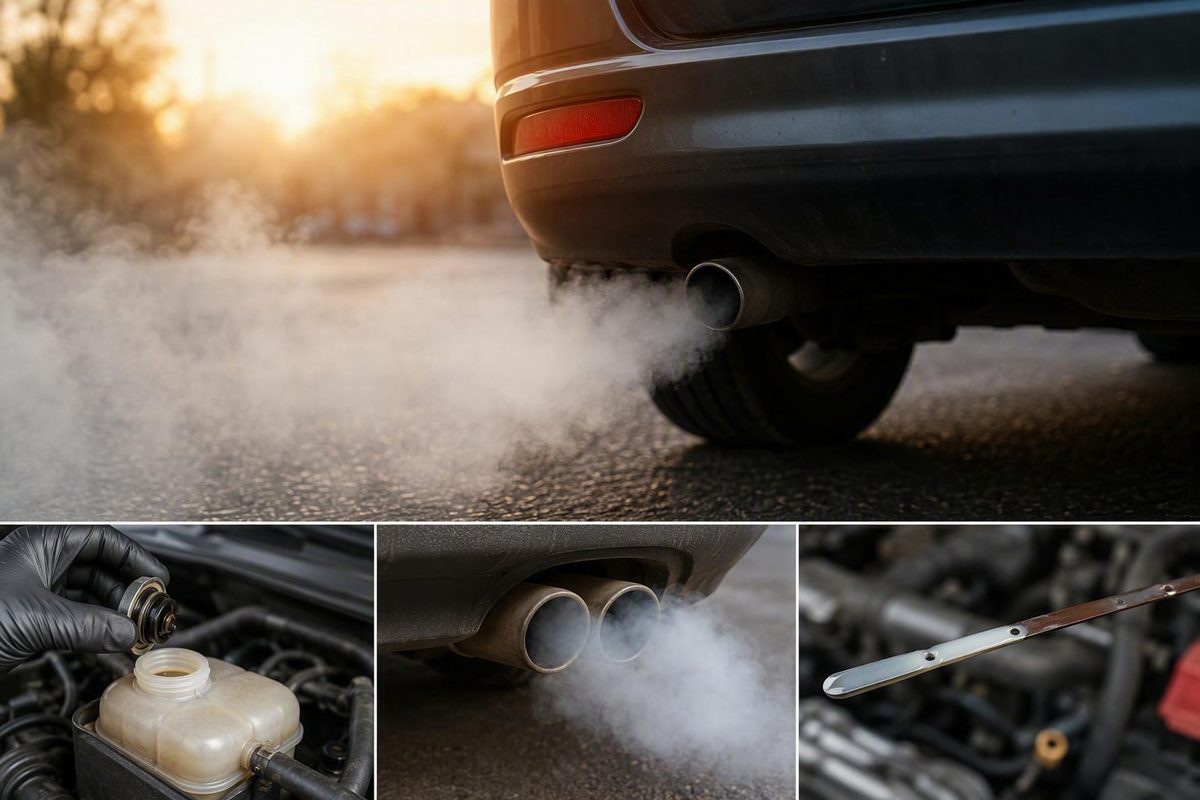
Distinguish harmless condensation from coolant or unburned diesel fuel by warm-up behavior, odor and fluid loss, with clear signs for stopping or towing.
White smoke from the exhaust can be harmless condensation—or a warning that coolant or unburned fuel is entering the exhaust. Color alone cannot tell you which. Engine temperature, plume density, persistence, odor, fluid levels, warning lights, and engine behavior all matter.
First confirm that the white output is coming from the tailpipe rather than under the hood. Then monitor a cold engine as it warms. Thin vapor that disappears completely is probably condensation. Dense or persistent white exhaust from a warm engine warrants diagnosis, especially if coolant is disappearing, the engine is overheating, or performance has changed.
Diesel vehicles require a separate diagnostic branch. Their white smoke may come from coolant, but it can also be unburned fuel caused by incomplete combustion. In either case, confirm the failure path before buying injectors, replacing a head gasket, or authorizing major engine work.
Quick triage: what the white exhaust is telling you
Use these six clues before drawing conclusions:
| Clue | More consistent with condensation | More consistent with a fault |
|---|---|---|
| Location | Thin vapor leaving the tailpipe | Persistent tailpipe smoke; under-hood smoke or steam is also abnormal but follows a separate diagnostic path |
| Engine condition | Cold engine and cold exhaust | Fully warm engine |
| Output density | Thin, wispy, translucent vapor | Dense, billowing, or continuous output |
| After warm-up | Disappears completely | Continues, repeatedly returns, or becomes heavier |
| Odor | Little distinctive odor | Sweet, raw-fuel, or burnt-oil odor |
| Other symptoms | No fluid loss, warnings, or drivability changes | Coolant loss, overheating, warning lights, rough running, misfires, or reduced power |
Thin vapor after a cold start that clears as the exhaust warms is usually condensation. Moisture can collect inside a cool exhaust while the vehicle is parked, then become visible steam when hot exhaust begins flowing. Thick or persistent output after warm-up does not fit that normal pattern. Jiffy Lube distinguishes temporary startup steam from persistent, sweet-smelling white exhaust associated with possible coolant intrusion.
For a warm gasoline engine, recurring white exhaust puts internal coolant leakage high on the list of possibilities. Potential paths include a failed head gasket, a cracked or warped cylinder head, or a cracked engine block. These are faults to investigate, not conclusions established by color.
For a diesel engine, divide the investigation into two branches:
- Coolant intrusion: Look for falling coolant, a sweet odor, overheating, cooling-system bubbles, widespread oil contamination, or an unexplained change in oil level.
- Incomplete combustion: Look for a raw-diesel odor, difficult cold starting, rough operation, misfires, diagnostic codes, or smoke that changes as the engine warms.
A diesel injector may deliver the wrong quantity of fuel, deliver it at the wrong time, leak, or atomize fuel poorly. Injection timing, inadequate compression, failed glow plugs or intake heaters, and contaminated or unsuitable fuel can also prevent complete combustion.
Smoke color is an initial clue, not proof of a failed component. A white plume does not establish that a head gasket, injector, cylinder head, or engine block has failed.
Location matters just as much as color. Tailpipe output points toward condensation or a combustion-related issue involving coolant, fuel, oil, cylinder sealing, or—on some vehicles—a turbocharger. Smoke or steam from under the hood follows another path involving possible external fluid leakage, overheating, wiring trouble, or fire.
If an under-hood fire is suspected, stop the vehicle, switch off the engine, evacuate, keep away, and call emergency services. The RAC specifically advises releasing but not opening the hood when responding to a suspected engine-bay fire. Follow that fire-response guidance rather than attempting further diagnosis.
When to keep observing, schedule an inspection, or arrange a tow
Whether you can keep driving depends on the complete symptom pattern—not simply whether the exhaust appears white.
1. Observe through warm-up
Brief observation is reasonable only when all of the following are true:
- The engine and exhaust are cold.
- The vapor is thin and wispy.
- It disappears completely as the exhaust warms.
- The temperature gauge remains normal.
- No warning lights appear.
- There is no unexplained coolant or oil loss.
- The engine runs normally, without misfires, roughness, or reduced power.
- The plume does not return after the engine is warm.
Do not use a universal minute-based cutoff. Complete disappearance after warm-up is the more useful distinction.
2. Schedule prompt diagnosis
Arrange an inspection soon if the white exhaust:
- Continues after normal operating temperature is reached
- Repeatedly returns on different trips
- Becomes progressively denser
- Appears during acceleration or under load
- Is accompanied by unexplained coolant loss
- Comes with difficult starting, rough running, misfires, or reduced power
- Smells distinctly sweet or, on a diesel, strongly of raw fuel
- Cannot confidently be identified as condensation
Smoke appearing during acceleration is a reason to investigate, but it does not identify a specific component. Record the operating conditions rather than repeatedly driving the vehicle to see whether the symptom becomes worse.
3. Stop as soon as safely possible
Pull over and shut the engine down if persistent smoke is accompanied by:
- A rising temperature gauge or overheating warning
- Rapid coolant loss
- A low-oil-pressure or serious engine warning
- Major power loss
- Severe rough running or knocking
- Milky or broadly contaminated oil
- An unexplained increase in the engine-oil level
- A strong sweet odor together with other coolant-leak symptoms
An increasing oil level is a nonspecific warning that another fluid may be entering the crankcase. Do not assume from the level alone that the contaminant is coolant; determine what is entering the oil before selecting a repair.
Continued operation with an internal coolant leak can contribute to overheating and further engine damage. The AA recommends prompt assessment of continuous white smoke and identifies coolant loss, overheating, contaminated oil, and reduced performance as associated warning signs. Its guidance generally advises against continued driving with persistent white exhaust.
4. Arrange a tow
Choose a tow when the vehicle is overheating, rapidly losing coolant, producing heavy continuous smoke, suffering major power loss, or showing signs that another fluid may be contaminating the oil. Towing is also the safer choice when you cannot distinguish condensation from a fault and other warning signs are present.
A diesel producing white smoke from unburned fuel may not have a coolant leak, but that does not justify continued driving or indiscriminate parts replacement. Fuel delivery, starting aids, timing, and compression still require diagnosis. Heavy, persistent diesel smoke accompanied by overheating, milky oil, a rising oil level, or a sweet smell is a shutdown-and-tow condition. Diesel diagnostic guidance recommends stopping and arranging a tow for these combined warning signs.
When uncertainty involves engine temperature, fluid loss, lubrication, or a serious change in how the engine runs, err on the side of stopping. White exhaust alone cannot establish that continued operation is safe.
Normal condensation versus persistent white smoke
An exhaust system cools while a vehicle is parked. Moisture can condense inside its pipes and mufflers, particularly in cool or humid conditions. When the engine starts, the warming exhaust turns that moisture into visible vapor.
Normal condensation is generally:
- Thin or wispy
- Most noticeable during a cold start
- More visible in cool ambient air
- Temporary
- Unaccompanied by fluid loss, warning lights, or poor running
- Gone once the exhaust has warmed fully
People commonly call this “white smoke,” but it is condensed water vapor rather than evidence that coolant or fuel has passed through the engine.
Do not apply a fixed rule such as “one minute is normal” to every vehicle.
The practical question is: Does the plume disappear completely after the engine and exhaust reach normal operating temperature? If it does and no related symptoms appear, continue monitoring. If it remains dense, returns after clearing, or continues from a fully warm engine, investigate it.
Persistent white output differs because another substance or combustion condition may be creating the plume. On a gasoline engine, coolant entering a cylinder is a central possibility. On a diesel, either coolant intrusion or incompletely burned fuel may be responsible. Oil smoke can look pale in some lighting, but oil burning is more commonly blue or blue-gray.
Do not dismiss every startup plume as moisture. Cold-start smoke accompanied by falling coolant, overheating, rough running, repeated dense clouds, or warning lights no longer fits the reassuring condensation pattern. Conversely, one thin plume on a cold morning does not justify assuming that the head gasket has failed.
Gasoline-engine causes: follow the evidence for coolant intrusion
When a warm gasoline engine produces persistent, dense white exhaust, look for evidence that coolant is entering a combustion chamber. Once inside a cylinder, coolant can leave through the exhaust as a white vapor or smoke-like plume, sometimes accompanied by a sweet odor.
Several internal paths are possible.
Failed head gasket
The head gasket seals the joint between the engine block and cylinder head. It helps contain cylinder pressure while keeping combustion, coolant, and oil passages separated. If the gasket fails between a coolant passage and a cylinder, coolant may enter the combustion chamber.
That is one possible explanation—not a diagnosis based on plume color. A head gasket can fail in different areas and produce different combinations of external leakage, compression loss, fluid contamination, cooling-system pressurization, or overheating. Some failures may not produce an obvious white plume.
Cracked or warped cylinder head
A cylinder head can crack or distort enough to compromise sealing. A crack connecting a coolant passage to a combustion chamber may admit coolant directly. A warped sealing surface can prevent the head gasket from maintaining an effective seal.
Cracked engine block
A crack in the block may create another route between a coolant passage and a cylinder or crankcase. This possibility belongs in the diagnostic path, but white exhaust cannot distinguish a block crack from a gasket or cylinder-head fault.
These internal failures differ from cooling-system faults that contribute indirectly. A damaged radiator, coolant leak, circulation problem, or another cooling fault may cause overheating. Overheating may then damage the head gasket or distort the cylinder head. Repairing only the resulting internal damage without finding the original cooling fault can leave the underlying cause unresolved.
Corroborating clues for internal coolant leakage include:
- Recurring coolant loss with no obvious external leak
- Overheating
- Rough running or a startup misfire
- Reduced power
- Persistent bubbles in the coolant reservoir
- Oily contamination in the coolant
- Milky or broadly contaminated engine oil
- An unexplained rise in the oil level
- A sweet exhaust odor
Overheating can damage a head gasket or warp a cylinder head, while creamy residue beneath the oil cap is only an indicator that requires corroboration. The RAC recommends considering the smoke’s location, color, timing, and accompanying warning lights together.
No single clue confirms a head-gasket failure. Coolant may be disappearing through an external leak. Poor running can result from ignition, fuel, mechanical, or control-system faults. Bubbles or fluid contamination also require proper interpretation.
Exhaust color can still help separate broad categories:
- White: condensation, coolant intrusion, or—in diesels—unburned fuel
- Blue or blue-gray: more commonly oil entering the combustion chamber
- Black: more commonly an overly rich fuel mixture
Some vehicles have unusual fluid-ingestion paths. For example, certain older systems may admit transmission fluid through a failed vacuum modulator. Such possibilities should be considered only when the vehicle has the relevant equipment and its symptom pattern supports that route. They should not distract from the primary distinction between condensation and coolant intrusion.
Diesel white smoke: coolant or unburned fuel?
A diesel engine requires its own troubleshooting path. Like a gasoline engine, it can produce white exhaust when coolant enters a cylinder. Unlike a gasoline engine, it may also emit white or pale gray smoke when diesel fuel fails to burn completely.
Branch one: incomplete diesel combustion
Diesel combustion depends on sufficient cylinder temperature, adequate compression, appropriate injection timing, and effective fuel atomization. If combustion is delayed or incomplete, some fuel may leave through the exhaust as white smoke.
Possible contributors include:
- An injector delivering the wrong quantity of fuel
- An injector leaking or delivering fuel at the wrong time
- Poor spray atomization
- Incorrect injection timing
- Low cylinder compression
- Failed glow plugs
- A failed intake-air heater
- Contaminated or unsuitable fuel
- Insufficient temperature during a cold start
An injector does not have to stop working completely to cause trouble. An incorrect spray pattern or fuel quantity can prevent complete combustion. Incorrect timing may introduce fuel when conditions are not right for ignition, while low compression may prevent the air from becoming hot enough for reliable combustion.
A diesel injector releasing the wrong amount of fuel or delivering it at the wrong time can allow raw diesel into the exhaust. Coolant intrusion through a gasket, cylinder head, or block produces a separate diagnostic branch. UTI’s diesel overview describes both routes and recommends coolant, oil, and compression checks as part of diagnosis.
Repeated cold-start smoke that clears as combustion stabilizes may justify checking glow plugs, the intake heater, injectors, injection timing, or compression. It is not automatically normal merely because it eventually clears. Compare the behavior with previous starts and note whether the engine cranks longer, runs unevenly, or produces a strong raw-fuel odor.
A raw-diesel smell without coolant loss supports the incomplete-combustion branch, but it does not identify the exact fault. Odor is subjective, and more than one problem may be present.
Branch two: coolant intrusion
Diesels can suffer the same general coolant-entry paths as gasoline engines:
- Failed head gasket
- Cracked or warped cylinder head
- Cracked engine block
- Another engine-specific internal sealing failure
A sweet odor, falling coolant level, overheating, persistent cooling-system bubbles, or broadly contaminated oil strengthens this branch. A rising oil level is also concerning, but the contaminant must be identified rather than automatically assumed to be coolant.
Several related observations are more useful than one isolated sign. Smoke color, odor, coolant behavior, diagnostic codes, injector tests, timing checks, and compression results can help distinguish incomplete combustion from coolant entry.
Turbocharger trouble belongs lower on the list unless other evidence supports it. A turbo oil leak may produce smoke that appears blue-white rather than purely white. Oil consumption, boost problems, and the vehicle’s turbo arrangement should be evaluated before blaming the turbocharger.
Do not label injectors or head gaskets as the “most common” cause without model-specific evidence. The correct branch depends on the operating pattern, odor, fluid behavior, cylinder condition, fuel system, and test results.
Safe checks to make before replacing any parts
Begin with observations that do not require opening the cooling system or dismantling the engine.
Confirm the source
Determine where the output originates:
- Tailpipe output directs attention toward condensation, combustion, coolant, fuel, oil, or turbo-related causes.
- Under-hood smoke or steam directs attention toward external fluid leaks, overheating, wiring, or possible fire.
If fire is suspected, stop diagnosing and follow the emergency procedure described earlier.
Record the operating pattern
Write down or film:
- Whether the engine was cold, partly warm, or fully warm
- Ambient temperature and weather
- Whether the plume was thin, dense, intermittent, or continuous
- Whether it disappeared completely
- Whether it occurred at startup, idle, acceleration, deceleration, or throughout operation
- Whether the engine had been sitting for hours or days
- Whether the output changed with engine speed or load
A short video can help a technician see a symptom that disappears before the vehicle reaches the shop. When practical, include the instrument panel so warning lights and temperature behavior are documented.
Note odor cautiously
Without deliberately breathing the exhaust:
- A sweet odor may support coolant intrusion.
- A raw-fuel odor, particularly on a diesel, may support incomplete combustion.
- A burnt-oil odor with blue-gray smoke may point toward oil burning.
Odor narrows the investigation; it is not a definitive test.
Watch engine behavior
Record:
- Temperature-gauge movement
- Check-engine, coolant-temperature, glow-plug, or other warnings
- Misfires or uneven idle
- Hard starting
- Hesitation
- Reduced power
- Unusual mechanical noise
- Changes in fuel economy or fluid consumption
Do not continue running an overheating or severely misfiring engine merely to improve the observation.
Inspect fluids only after the engine cools
Allow the engine to cool before checking coolant, and follow the vehicle manufacturer’s instructions for accessing and checking the cooling system. UTI likewise advises allowing a diesel engine to cool before inspecting coolant when investigating white smoke. Its diagnostic overview pairs coolant inspection with oil and compression checks.
Then compare current fluid levels and condition with previous observations:
- Is the coolant repeatedly dropping after being set correctly?
- Is the coolant oily, rusty, or otherwise contaminated?
- Is the engine oil milky or frothy on the dipstick?
- Has the oil level risen unexpectedly?
- Is contamination widespread rather than limited to residue under the filler cap?
Creamy residue found only under the oil filler cap is not enough to diagnose a failed head gasket. Look for corroboration such as recurring coolant loss, overheating, contamination on the dipstick or in drained oil, abnormal cooling-system behavior, or a failed diagnostic test.
Do not add a leak sealer, replace a gasket, or order injectors based on these observations alone. A home inspection should identify the next appropriate test—not predetermine the repair.
Tests that confirm the cause instead of guessing
A useful diagnostic plan maps the symptom group to the system most likely to explain it.
If coolant intrusion is suspected
Choose this path when white exhaust persists after warm-up and is accompanied by coolant loss, a sweet odor, overheating, cooling-system bubbles, or fluid contamination.
Cooling-system pressure test: This checks whether the cooling system holds pressure and may reveal an external leak or support further investigation of an internal one. A pressure loss does not, by itself, identify the failed component.
Combustion-gas test: Testing for combustion gases in the cooling system may support a leakage path between a combustion chamber and the cooling system. Results must be interpreted with the other symptoms and according to the applicable test and vehicle procedures.
Fluid inspection: Coolant condition, oil condition, and changing fluid levels can show whether contamination may be occurring. An unexplained rise in oil level is concerning but does not identify the contaminant by itself.
Repeated level checks: Recurring loss after the level has been corrected is more useful evidence.
If one cylinder is weak or uneven
Compression testing may be appropriate when there is a persistent misfire, hard starting, uneven cranking, low power, or other evidence that a cylinder is not sealing properly.
A compression test can identify a weak cylinder and support concerns involving a head gasket, valve, piston, ring, cylinder, or related sealing surface. It does not automatically determine which component failed. Cylinder-to-cylinder comparison and vehicle-specific specifications matter.
If a gasoline cylinder may be receiving coolant
Spark-plug inspection can provide supporting evidence. A plug from a coolant-exposed cylinder may look unusually clean, pale, or different from the others.
That appearance is not proof. HOT ROD’s diagnostic discussion similarly treats smoke color, plug condition, fluid contamination, compression, and cooling-system pressure testing as evidence that must be interpreted together. Its exhaust-smoke guide emphasizes combined testing rather than diagnosis from one isolated sign.
If diesel exhaust smells like raw fuel
Prioritize checks of combustion and fuel delivery:
- Scan for diagnostic trouble codes and relevant live data.
- Evaluate glow plugs or the intake heater.
- Check injector return rates where that test applies.
- Test injector delivery or spray pattern with suitable equipment.
- Check injection timing or timing-related data.
- Test cylinder compression.
- Inspect fuel quality and contamination.
A diagnostic code identifies a condition, circuit, or affected system; it does not prove that the component named in the code description is defective. Electrical faults, voltage problems, mechanical conditions, or another component can produce the same code.
Results must be compared with vehicle-specific limits. Glow-plug and intake-heater checks are especially relevant when smoke and rough running are concentrated at cold startup. Compression testing becomes more important when starting-aid and fuel-delivery checks do not explain the weak combustion.
Diesel diagnostic guidance includes code scanning, injector checks, timing evaluation, compression testing, and combustion-gas testing as ways to separate unburned fuel from coolant intrusion. These checks should be selected according to the symptom pattern rather than performed as an unprioritized parts search.
Use vehicle-specific information
Consult manufacturer service information for:
- Test procedures and safety precautions
- Cooling-system test specifications
- Compression specifications
- Injector test limits
- Timing procedures
- Known fault patterns
- Cylinder-head and sealing-surface inspection requirements
- Cooling-system refill and bleeding procedures
The workflow should remain disciplined:
- Reproduce the symptom.
- Record temperature, timing, odor, density, and engine behavior.
- Check fluid levels and condition after the engine cools.
- Select tests for the suspected system.
- Confirm the failure path.
- Assess related or secondary damage.
- Only then choose and authorize the repair.
What the repair may involve—and what white smoke does not prove
The correct repair follows the confirmed cause:
- Normal condensation: No mechanical repair is required.
- Failed glow plug or intake heater: Repair the circuit or replace the verified failed component.
- Injector fault: Repair or replace the injector after testing confirms the problem.
- Injection-timing fault: Correct the cause using the applicable service procedure.
- Contaminated fuel: Correct the verified contamination problem according to the vehicle’s fuel-system requirements.
- External coolant leak: Repair the confirmed hose, radiator, pump, housing, connection, or other leak source.
- Failed head gasket: Correct the sealing failure and investigate why it occurred.
- Damaged cylinder head: Inspect it for distortion or cracking and repair or replace it as appropriate.
- Cracked engine block: Determine the required repair or replacement from the confirmed damage and manufacturer guidance.
- Turbo-related oil leak: Repair the confirmed oil-leak path and inspect the related lubrication, intake, and exhaust systems.
White smoke does not automatically mean that an engine is blown, irreparable, or due for replacement. Severity depends on the cause, how long the vehicle was operated, whether it overheated, whether lubrication was compromised, and what inspection reveals.
Repair costs and labor requirements vary too widely by engine design, vehicle access, location, parts requirements, and damage extent to estimate responsibly from exhaust color.
Keep three misconceptions out of the authorization process:
- “White smoke proves the head gasket has failed.” It does not. Condensation, another coolant-entry path, or incomplete diesel combustion can produce a similar appearance.
- “Creamy residue proves coolant is in the oil.” Residue in one location is not definitive. Check the overall symptom pattern and test the relevant system.
- “The code tells me which part to replace.” A code identifies what the control module detected, not necessarily the root cause.
Leak-sealing additives should not be treated as a proven permanent repair. Without evidence of durability and compatibility for the specific engine and cooling system, an additive is not a substitute for locating the leak, checking the affected sealing surfaces, and evaluating related damage.
Before approving a repair estimate, ask:
- What test failed?
- What was the measured result?
- How does that result identify the proposed leak or combustion fault?
- Were external coolant leaks ruled out?
- Was the engine checked for overheating-related damage?
- If a head gasket is proposed, were the cylinder head and related sealing surfaces evaluated?
- If an injector is proposed, what test confirmed its delivery or leakage problem?
- Which manufacturer procedure and specifications support the repair?
- Is there an underlying fault that could damage the replacement part?
Frequently asked questions
Why is there white smoke from the exhaust on startup that then goes away?
Thin white vapor on startup is usually moisture that collected inside the cool exhaust while the vehicle was parked. As the exhaust warms, the moisture becomes visible steam and then disappears.
That pattern is generally harmless when the plume clears completely and there is no coolant loss, overheating, warning light, rough running, or reduced power. If the startup plume is dense, repeatedly returns, continues after warm-up, or accompanies other symptoms, do not assume it is condensation.
Does white smoke always mean a blown head gasket?
No. White exhaust may be normal condensation, coolant entering through a head gasket, cylinder head, engine block, or another vehicle-specific leak path, or incompletely burned fuel in a diesel.
A head-gasket diagnosis requires supporting evidence and testing. Coolant loss, overheating, oil contamination, cooling-system bubbles, compression imbalance, or combustion gases in the cooling system may strengthen the case, but no single clue proves the gasket has failed.
Can I drive a car that is producing white exhaust smoke?
You can briefly observe a cold engine when the output is thin, temporary, clears completely after warm-up, and comes with no warning signs.
Arrange prompt diagnosis if the smoke persists, returns, becomes dense, appears during acceleration, or accompanies poor performance or unexplained coolant loss. Stop and arrange a tow for heavy continuous smoke with overheating, rapid fluid loss, contaminated oil, warning lights, severe roughness, or major power loss. If you cannot confidently distinguish condensation from a fault, choose the safer option.
What causes white smoke from a diesel exhaust?
A diesel may produce temporary condensation, coolant vapor, or white smoke from fuel that has not burned completely. Fuel-related causes can include injector leakage or poor atomization, incorrect injection timing, inadequate compression, failed glow plugs or intake heaters, and contaminated or unsuitable fuel.
A raw-fuel odor, hard cold starting, and rough running support the incomplete-combustion path. A sweet odor, falling coolant, overheating, cooling-system bubbles, or contaminated oil support coolant intrusion. Neither odor nor smoke color is definitive.
How does a mechanic test whether coolant is entering a cylinder?
A mechanic normally combines several checks rather than relying on one result. These may include a cooling-system pressure test, a combustion-gas test, inspection for recurring coolant loss or fluid contamination, spark-plug examination on applicable gasoline engines, and compression testing.
Results must be interpreted together. A pressure drop shows that the cooling system is losing pressure but may not locate the leak. Weak compression identifies a cylinder-sealing problem but may not identify the exact failed component. The repair should be selected only after the evidence establishes the failure path and whether overheating caused related damage.
The practical decision path: Let a cold engine and exhaust warm while monitoring the plume. If thin vapor disappears completely and no other symptoms appear, it is probably condensation. If white exhaust persists, separate gasoline from diesel diagnosis and gather evidence from odor, coolant and oil condition, engine temperature, warning lights, and operating pattern. Shut the engine down and arrange a tow when heavy smoke accompanies overheating, rapid fluid loss, contamination, serious warnings, or major power loss. In every other abnormal case, test the relevant cooling, cylinder-sealing, or diesel fuel system before authorizing parts or major engine work.