
What a Competent Shop Should Prove Before Servicing Your Truck’s EGR System
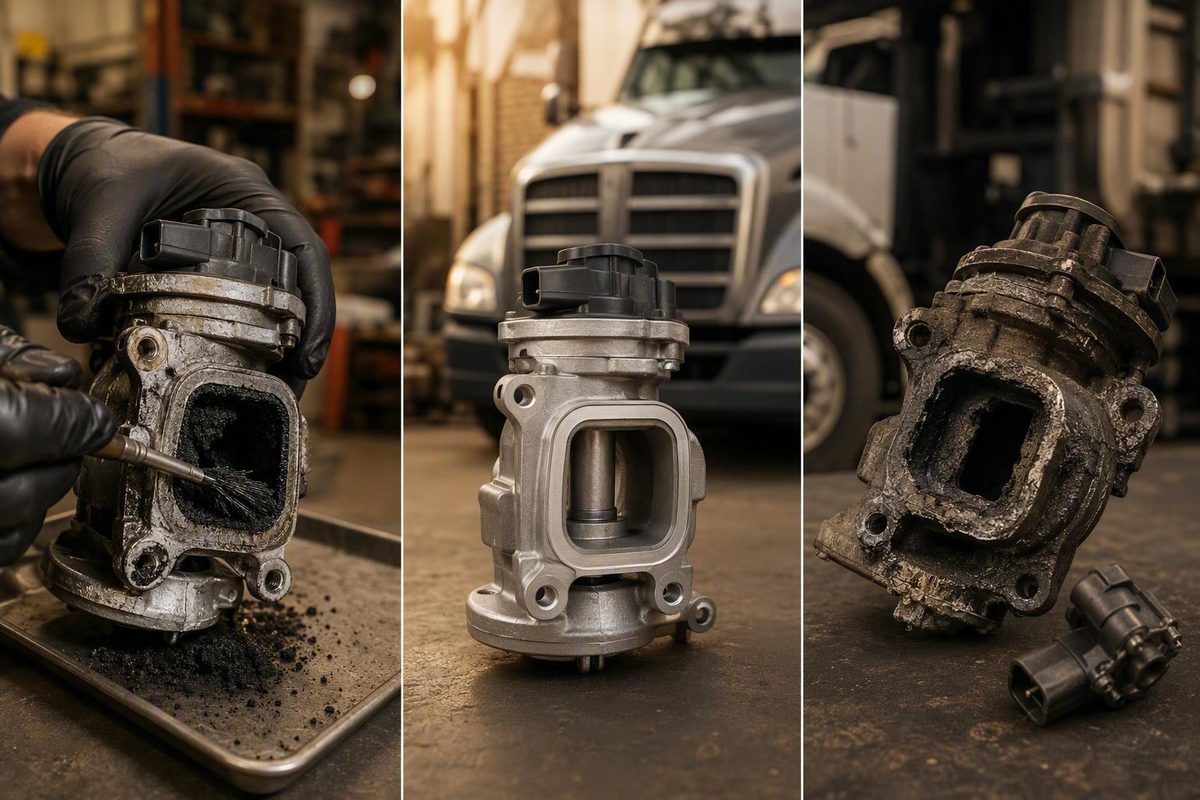
Cleaning fits removable carbon when the part still works; replacement fits leaks, physical damage, failed electronics or an unusable actuator.
By Manny Ortiz. Engine Repair Zone says its engine-diagnostic and repair guidance draws on Manny’s 22 years of hands-on experience with gas and diesel engines (about the site’s editorial approach).
Truck EGR service should not begin with “clean it” or “replace the valve.” It should begin with a specific question: Which part of the system failed, and what test supports that conclusion?
An EGR-related code or symptom can identify the system that needs investigation without identifying the failed component. Carbon may restrict a valve, tube, passage, or cooler. The valve may move while a pressure sensor reports the wrong flow. A circuit fault may originate in wiring or a connector rather than the actuator. Coolant loss may justify cooler testing, but it does not prove that the cooler is leaking.
A competent shop should therefore approach truck EGR service as a diagnosis-and-verification process:
- Document the complaint and the conditions under which it occurs.
- Retrieve codes, freeze-frame information, and relevant live data.
- Inspect and test the system instead of assuming the valve is bad.
- Match cleaning, repair, or replacement to the supported failure mode.
- Verify the result under appropriate operating conditions.
This article is a customer-facing evaluation checklist, not an OEM procedure. Exact tests, specifications, chemicals, coolant procedures, calibrations, and safety requirements vary by engine and emissions configuration. Apply the guidance with current service information for the exact truck, consistent with Engine Repair Zone’s terms for informational use.
What truck EGR service actually covers
The exhaust gas recirculation system meters a controlled amount of exhaust back into the intake. Recirculation lowers combustion temperature and reduces nitrogen oxide formation. The valve controls flow, but it is only one part of the system.
Depending on the engine and emissions configuration, the system may include:
- An electronic or vacuum-operated EGR valve
- An EGR cooler
- Exhaust transfer tubes or crossover pipes
- Intake and EGR passages
- Differential-pressure or flow sensors
- Valve-position sensors
- Vacuum or electronic control solenoids
- Wiring, connectors, hoses, and control circuits
- Coolant connections and seals
- Related intake, turbocharger, and airflow sensors
- Engine-control software and learned values
That is why “EGR service” is incomplete unless the estimate defines its scope. One shop may mean removing and cleaning the valve. Another may mean flushing the cooler. A chemical-cleaning provider may treat parts of the circuit without removing components. A comprehensive emissions shop may separately offer sensor replacement, regeneration support, calibration, resets, or checks of related aftertreatment systems. One heavy-duty provider, for example, lists valve diagnostics, carbon removal, cooler flushing or replacement, sensor replacement, code handling, regeneration support, and calibration as distinct service elements (Iron Buffalo’s published EGR service scope).
As a customer-facing checklist, a complete conversation with the shop should cover:
- Complaint and service history. Record when the symptom occurs, recent repairs, coolant use, smoke color, duty cycle, and whether the fault is intermittent or recurring.
- Full-system scan. Ask for active, pending, and history codes rather than only the first EGR-related code displayed.
- Freeze-frame review. Identify the engine speed, load, temperature, vehicle speed, and other recorded conditions present when the fault set.
- Relevant live data. Compare commanded EGR operation with available valve-position, pressure, airflow, temperature, or calculated-flow feedback.
- Visual inspection. Check accessible wiring, connectors, hoses, coolant evidence, intake connections, tubes, and passages.
- Directed testing. Test the valve, sensors, solenoids, cooler, and associated circuits as indicated by the code and engine design.
- Failure-mode decision. Determine whether the evidence points to contamination, restriction, leakage, mechanical damage, electrical failure, erroneous measurement, or another airflow fault.
- Supported service. Clean, repair, or replace only what the diagnosis supports.
- Verification. Recheck codes and data, inspect for leaks, perform any required relearn or regeneration, and operate or road-test the truck under suitable conditions.
Ask what “code handling” means. Simply clearing codes is administrative. A meaningful repair verification shows that the original failed test now passes or that the relevant monitor runs without the fault returning.
Also confirm whether the quote includes the valve, cooler, tubes, passages, sensors, seals, coolant, calibration, regeneration, and post-service road test. Inclusions vary by provider and engine.
Symptoms and codes are clues, not a parts diagnosis
EGR faults can cause noticeable drivability problems, but common symptoms are not exclusive to the EGR system.
Reported complaints include:
- Rough or unstable idle
- Hesitation or weak acceleration
- Reduced power
- Increased fuel consumption
- Black, gray, or white exhaust smoke
- Check-engine or emissions warning lights
- Stalling
- Surging at cruise
- Hard starting in some conditions
- Engine or emissions-system derates
Fuel-delivery faults, charge-air leaks, turbocharger-control problems, intake restrictions, sensor errors, cooling-system faults, and aftertreatment problems can produce overlapping symptoms. Even if the EGR system is involved, the symptom does not identify whether the valve, cooler, passage, sensor, wiring, or control system is responsible.
Coolant loss, overheating, or white smoke warrants prompt investigation. Those signs can be consistent with an EGR-cooler problem, but they can also originate elsewhere in the cooling system or engine. A commercial cooler-service provider similarly presents clogging, coolant leakage, overheating, and white smoke as reasons for inspection rather than proof of a single failure (DPF Alternatives’ EGR-cooler overview).
A cooler should therefore be condemned only after the shop performs the applicable engine-specific leak, pressure, isolation, or inspection procedure.
Three commonly discussed diagnostic trouble codes are:
- P0401: insufficient EGR flow
- P0402: excessive EGR flow
- P0403: EGR circuit malfunction
These descriptions identify detected conditions, not automatically defective valves. Commercial heavy-duty guidance uses the same broad code meanings while distinguishing carbon contamination from bent, warped, or electrically failed components (Skyliner Truck Center’s EGR overview).
For example, P0401 may be associated with:
- A restricted EGR valve
- A plugged transfer tube or intake passage
- A restricted cooler
- A faulty differential-pressure sensor
- Blocked or damaged pressure-sensor tubes
- A control-solenoid problem
- Wiring or connector faults
- Incorrect airflow measurement
- An intake or turbo airflow problem
- A valve that does not reach the commanded position
P0402 may involve a valve that does not seal, an inaccurate position or flow signal, a control fault, or another condition that causes calculated flow to appear excessive. P0403 points toward a circuit condition, but testing must still distinguish the actuator from the wiring, connector, power supply, ground, solenoid, or control side.
Do not authorize valve replacement merely because an estimate lists rough idle, smoke, low power, and P0401. Ask what test isolated the valve from the rest of the system. If the only answer is “the code came back,” the diagnosis is incomplete.
A diagnosis-first workflow before cleaning or replacement
A sound EGR investigation moves from evidence toward isolation. The following steps are questions and checkpoints for evaluating a shop’s process; they are not substitutes for the exact OEM diagnostic tree.
1. Define the complaint precisely
The shop should establish:
- Whether the fault occurs cold, hot, under load, at idle, or during regeneration
- Whether power loss is constant or intermittent
- What color the smoke is and when it appears
- Whether coolant is disappearing
- Whether the truck has overheated
- Whether the valve, cooler, turbo, intake, DPF, or a related sensor was recently serviced
- How much idling, stop-and-go operation, or low-load work the truck performs
- Whether this is a first occurrence or a repeat failure
- Whether an earlier cleaning or replacement changed the symptoms
This context may reveal that a code followed another repair, that a cooler test is justified, or that a recurring restriction requires a broader root-cause review.
2. Retrieve more than the headline code
Ask the shop to record active, pending, and history faults from relevant control modules. Freeze-frame data may show whether the code set at idle, during a loaded pull, at operating temperature, or during another emissions event.
Live data should be reviewed under the conditions required by the engine-specific diagnostic procedure. Potentially useful parameters include:
- Commanded EGR position
- Actual valve position
- Differential pressure
- Mass airflow
- Manifold pressure
- Exhaust temperature
- Coolant temperature
- Calculated EGR flow
The useful parameters vary by engine, and not every platform exposes the same data.
3. Inspect accessible hardware and circuits
Before condemning an expensive valve or cooler, ask whether the technician inspected:
- Harness routing and rubbed-through wiring
- Loose, spread, corroded, or contaminated terminals
- Vacuum hoses on systems that use them
- Pressure-sensor hoses, tubes, and ports
- Intake and exhaust connections
- Accessible EGR passages
- Soot tracks around joints
- Coolant staining or wetness
- Damaged clamps, hoses, and seals
- Connections or tubes disturbed during previous work
A visual inspection cannot prove every fault, but it can identify defects that make immediate parts replacement unnecessary.
4. Test the valve according to its design
On an electronic system, the applicable procedure may call for commanding the valve with a bidirectional scan tool while monitoring actual position and related response data. On a diaphragm-operated design, a suitable vacuum test may be appropriate. General automotive diagnostic guidance recommends retrieving codes, inspecting wiring and vacuum connections, and then consulting vehicle-specific information because there is no universal EGR-valve test (CarParts.com’s EGR testing overview).
Depending on the engine, testing may help answer:
- Does the control module issue a command?
- Does the actuator respond?
- Does the position signal track the command?
- Does airflow or pressure change as expected?
- Does the engine respond to introduced EGR flow?
- Does the valve return and seal?
Movement alone does not prove that the cooler and passages can flow enough exhaust. Conversely, an apparent lack of measured flow does not automatically prove valve failure if the sensor, pressure tubes, or ports are restricted.
5. Test the rest of the flow path
If valve testing is satisfactory or the results remain ambiguous, the investigation may need to include:
- Differential-pressure or flow sensors
- Sensor tubes and ports
- Control solenoids
- Cooler restriction or leakage
- Intake-manifold and EGR passages
- Mass-airflow and manifold-pressure plausibility
- Charge-air and turbocharger operation
- Related cooling-system concerns
- Aftertreatment status where it affects operation or diagnosis
This explains why installing a new valve may not correct P0401. If the real cause is a blocked passage, restricted cooler, plugged pressure port, inaccurate sensor, or another airflow problem, the control module can still detect insufficient flow after replacement. Retailer-authored diagnostic guidance specifically notes that clogged passages can leave P0401 unresolved after a valve is changed (CarParts.com’s EGR replacement guide).
6. Require engine-specific pass/fail criteria
The available evidence does not support universal specifications for EGR position error, differential pressure, vacuum response, cooler flow, fastener torque, or coolant quantity across heavy-duty engines.
Ask the service writer to identify:
- The test that failed
- The measured result
- The applicable specification or diagnostic decision point
- The component or passage that the result isolates
- The operating prerequisites required before testing
- The source of the engine-specific procedure
A scan report is useful. A scan report tied to a failed test and an applicable specification is much stronger evidence.
Clean, repair, or replace: match the remedy to the failure mode
Cleaning is not inherently inferior, and replacement is not inherently more professional. The appropriate choice depends on what failed and whether the affected component remains serviceable.
| Supported condition | Potentially appropriate action | What the shop should demonstrate |
|---|---|---|
| Carbon-coated but mechanically functional valve | Approved in-place or removal-based cleaning may be reasonable | The valve moves correctly, actuator and feedback pass applicable tests, sealing surfaces are sound, and no physical damage is found |
| Restricted EGR passage or tube | Clean the confirmed restriction | Inspection or an engine-specific flow, pressure, or functional test supports the diagnosis and later confirms restored operation |
| Restricted cooler without evidence of leakage or damage | Approved flushing or off-engine cleaning may be considered; replacement may also be quoted | Testing isolates the restriction to the cooler, the cleaning method is compatible, and the applicable post-cleaning check passes |
| Leaking cooler | Use an approved repair if one exists; otherwise replace | An applicable leak, pressure, isolation, or inspection procedure demonstrates leakage or coolant intrusion |
| Seized, bent, warped, or mechanically damaged valve | Replace | Physical inspection or functional testing identifies the defect |
| Failed actuator, internal electronics, or integrated position sensor | Replace the applicable assembly unless the failed part is separately serviceable | Circuit testing distinguishes an internal failure from external wiring, connectors, power, or ground |
| Sensor, solenoid, connector, or wiring fault | Repair or replace the failed circuit component | Electrical or signal testing identifies the circuit fault without condemning a functional valve |
| Unsuccessful prior cleaning | Reassess the diagnosis; replace if operation cannot be restored | Post-cleaning results still fail and other flow or measurement faults have been considered |
Cleaning is most plausible when removable carbon is the supported problem and the component remains mechanically sound, electrically functional, and free of demonstrated leakage. Replacement is more appropriate when testing identifies coolant leakage, seizure, bent or warped parts, internal wear, physical damage, failed electronics, a failed actuator, or contamination that an approved cleaning process cannot remove.
If testing instead identifies a sensor, wiring, solenoid, intake, passage, or airflow fault, the repair should address that fault. Adding an EGR valve to an unrelated repair may increase the invoice without correcting the failure mode.
Coolers deserve particular caution. A restricted but intact cooler may be a cleaning candidate if an approved process can restore flow and the result can be checked. A cracked or leaking cooler is not simply a carbon-cleaning problem. The supplied evidence also does not establish that a cleaned cooler provides the same service life as a replacement cooler.
Owner discussions illustrate why the choice remains debated. In one Power Stroke forum thread, participants generally favored installing a replacement core and retaining the removed, cleaned core as a spare, but the thread supplied no controlled comparison of restored flow or durability (Ford Truck Enthusiasts’ cooler discussion). That is evidence of owner decision-making, not a factory procedure or service-life study.
In-place chemical service versus removal-based cleaning
“EGR cleaning” can describe very different work. Before comparing prices, determine which method the estimate covers.
| Option | What it generally involves | Potential fit | Main limitations |
|---|---|---|---|
| In-place chemical or foam cleaning | Introduces a purpose-designed product through selected access points without complete component removal | Deposits considered suitable for an approved process in an otherwise serviceable system | Limited direct inspection; suitability varies; it does not repair electrical faults, broken parts, or demonstrated leakage |
| Removal-based valve and passage cleaning | Removes the valve or related tubes for direct cleaning and inspection | Accessible carbon contamination where the hardware remains functional | More labor and disassembly; may involve replacement seals and calibration |
| Cooler flushing or off-engine cleaning | Flushes in place where approved or removes the cooler for controlled cleaning and inspection | Confirmed restriction without demonstrated leakage or damage | May involve coolant handling and substantial access labor; long-term durability after cleaning is not established |
| Component replacement | Installs the specified service component | Leakage, mechanical damage, internal electrical failure, severe obstruction, wear, or unsuccessful cleaning | Higher parts cost; diagnosis is still necessary to avoid replacing the wrong component |
In-place foam cleaning
One promotional commercial demonstration shows equipment connected at intake and exhaust-side access points. The provider checks codes and live data, introduces cleaning products, and performs a regeneration afterward; separate DPF and oil-related services are also offered. The presenters say their featured process normally takes about three hours, but that duration belongs to that provider and process rather than truck EGR service generally (Diesel Force promotional demonstration).
The video also promotes broader effects involving the intake, engine top end, turbocharger, DOC, and DPF. It provides no before-and-after measurements for airflow, emissions, power, fuel economy, compression, fault status, or component cleanliness. Those statements should therefore be treated as promotional claims rather than verified outcomes.
In-place chemical service has an operational appeal: less disassembly may reduce labor and downtime. The tradeoff is reduced direct access. A technician may not be able to inspect the valve seat, pintle, cooler core, or concealed passages as thoroughly as with removal.
The available evidence does not establish chemical cleaning as an appropriate remedy for:
- A cooler shown to be leaking or cracked
- Failed valve electronics
- A damaged actuator
- Bent, warped, or seized parts
- Broken wiring or connectors
- An obstruction the approved process cannot clear
- A non-EGR airflow fault
Suitability must be determined from the confirmed failure mode, engine-specific service information, and the cleaning-equipment or component manufacturer’s instructions.
Removal-based valve and passage cleaning
Removal permits direct inspection of the valve, mating surfaces, ports, and accessible passages. It can help distinguish deposits from wear or physical damage.
The tradeoff is additional labor and application-specific disassembly. The job may disturb gaskets, O-rings, clamps, hoses, electrical connections, coolant connections, and nearby components. Access may be straightforward on one engine and extensive on another.
The quote should specify whether it includes:
- Removal and installation labor
- Cleaning of the valve only or also the passages and tubes
- Inspection of the seat, pintle, shaft, and actuator
- Required gaskets, O-rings, clamps, or hoses
- Mating-surface preparation
- Calibration or relearn where applicable
- Verification after reassembly
Cooler flushing or off-engine cleaning
Cooler service may involve approved in-place flushing, removal and off-engine cleaning, or replacement. Removal can improve access and inspection, but it may also add engine-specific coolant recovery, refill, air-removal, and leak-check procedures.
Do not select a cleaner, concentration, soak time, or flushing method from a generic article or forum post. Materials and internal construction vary. The shop should use current service information and the applicable component or chemical manufacturer’s instructions.
Replacement
Replacement is the direct answer to an isolated internal failure or a component that cannot be restored, but it still requires diagnosis. A new cooler will not correct a faulty differential-pressure sensor. A new valve will not open a plugged intake passage. Replacement is justified when testing has isolated the failed part.
Related systems, seals, coolant, and root-cause checks
EGR operation can intersect with:
- Intake plumbing and manifold passages
- Mass-airflow and manifold-pressure sensing
- Turbocharger and charge-air operation
- Diesel oxidation catalyst
- Diesel particulate filter
- Selective catalytic reduction system
- Regeneration controls
- Exhaust-temperature and pressure sensors
- The engine cooling circuit
That does not mean EGR cleaning automatically repairs the turbocharger, DOC, DPF, or SCR. It means those systems may provide relevant data, share operating conditions, or require evaluation when the fault cannot be isolated within the valve, cooler, and EGR flow path.
Commercial repair guidance suggests that unresolved EGR problems may add load to connected emissions systems or contribute to derates, but it does not establish inevitable DPF, SCR, turbocharger, or engine failure. Each concern should be treated as a separate testable condition.
Plan cooler work as potential cooling-system work
If cooler removal is included, ask the shop whether the engine-specific procedure calls for:
- Coolant recovery or draining
- Suitable storage or disposal of removed coolant
- The specified replacement fluid and quantity
- A prescribed refill or air-removal method
- Pressure or leak testing
- Warm-up and reinspection
- Additional checks after the road test
The answer depends on the engine and cooling-circuit layout. Do not assume that the coolant quantity or bleeding method for one engine applies to another.
Have application-specific seals ready
Disassembly may leave some seals unsuitable for reuse or may damage them during removal. In a discussion among owners of certain Cummins applications, participants reported gaskets sticking or tearing and generally recommended having a complete application-specific service kit available before beginning work (Cummins Diesel Forum service discussion). Those reports are anecdotal, not manufacturer instructions, but they illustrate the scheduling risk of starting without the required parts.
A prudent estimate should identify the gaskets, O-rings, seals, fluids, clamps, and specified hoses that may be needed. Reuse should not be assumed; the shop should follow the applicable service information.
Removing nearby components may expose hoses, intake passages, pressure ports, or other service items. Inspection can be sensible while access is available, but additional repairs should be explained and authorized rather than automatically added.
Ask for a root-cause review
A repaired component may experience another problem if the underlying condition remains. Ask:
- What produced the restriction?
- Was the deposit localized or present elsewhere in the flow path?
- What evidence explains the cooler leak?
- Could the flow reading be wrong because of the sensor, tubes, or ports?
- Were relevant cooling-system concerns evaluated?
- Were intake, turbocharger, and charge-air data plausible?
- Was aftertreatment status relevant to the operating complaint?
- Did an earlier repair leave contamination or an open connection elsewhere?
- If this is a repeat fault, how does the proposed repair address the recurrence?
Root-cause review is particularly important when the truck has already received a valve, cooler, or cleaning for the same code.
Cost, downtime, and how to compare quotes
There is no fixed nationwide price for truck EGR service.
A general commercial automotive guide estimates approximately $150–$400 for some professional cleaning and $300–$800 for some professional valve replacements. These are broad commercial estimates, not guaranteed heavy-duty prices, and the source notes that diagnosis, vehicle design, and damage affect the total (ANCEL’s cleaning-versus-replacement estimate).
A heavy-duty repair provider separately estimates $150–$300 in cleaning labor and $400–$800 total for a typical valve replacement (Skyliner Truck Center’s published estimates). The distinction matters: one figure is described as labor, while the other is a total estimate. Model examples and local shop pricing should not be generalized because access, component design, labor rates, taxes, and additional damage vary.
Cooler work or difficult heavy-duty applications may cost more because an invoice can include:
- Diagnostic time
- Access and reassembly labor
- Valve, cooler, sensor, or actuator parts
- Gaskets, O-rings, clamps, and hoses
- Coolant recovery, replacement, and air removal
- Cleaning equipment and materials
- Calibration or relearn
- Stationary regeneration
- Separate DPF work
- Related intake, turbocharger, cooling, or wiring repairs
- Waste handling and shop supplies
- Mobile call-out or towing
- Taxes and regional labor rates
The provider-specific foam-cleaning example discussed above is not a standard turnaround. Diagnosis, removal-based cleaning, cooler work, parts delays, regeneration problems, or repeat testing can extend downtime.
Itemized quote template
Ask the shop to separate these items:
| Quote line | What to clarify |
|---|---|
| Diagnostic charge | Which scans, inspections, command tests, circuit checks, pressure checks, or leak tests are included? |
| Valve cleaning | Is it performed in place or after removal? Are passages included? |
| Cooler cleaning | Is the cooler flushed in place or removed? How will flow and leak integrity be checked? |
| Replacement parts | What brand and part type are quoted? Are there core charges or integrated sensors and actuators? |
| Access labor | What must be removed and reinstalled? |
| Gaskets and O-rings | Are all required application-specific seals included? |
| Coolant service | Does the quote cover recovery, fluid, refill, air removal, inspection, and disposal? |
| Calibration or relearn | Is one required for this engine, and is it included? |
| Regeneration | Is it required or optional? What happens if it cannot complete? |
| DPF work | Is it included, recommended, or separately authorized? |
| Related repairs | Are wiring, hoses, sensors, intake, turbocharger, or cooling repairs separate? |
| Fees and taxes | What shop-supply, environmental, mobile, disposal, and tax charges apply? |
| Verification | Does the price include a rescan, data review, leak inspection, and road test? |
| Warranty | What are the parts and labor terms, exclusions, and return-code process? |
A low estimate may cover only chemical application. A higher estimate may include diagnosis, removal, seals, coolant work, and verification. Compare scope rather than headline price.
If considering mobile service, ask whether the provider is equipped for the proposed work at the site. Confirm whether it can perform more than a code scan and whether the location and equipment support the intended cleaning, component removal, coolant handling, regeneration, and waste management. Mobile capability varies; it should not be inferred from the word “mobile.”
Proof the service worked and a fleet maintenance plan
The final invoice should show more than “cleared codes.” Clearing stored information does not demonstrate that the valve moves, the passage flows, the cooler is leak-free, or the original fault has been corrected.
Post-service verification checklist
Depending on the engine and repair, ask whether verification includes:
- Rescanning for active, pending, or returning codes
- Confirming that intentionally disconnected components were restored
- Commanding the valve and checking its response where applicable
- Comparing commanded and actual position
- Reviewing relevant airflow, differential-pressure, temperature, or calculated-flow data
- Repeating the test that originally demonstrated the fault
- Inspecting for exhaust leaks or soot tracks
- Inspecting for coolant leaks
- Checking coolant level after the prescribed refill, air-removal, and warm-up process
- Confirming regeneration status where relevant
- Performing an operating-condition-appropriate road test
- Rescanning after the road test
- Documenting any monitor or test that could not yet run
Where the platform supports it, request before-and-after documentation for:
- Codes and status
- Freeze-frame data
- Valve command and response
- Pressure or flow readings
- Relevant sensor values
- Leak-check findings
- Regeneration results
- Road-test observations
Not every engine reports the same parameters, and not every repair requires every item. The central requirement is that the shop should repeat or otherwise resolve the test that originally established the fault.
Do not adopt a universal cleaning interval
Commercial recommendations conflict. Iron Buffalo suggests 80,000–120,000 miles, depending on usage and driving conditions (Iron Buffalo’s published interval). Skyliner Truck Center discusses attention at 150,000–200,000 miles under normal conditions, potentially earlier with frequent idling or stop-and-go operation.
Neither commercial recommendation establishes a universal OEM schedule. The wider evidence pack contains still shorter general-vehicle recommendations, reinforcing that these figures are not interchangeable across engines and duty cycles.
Use current OEM maintenance and service guidance for the exact engine and emissions configuration. Fleet planning can then consider:
- Mileage
- Engine hours
- Idle hours or idle percentage
- Local versus highway duty
- Load profile
- Operating environment
- Fuel or oil consumption concerns
- Regeneration frequency
- Code history
- Measured restriction or response
- Previous cleaning or replacement
- Repeat-failure patterns
Condition-based records are more useful than automatically cleaning every truck at the same mileage.
Fleet EGR service record template
| Field | Entry |
|---|---|
| Unit number and VIN | |
| Engine family and emissions configuration | |
| Mileage | |
| Engine hours | |
| Idle hours or idle percentage | |
| Duty cycle and operating region | |
| Driver complaint | |
| Active, pending, and history codes | |
| Freeze-frame conditions | |
| Commanded versus actual response | |
| Pressure, flow, temperature, or restriction result | |
| Coolant-loss or leak-check findings | |
| Confirmed failure mode | |
| Service performed | |
| Parts, seals, and fluids used | |
| Calibration, relearn, or regeneration performed | |
| Verification and road-test results | |
| Total downtime | |
| Total cost | |
| Parts-and-labor warranty | |
| Recurrence date or mileage |
Over time, these records can help distinguish an isolated contamination event from a recurring problem associated with duty cycle, cooling, sensing, airflow, or another system.
Questions to ask before authorizing truck EGR service
- Which engine families and emissions configurations do you support?
- What tests are included before cleaning or replacement?
- Which component or passage failed, and what result supports that conclusion?
- What objective criteria determine cleaning versus replacement?
- Is the quoted cleaning in place, removal-based, or off-engine?
- Does the estimate include passage inspection, cooler testing, sensors, and wiring checks?
- Are required gaskets, O-rings, coolant work, and leak checks included?
- Is calibration, relearn, or regeneration required?
- Is DPF work included, optional, or separately authorized?
- What is the engine-specific turnaround estimate?
- What before-and-after evidence will be provided?
- What parts-and-labor warranty applies?
- If the code returns, what diagnostic or warranty process follows?
- If this is a repeat failure, what root cause does the proposed repair address?
Can a P0401 code be fixed by cleaning the EGR valve?
Only if testing shows that removable valve deposits are causing insufficient flow and that the valve remains mechanically and electrically functional.
P0401 does not identify the valve by itself. Restricted passages, a restricted cooler, blocked pressure-sensor tubes, an inaccurate differential-pressure sensor, solenoid or wiring faults, and other airflow problems can produce the same code. Cleaning only the valve will not correct those conditions.
How long does truck EGR service take?
It depends on the diagnostic work, service method, engine access, parts availability, and whether coolant or aftertreatment work is required.
The featured commercial foam process is described by its provider as taking about three hours, but that figure applies only to the demonstrated process (Diesel Force promotional demonstration). Removal-based cleaning, cooler service, replacement, coolant work, regeneration, and post-repair testing can take longer. Ask for separate estimates for diagnosis, repair labor, parts delay, and verification.
How much does professional truck EGR cleaning or valve replacement cost?
Broad commercial estimates place some professional cleaning at approximately $150–$400 and some professional valve replacements at approximately $300–$800 (ANCEL’s published estimates). A specific heavy-duty truck may fall outside those ranges.
Diagnosis, difficult access, cooler work, seals, coolant, regeneration, DPF service, related repairs, mobile charges, taxes, and regional labor rates can materially change the total. Compare itemized scopes rather than relying on a nationwide headline price.
Does EGR-cooler removal require draining and bleeding the coolant system?
It may require coolant recovery or draining, refill, and an engine-specific air-removal procedure, but the exact requirements depend on the engine and cooling-circuit design.
Ask the shop to identify the applicable service procedure and confirm whether coolant, replacement seals, refill, warm-up inspection, and leak testing are included. Do not transfer coolant quantities or procedures from another engine family.
How often should a heavy-duty truck’s EGR system be cleaned?
The supplied evidence does not establish a universal interval. Commercial recommendations differ substantially and are not substitutes for the maintenance schedule or service information for the exact engine.
Follow current OEM guidance, then consider engine hours, idle exposure, duty cycle, operating conditions, fault history, measured restriction, regeneration behavior, and repeat repairs. A documented condition-based plan is more defensible than cleaning every truck at one generic mileage.
The useful question is not simply whether the truck needs EGR cleaning. It is which valve, cooler, passage, sensor, circuit, or related system failed—and what test supports that finding.
Authorize the work only when the shop can connect its recommendation to a defined failure mode, provide an itemized estimate, identify the engine-specific scope, and explain how it will verify the repair.