
Black Soot on the Tailpipe: Harmless Film or Active Smoke Problem
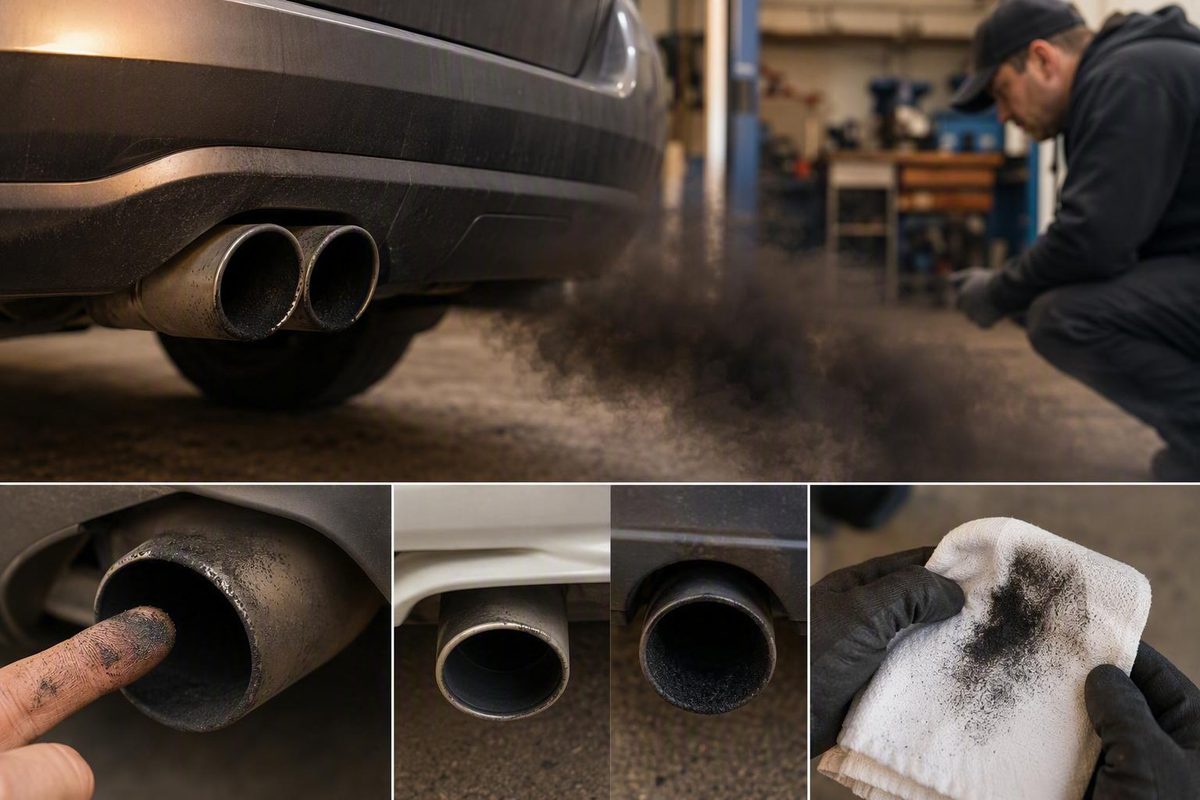
Tell dry tailpipe residue from active black smoke, sort gasoline from diesel patterns, and see when GM's cold-start bulletin applies before buying parts.
Black exhaust soot is carbon left over from incomplete combustion, and what it means depends on whether you are looking at a dry film or a live plume. A dry black film on the tip, with no visible smoke, no codes and no change in how the engine runs, does not prove a fault. Black smoke that continues after warm-up or appears under load has moved past cosmetic and needs diagnosis for that exact engine. Color alone cannot identify a failed part (EPA technical reference).
Treat what follows as triage. Apart from one narrowly documented GM cold-start check, no universal pass/fail values are supported here. The next test has to come from service information for the exact engine, fuel system, model year and emissions configuration.
Pick what you see, the fuel and the code status; the next step updates beside your choices.
Black Soot Triage: Your Next Documented Step
Optional: scan-tool injector pulse width, in milliseconds
Next step
Monitor it. Dry residue alone does not prove a fault.
- Photograph the tip and note how fast the film returns. No universal recurrence threshold exists.
- Cleaning the tip is optional and only resets the visual baseline.
| What you see | Next step |
|---|---|
| Dry black tip residue, no visible smoke | Photograph it, note how fast it returns, consider a code scan. Monitor rather than replace parts. |
| Brief black smoke at cold start | Record duration and temperature. Covered GM direct-injected gasoline vehicles: check bulletin 19-NA-044. All others: document for application-specific diagnosis. |
| Smoke continuing after warm-up | Move past cosmetic inspection to fuel- and model-specific diagnosis. |
| Black smoke on acceleration or load | Record the load and whether smoke stops afterward. Save codes and freeze-frame data; follow application-specific airflow, fueling, sensor and emissions procedures. |
Sources: EPA AP-42 engine reference (smoke colors), GM bulletin 19-NA-044 via NHTSA (cold-start pattern), AutoZone general guidance (possible causes). No universal pass/fail values exist for these checks.
Tip Residue and Active Smoke Are Two Different Clues
Deposits on the tip can build up over many trips. Active smoke shows what is leaving the exhaust under the conditions in front of you right now. Black material on the tip does not, by itself, prove the engine has a fault, so the two observations get handled differently.
Dry residue with no visible smoke: photograph it, note how quickly it comes back, and consider a code scan. Monitor it rather than replacing parts. With no active smoke and no drivability complaint, a scan is information gathering, not proof that a fault exists.
Brief black smoke at cold start: record how long it lasts and the temperature, along with any rough idle, misfires or warning light. On a covered GM direct-injected gasoline vehicle, check the bulletin described below. On anything else, document the event for application-specific diagnosis.
Smoke that continues after warm-up, at idle or in normal driving: move beyond cosmetic inspection to fuel- and model-specific diagnosis, especially with codes, rough running, power loss or rising fuel use.
Black smoke during acceleration or load: record the throttle or load and whether the smoke stops afterward. Save codes and freeze-frame data, then follow application-specific airflow, fueling, sensor and emissions-system procedures.
Cleaning the tip is optional. It gives a fresh visual baseline, but how fast the film returns has no universal diagnostic threshold.
One enthusiast article reports removing deposits from the chrome tips of a 2015 Volkswagen GTI (TFLcar’s GTI account). That is a single-vehicle cleaning account, not a manufacturer procedure. Do not treat its abrasive-cleaner method as approval for a different plated, painted, polished or coated finish.
What Black, White, and Blue Smoke Mean in Combustion Terms
The EPA describes black smoke primarily as agglomerated carbon particles, soot, formed in oxygen-deficient regions of the combustion mixture. The same reference connects incomplete combustion with poor air-fuel mixing or an incorrect air-fuel ratio. That explains why black smoke points toward incomplete combustion. It does not name the component responsible.
| Color | General Description | Diagnostic Limit |
|---|---|---|
| Black | Carbon soot from oxygen-deficient combustion regions | Does not identify an injector, sensor, filter or other failed part |
| White | Liquid particulates from fuel failing to ignite under some low-temperature conditions | Does not establish the cause of every white road-vehicle plume |
| Blue | Partially burned lubricating oil | Does not locate the oil-entry path on a particular engine |
This classification comes from a reference covering stationary gasoline and diesel industrial engines. It explains combustion principles; it is not a complete smoke-diagnosis chart for modern road vehicles. It does not establish that every white plume is condensation, coolant or raw fuel, and it does not prove the source of every blue plume.
If the exhaust is white rather than black, switch to a white-smoke diagnostic path. A black-soot parts list does not fit a different symptom.
Gasoline Engines: Airflow, Fuel Delivery, and Sensor Input
On a gasoline engine, organize the investigation around three hypotheses: restricted intake airflow, excessive fuel delivery, or erroneous sensor information that causes excessive commanded fuel. General retailer guidance from AutoZone lists a dirty air filter, a stuck injector, fuel-pressure-regulator trouble and incorrect engine-sensor input as possibilities, not confirmed failures (AutoZone’s black-soot overview).
| Hypothesis | Inspect or Collect | Do Not Condemn Yet |
|---|---|---|
| Restricted airflow | Filter condition, inlet and ducting, codes, operating data | Air filter |
| Excessive fuel delivery | Codes, freeze-frame data, specified fuel-pressure and injector-test results | Injector or regulator |
| Erroneous sensor input | Codes, connectors, wiring, live data, model-specific test results | Any individual sensor |
A dirty filter is one possibility, but soot alone is not a pass/fail test for the filter. Check for visible blockage, damaged or obstructed ducting, and anything else the vehicle’s service procedure covers.
For the fueling branch, compare the captured conditions with service information for the exact engine and fuel system. Smoke color does not distinguish a stuck injector from a regulator problem or another source of excess fuel.
Do not pick an oxygen sensor, or any other sensor, from exhaust color. Incorrect sensor information can raise commanded fuel, but the broad guidance does not point to one universal sensor failure.
There are no supported, model-independent pass/fail values here for fuel trim, oxygen-sensor output, injector balance or fuel pressure. Use the manufacturer’s procedure and specification for the vehicle on the lift.
The GM Cold-Start Bulletin Covers Only Direct-Injected 2008–2022 Models
The sources reviewed for this guide document one tightly bounded gasoline cold-start case. Other manufacturers may have their own model-specific strategies; the GM condition is simply the one supported here.
GM’s bulletin applies to Buick, Cadillac, Chevrolet and GMC passenger cars and light-duty trucks from model years 2008 through 2022 with direct-injected gasoline engines, subject to the bulletin’s complete applicability information. GM says a dual-pulse injection strategy may run for about 60 seconds during cold starts to heat the catalytic converter more quickly. Associated observations can include black smoke or soot, rough idle and minimal misfires.
During the condition, injector pulse width should be nearly twice the normal-idle value. After roughly 20 seconds it should fall by about 50 percent as the idle smooths (GM bulletin 19-NA-044).
GM’s no-repair direction applies only when all three conditions are met:
- The vehicle, engine, model year, brand and region are covered by the bulletin.
- The cold-start pattern and injector pulse-width behavior match the bulletin.
- No diagnostic trouble codes are set.
Do not stretch this finding to another manufacturer, a port-injected engine, an uncovered model year or a diesel. Similar-looking smoke is not enough to call a condition normal.
Diesel Soot Is Common, but That Does Not Make a Plume Normal
AutoZone’s general guidance describes soot as not uncommon on diesel engines. It does not define when a visible plume is normal, and it does not provide a diesel diagnostic procedure. Persistent or heavy smoke should not be dismissed just because the engine burns diesel.
Document whether the smoke occurs at cold start, warm idle, acceleration or sustained load. Record engine temperature, warning indications, codes, rough running, power changes and whether the smoke stops when load drops.
Do not jump from “diesel soot” to a particulate-filter regeneration, EGR, turbocharger, injector, airflow, boost, compression or smoke-opacity test. Diesel engines and aftertreatment systems differ, and the available evidence does not support one generic test sequence or threshold. Manufacturer service information decides which parameter, circuit or mechanical system gets tested next.
Soot also matters as an emissions issue. The EPA identifies diesel particulate matter as a mobile-source air toxic. That is a reason to take visible diesel soot seriously; it says nothing about the mechanical condition of an individual vehicle.
What to Record Before Anyone Buys Parts
A list of possible causes is not a parts order. Whoever diagnoses the vehicle, you or a shop, needs the same facts:
- Vehicle model year and engine
- Gasoline or diesel
- Dry residue or active plume
- Cold, warming or fully warm when it happens
- How long the smoke lasts, and whether it appears at idle, during acceleration or under sustained load
- All trouble codes, with freeze-frame data saved before anything is cleared
- Rough running, power loss, warning indications and changes in fuel use
Record only conditions that occur naturally. Do not prolong or repeatedly reproduce the event just to get a photograph or video.
On a covered GM direct-injected gasoline vehicle with only a brief cold-start event, verify full bulletin applicability, confirm that no codes are set, and compare injector pulse width during the event with normal idle before authorizing a repair.
On other gasoline vehicles, inspect the intake path and use application-specific procedures to evaluate fuel delivery and the implicated sensor circuits.
On a diesel, collect the operating conditions, codes, freeze-frame information and relevant scan data, then move to the manufacturer’s procedure for that exact engine and emissions system. Without platform details, a generic DPF, injector, EGR or turbo test is guesswork.
If active smoke continues after warm-up, or comes with substantial rough running, power loss or warning indications, the steps here are not a complete diagnosis. Qualified, application-specific evaluation is the next step. Exhaust color alone does not establish a damage timeline or identify the repair.