
Find the Cause of Your Car’s Click Before Replacing Parts
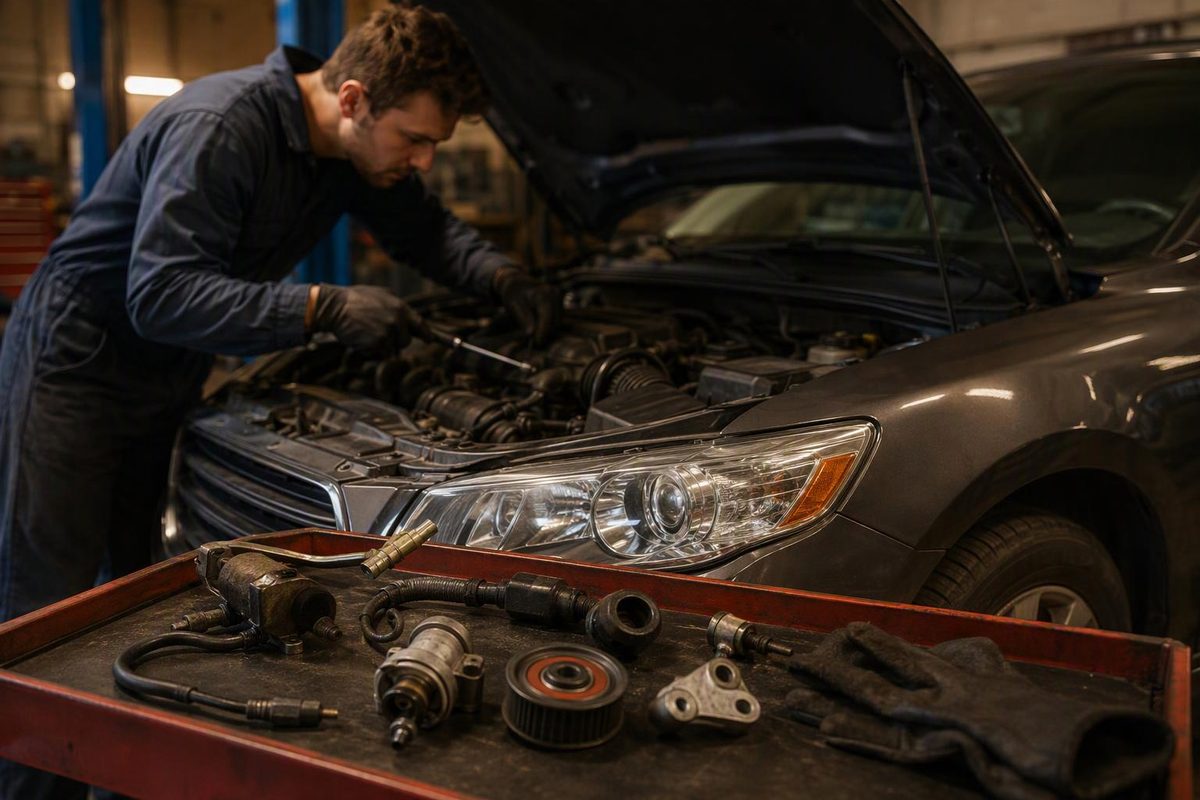
Match starting clicks, engine ticks, turning noises and dashboard clicks to the right tests. Find stop-driving signs and avoid replacing parts on sound alone.
Your car’s clicking noise may come from the battery or starting circuit if it will not crank, the fuel system or engine if it ticks while parked, a CV joint if it clicks during turns, or an HVAC mechanism if it clicks behind the dashboard. The trigger determines the first test; the sound alone does not identify a failed part. Clicking with an oil-pressure warning, overheating, heavy metallic knocking, or severe shaking and power loss means stop safely and shut the engine off.
Choose when the clicking happens and check for stop signs; the tool shows where diagnosis starts.
Clicking Noise Test Selector
Engine stop signs: oil-pressure warning, overheating, sudden heavy metallic knock, severe shaking with power loss, or a flashing check-engine light with rough running.
Check stop signs before testing.
Starting Circuit First
For a conventional 12-volt starter system, inspect battery connections with the ignition off, then test battery charge and capability. One click does not prove the starter is bad.
Do not reproduce the noise until you have checked the stop signs. This selects a diagnostic path, not a confirmed fault.
Sources: article’s Ford safety guidance, DENSO starter tests, GM/Stellantis bulletins and TrakMotive CV guidance; manufacturer-specific examples are not universal diagnoses.
Stop Testing When Clicking Comes With Warnings
Pull over safely and shut the engine off if clicking accompanies an oil-pressure warning, overheating, a sudden heavy metallic knock, or severe shaking and power loss. Arrange assistance rather than repeatedly restarting to reproduce it. Ford’s guidance specifically calls for stopping and switching off for an engine-oil warning or excessive coolant temperature; a correct oil level does not make continued driving safe if the oil warning remains. Ford warning-light guidance
A flashing check-engine light with rough running is another stop-testing point. See what a flashing check-engine light means.
For stationary observations, park outdoors on level ground, select Park or Neutral, and apply the parking brake. Keep hands, clothing, tools and phones away from belts and fans—even with the ignition off, a cooling fan may start automatically. Never crawl under a vehicle supported only by a jack.
Match the Clicking to Its Trigger
| When You Hear It | Where Diagnosis Starts | Useful Observation |
|---|---|---|
| Start request; engine does not turn | Battery, connections, starting circuit | Rapid chatter or one click? Lights dim? |
| Engine running while parked | Fuel system, exhaust, engine | Cold only? Follows RPM? Runs rough? |
| Repeated clicks during a moving turn | CV joints, nearby wheel components | Changes with steering and light acceleration? |
| Follows road speed, not engine RPM | Tire, wheel, brake, driveline | One click per wheel revolution? |
| Dashboard click after HVAC changes | HVAC doors, actuators, obstructions | Same command reproduces it? |
These observations select a test—not a replacement part.
Starting Clicks Put Battery and Cable Tests First
Rapid chatter during a start request puts battery voltage and connections first. A single solid click still does not prove that the starter has failed. DENSO explains that a clicking starter magnetic switch may lack the voltage needed to activate fully; with proper voltage, burnt switch contacts are another possibility. Its troubleshooting guidance also supplies the cranking references below. DENSO starter troubleshooting
Use this sequence for a conventional 12-volt battery-and-starter system. Hybrid and other starting arrangements require their own service procedures; do not probe high-voltage components.
- Inspect with the ignition off. Look for loose terminal clamps, corrosion, damaged cables and loose engine/body ground connections. Stop if the battery appears damaged. Do not jump-start a suspected frozen battery; Ford warns that it can rupture or explode. Ford battery-safety guidance
- Check charge, then battery capability. A resting-voltage reading is not a load test. Charge and test the battery using the correct procedure for its type before condemning the starter.
- Record battery voltage during the start request. Measure directly across the battery posts, not just the cable clamps. If the engine actually cranks, DENSO gives approximately 9.6 volts at 20–25°C as a typical minimum, subject to the vehicle manufacturer’s actual limit. This is a cranking reference—not a universal pass/fail threshold for a single click with no engine rotation.
- Test voltage loss under load. A technician can compare the positive battery post with the starter’s battery terminal, then the starter housing with the negative battery post. DENSO’s general cranking limits are 0.5 volts maximum on the positive side and 0.2 volts maximum on the negative side; use the vehicle’s specifications where provided. Excessive loss points toward connections, cables or grounds that need isolation and repair. These tests require current flow: a low reading on an unloaded circuit does not prove it good.
Starter-terminal measurements involve high-current wiring and possible unexpected engine movement. Leave them to a technician unless you can follow the vehicle’s procedure safely.
If battery capability, loaded cable tests and the starter-control signal pass, investigate the starter and possible mechanical resistance to engine rotation. Do not bridge starter terminals or bypass start interlocks. For the charging-versus-cranking distinction, see alternator vs. starter diagnosis.
Engine Ticks Need Cold, Warm and RPM Comparisons
Record whether the sound is present on a cold start, remains warm, and changes with engine RPM. Note its apparent location: top of engine, exhaust-manifold side or belt-drive area. Sound can travel through brackets and covers, so location alone is not proof.
An Even Tick Can Be Normal on Specified Injection Systems
GM bulletin 14-06-04-004H describes subtle high-pressure fuel-pump ticking and higher-pitched injector clicking as normal on its listed vehicles and engines. For example, the bulletin includes 2015–2022 Chevrolet Tahoe models with specified engines, including 5.3-liter L83/L84 applications. It also notes that pump noise may be more noticeable cold and lessen warm. GM direct-injection noise bulletin
That does not establish that every gasoline or diesel engine tick is normal. Verify the exact model year and engine, compare the sound with applicable manufacturer guidance, and investigate a new, louder or uneven tick—especially with misfires or warnings.
A Cold Tick Can Come From an Exhaust Leak
A tick that fades warm does not automatically mean a lifter problem. Stellantis bulletin 09-019-23 covers cold exhaust-manifold ticking on specified 5.7-liter Hemi vehicles, including 2019–2022 DS-platform Ram 1500 pickups with engine sales code EZH or EZC. Its procedure localizes the cold noise and inspects for a cracked manifold before replacement. Stellantis manifold bulletin
With the engine off and cool, look for soot, visible cracks or missing fasteners around accessible manifold joints. Those are inspection clues; an engine-off leak test can confirm the source. See exhaust manifold leak tests. Do not feel for escaping gas around a running, hot manifold.
A Persistent Tick With Misfire Needs Mechanical Tests
Check oil level using the owner’s manual procedure, and save fault codes and freeze-frame data before clearing anything. If oil pressure is suspect, have actual pressure measured against the engine’s specification.
GM bulletin 19-NA-219, for listed 2002–2023 GM V6/V8 pushrod engines, identifies worn cam/lifter components, broken valve springs and other mechanical faults as possible tick/misfire causes when standard service diagnosis has not isolated the concern. It uses targeted inspections and comparative valve-lift measurements rather than noise alone; normal compression does not necessarily exclude cam-lobe wear. GM mechanical diagnostic bulletin
Do not add thicker oil or an additive as a substitute for finding the fault.
Turning Clicks Point Toward CV Joints
Repeated clicking during a moving turn makes an outer CV joint a strong candidate. TrakMotive associates this pattern with worn or damaged outer joints. TrakMotive CV-shaft bulletin
If steering, braking and wheel security appear normal, note whether it occurs during an ordinary low-speed turn in a clear area. Avoid aggressive acceleration or repeated tight circles. Inspect accessible CV boots for splits and thrown grease with the vehicle safely parked; confirm the noisy joint before ordering an axle.
If clicking follows road speed even going straight, start with tire, wheel and brake inspection instead of engine parts. Do not road-test through wheel wobble, abnormal braking or a suspected loose wheel.
Dashboard Clicks Need an HVAC Command Test
While parked, change airflow mode, temperature and recirculation one setting at a time. Record which command reproduces the click and whether airflow actually changes.
Do not assume the actuator itself is defective. GM bulletin PI1365, limited to 2015 Chevrolet Equinox/GMC Terrain vehicles with HVAC code C67 or C68 built before August 8, 2014, documents OnStar cables obstructing an HVAC mode door and calls for checking interference and actuator operation. GM HVAC bulletin
Before repair, gather the vehicle and engine details, exact trigger, cold-versus-warm behavior, noise location, warning lights, codes and measured test results. A recording helps preserve the symptom, but the repair decision should follow the test that identifies its source.